AAWSAP DIRD, MHD Air Breathing Propulsion and Power for Aerospace Applications, November 2010
DOW-UAP-D149 · page 25 of 32
Text
This text came with the file. It may have mistakes. When the text and the image disagree, the image is right.
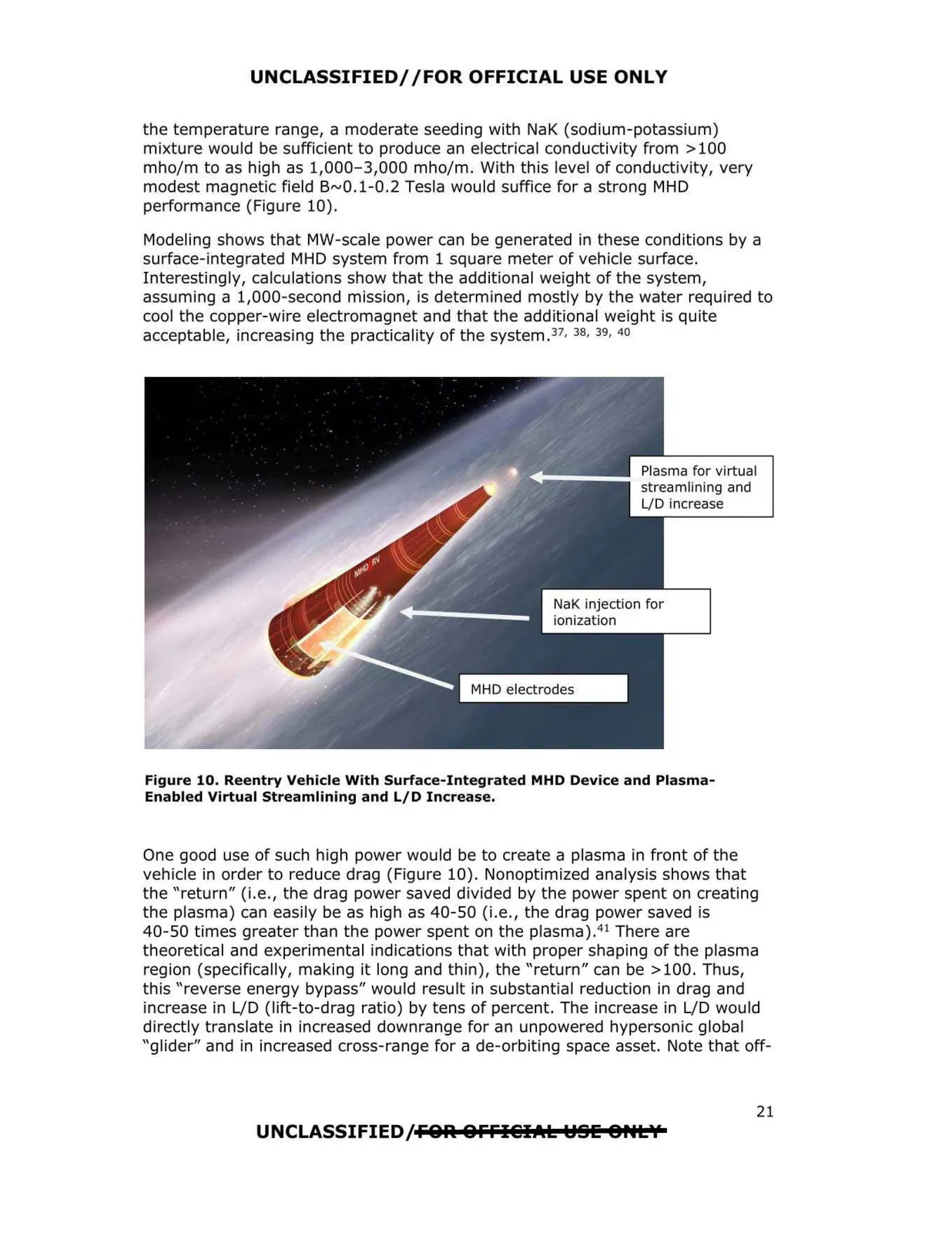
UNCLASSIFIED/ /FOR OFFICIAL USE ONLY the temperature range, a moderate seeding with NaK (sodium-potassium) mixture would be sufficient to produce an electrical conductivity from > 100 mho/m to as high as 1,000-3,000 mho/m. With this level of conductivity, very modest magnetic field B~0.1-0.2 Tesla would suffice for a strong MHD performance (Figure 10). Modeling shows that MW-scale power can be generated in these conditions by a surface-integrated MHD system from 1 square meter of vehicle surface. Interestingly, calculations show that the additional weight of the system, assuming a 1,000-second mission, is determined mostly by the water required to cool the copper-wire electromagnet and that the additional weight is quite acceptable, increasing the practicality of the system. 37, 38, 39, 40 a for virtual lining and crease Figure 10. Reentry Vehicle With Surface-Integrated MHD Device and Plasma Enabled Virtual Streamlining and L/D Increase. One good use of such hig h power would be to create a plasma in front of the vehicle in order to reduce drag (Figure 10). Nonoptimized analysis shows that the "return" (i.e., the drag power saved divided by the power spent on creating the plasma) can easily be as high as 40-50 (i.e., the drag power saved is 40-50 times greater than the power spent on the plasma). 41 There are theoretical and experimental indications that with proper shaping of the plasma region (specifically, making it long and thin), the "return" can be > 100. Thus, this "reverse energy bypass" would result in substantial reduction in drag and increase in L/D (lift-to-drag ratio) by tens of percent. The increase in L/D would directly translate in increased downrange for an unpowered hypersonic global "glider" and in increased cross-range for a de-orbiting space asset. Note that off- UNCLASSIFIEDfFQR &FFIEilslll ~91: 8Hl'I 21