AAWSAP DIRD, Quantum Computing and Utilizing Organic Molecules in Automation Technology, December 2010
DOW-UAP-D150 · page 13 of 54
Text
This text came with the file. It may have mistakes. When the text and the image disagree, the image is right.
UNCLASSIFIED//fQR OFFICI0k WSE 8HLI
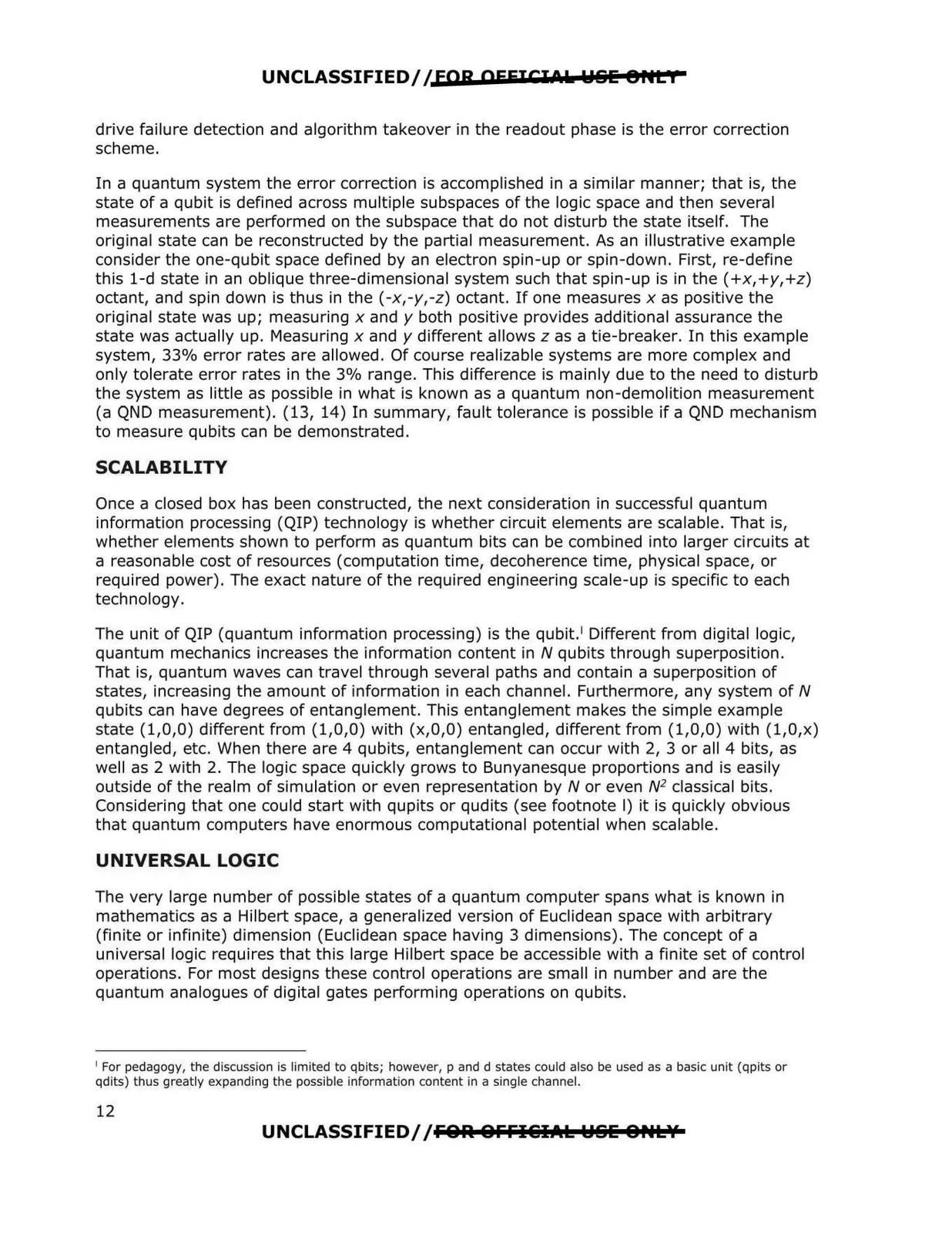
drive failure detection and algorithm takeover in the readout phase is the error correction
scheme.
In a quantum system the error correction is accomplished in a similar manner; that is, the
state of a qubit is defined across multiple subspaces of the logic space and then several
measurements are performed on the subspace that do not disturb the state itself. The
original state can be reconstructed by the partial measurement. As an illustrative example
consider the one-qubit space defined by an electron spin-up or spin-down. First, re-define
this 1-d state in an oblique three-dimensional system such that spin-up is in the (+x,+y,+z)
octant, and spin down is thus in the (-x,-y,-z) octant. If one measures x as positive the
original state was up; measuring x and y both positive provides additional assurance the
state was actually up. Measuring x and y different allows z as a tie-breaker. In this example
system, 33% error rates are allowed. Of course realizable systems are more complex and
only tolerate error rates in the 3% range. This difference is mainly due to the need to disturb
the system as little as possible in what is known as a quantum non-demolition measurement
(a QND measurement). (13, 14) In summary, fault tolerance is possible if a QND mechanism
to measure qubits can be demonstrated.
SCALABILITY
Once a closed box has been constructed, the next consideration in successful quantum
information processing (QIP) technology is whether circuit elements are scalable. That is,
whether elements shown to perform as quantum bits can be combined into larger circuits at
a reasonable cost of resources (computation time, decoherence time, physical space, or
required power). The exact nature of the required engineering scale-up is specific to each
technology.
The unit of QIP (quantum information processing) is the qubit. 1 Different from digital logic,
quantum mechanics increases the information content in N qubits through superposition.
That is, quantum waves can travel through several paths and contain a superposition of
states, increasing the amount of information in each channel. Furthermore, any system of N
qubits can have degrees of entanglement. This entanglement makes the simple example
state (1,0,0) different from (1,0,0) with (x,0,0) entangled, different from (1,0,0) with (1,0,x)
entangled, etc. When there are 4 qubits, entanglement can occur with 2, 3 or all 4 bits, as
well as 2 with 2. The logic space quickly grows to Bunyanesque proportions and is easily
outside of the rea lm of simulation or even representation by Nor even N2 classical bits.
Considering that one could start with qupits or qudits (see footnote I) it is quickly obvious
that quantum computers have enormous computational potential when scalable.
UNIVERSAL LOGIC
The very large number of possible states of a quantum computer spans what is known in
mathematics as a Hilbert space, a generalized version of Euclidean space with arbitrary
(finite or infinite) dimension (Euclidean space having 3 dimensions). The concept of a
universal logic requires that this large Hilbert space be accessible with a finite set of control
operations. For most designs these control operations are small in number and are the
quantum analogues of digital gates performing operations on qubits.
1 For pedagogy, the discussion is limited to qbits; however, p and d states could also be used as a basic unit (qpits or
qdits) thus greatly expanding the possible Information content In a single channel.
UNCLASSIFIED//FOR &FFl&I.Tik WSE &Hk\f
12