AAWSAP DIRD, Quantum Computing and Utilizing Organic Molecules in Automation Technology, December 2010
DOW-UAP-D150 · page 38 of 54
Text
A machine read this text from the scan. When the text and the image disagree, the image is right.
UNCLASSIFIED / /FOR OFFICIAL USE ONLY
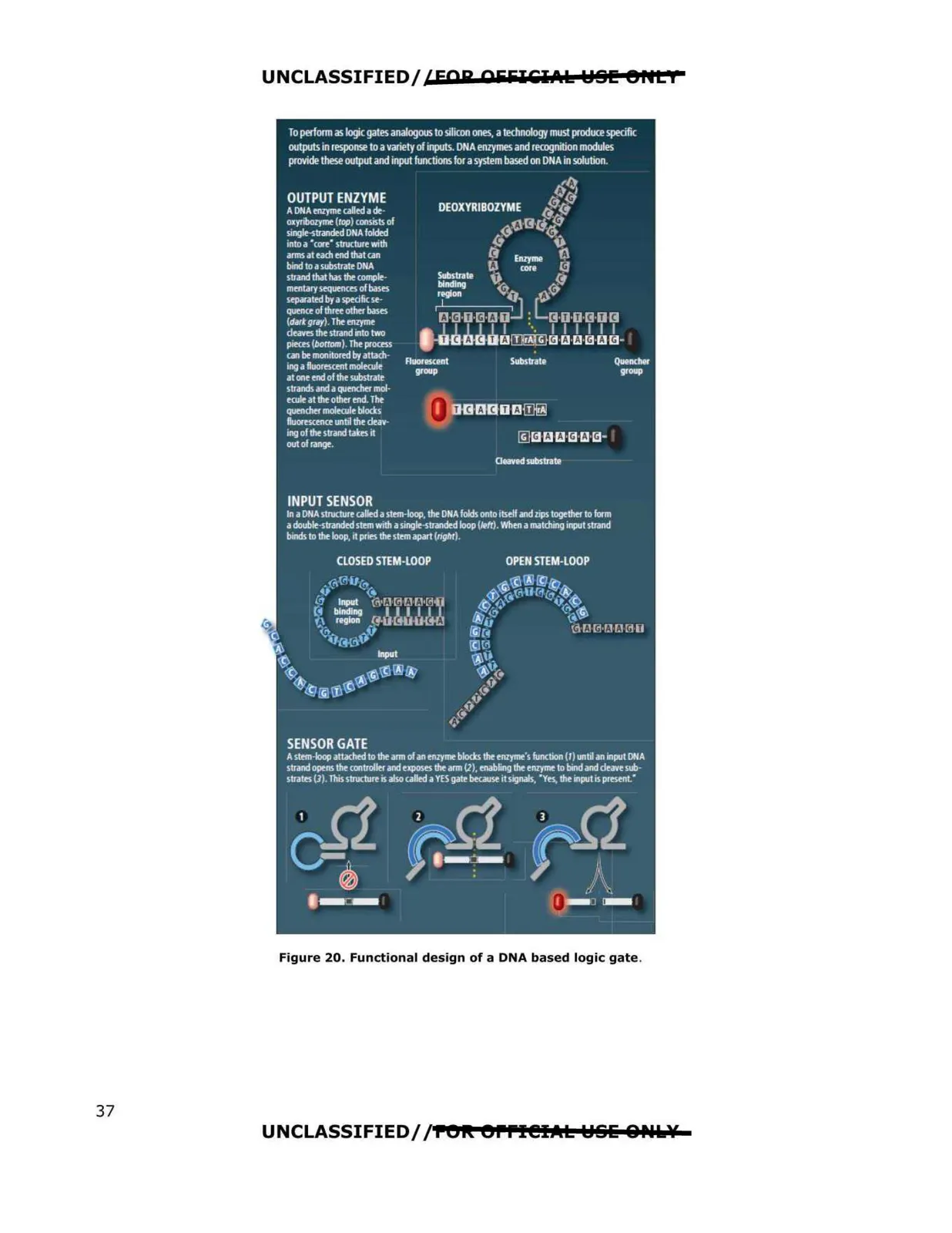
To perform as logic gates analogous to silicon ones, a technology must produce specific
outputs in response to a variety of inputs. DNA enzymes and recognition modules
provide these output and input functions for a system based on DNA in solution.
OUTPUT ENZYME
A DNA enzyme called a de-
DEOXYRIBOZYME
oxyribozyme (top) consists of
single-stranded DNA folded
into a "core" structure with
arms at each end that can
Enzyme
bind to a substrate DNA
core
strand that has the comple-
Substrate
mentary sequences of bases
binding
separated by a specific se-
region
quence of three other bases
(dark gray). The enzyme
AGTGAT
CTTCTC
cleaves the strand into two
pieces (bottom). The process
can be monitored by attach-
Fluorescent
Substrate
ing a fluorescent molecule
Quencher
at one end of the substrate
group
group
strands and a quencher mol-
ecule at the other end. The
quencher molecule blocks
TCACTATA
fluorescence until the cleav-
ing of the strand takes it
GAAGAG-I
out of range.
Cleaved substrate
INPUT SENSOR
In a DNA structure called a stem-loop, the DNA folds onto itself and zips together to form
a double-stranded stem with a single-stranded loop (left). When a matching input strand
binds to the loop, it pries the stem apart (right).
CLOSED STEM-LOOP
OPEN STEM-LOOP
Input
GAGAAGT
binding
region
CTCTICA
NO
GAGAAGT
Input
THE
E
assesss
SENSOR GATE
A stem-loop attached to the arm of an enzyme blocks the enzyme's function (1) until an input DNA
strand opens the controller and exposes the arm (2), enabling the enzyme to bind and cleave sub-
strates (3). This structure is also called a YES gate because it signals, "Yes, the input is present."
1
2
3
0
Figure 20. Functional design of a DNA based logic gate.
37
UNCLASSIFIED /FOR OFFICIAL USE ONLY