AAWSAP DIRD, Negative Mass Propulsion, January 2011
DOW-UAP-D152 · page 11 of 43
Text
This text came with the file. It may have mistakes. When the text and the image disagree, the image is right.
UNCLASSIFIED/ /P'OR. 8FFIEil1'1.k lellii Ql'II.¥
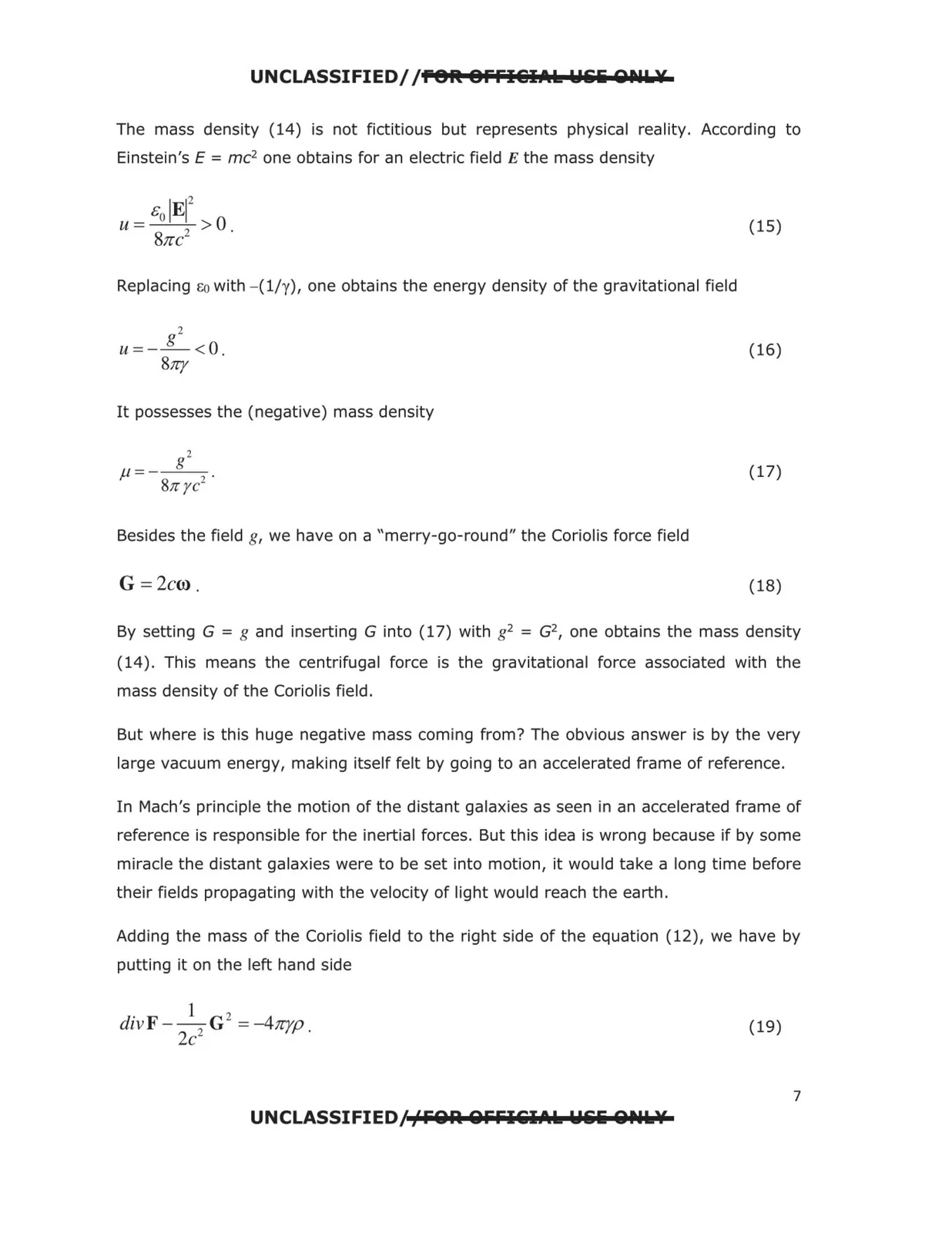
The mass density (14) is not fictitious but represents physical reality. According to
Einstein's E = mc2 one obtains for an electric field Ethe mass density
(15)
Replacing Eo with-(1/y), one obtains the energy density of the gravitational field
g 2
U=--<0.
(16)
8ny
It possesses the (negative) mass density
g2
µ= - --, .
(17)
8nyc
Besides the field g, we have on a "merry-go-round" the Coriolis force field
G =2cro.
(18)
By setting G = g and inserting G into (17) with g2 = G2, one obtains the mass density
(14). This means the centrifugal force is the gravitational force associated with the
mass density of the Coriolis field.
But where is this huge negative mass coming from? The obvious answer is by the very
large vacuum energy, making itself felt by going to an accelerated frame of reference.
In Mach's principle the motion of the distant galaxies as seen in an accelerated frame of
reference is responsible for the inertial forces. But this idea is wrong because if by some
miracle the distant galaxies were to be set into motion, it would take a long time before
their fields propagating with the velocity of light would reach the earth.
Adding the mass of the Coriolis field to the right side of the equation (12), we have by
putting it on the left hand side
1
- -G 2
divF -
?
= -41r11
'"IIp .
(19)
2c-
UNCLASSIFIED/fFOA OFFI&il.t.k lellii OJi,k¥
7