AAWSAP DIRD, Negative Mass Propulsion, January 2011
DOW-UAP-D152 · page 18 of 43
Text
This text came with the file. It may have mistakes. When the text and the image disagree, the image is right.
UNCLASSIFIED//fOR. 8FFI61.t..k W&i QJsll,¥
r
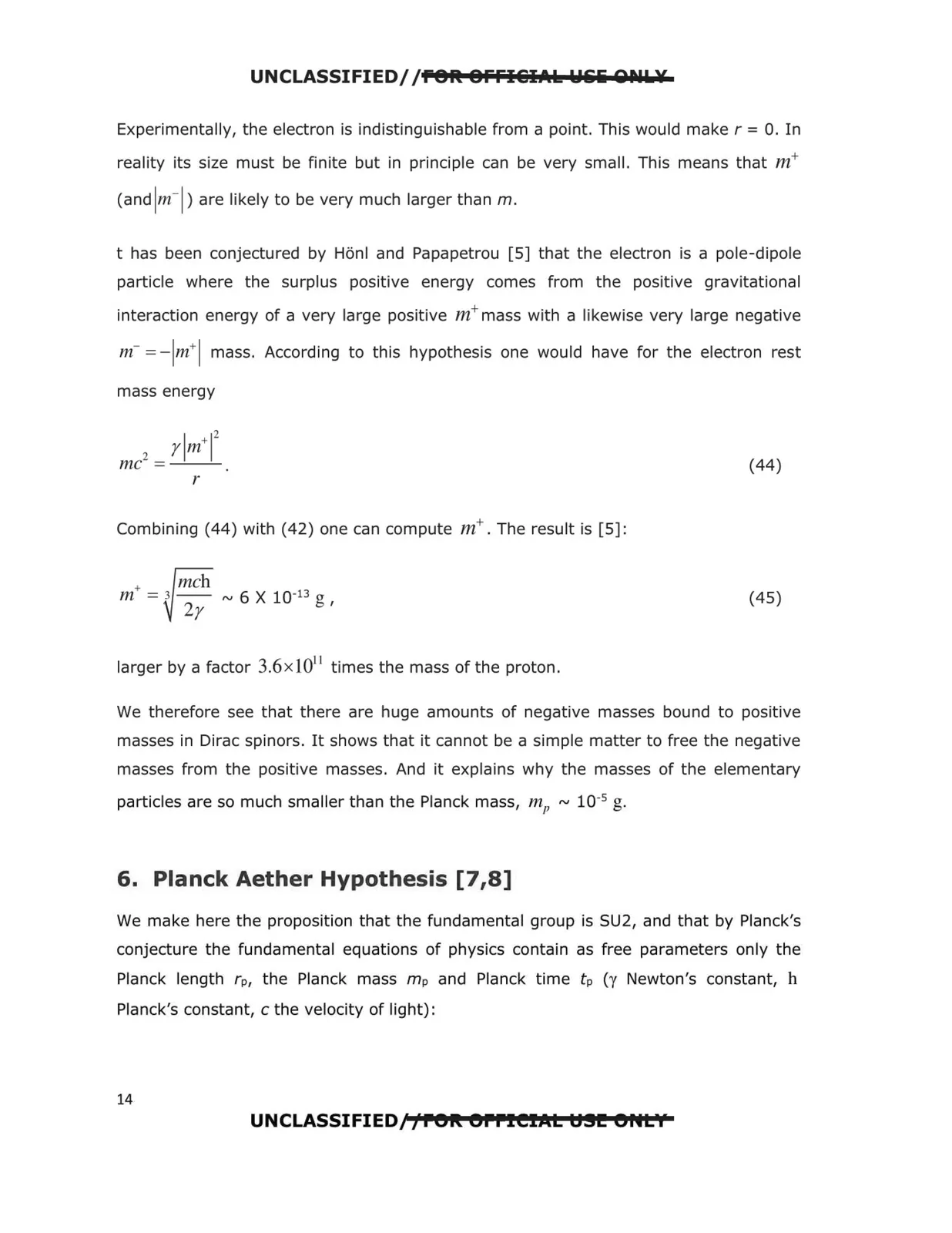
Experimentally, the electron is indistinguishable from a point. This would make r = 0. In
reality its size must be finite but in principle can be very small. This means that m+
(andlm- I) are likely to be very much larger than m.
t has been conjectured by Honl and Papapetrou [SJ that the electron is a pole-dipole
particle where the surplus positive energy comes from the positive gravitational
interaction energy of a very large positive m+ mass with a likewise very large negative
m- =-lm+I mass. According to this hypothesis one would have for the electron rest
mass energy
(44)
Combining (44) with (42) one can compute m+. The result is [S]:
m• t~h ~6 X 10-13 g,
(45)
= 31/
larger by a factor 3.6xl011 times the mass of the proton.
We therefore see that there are huge amounts of negative masses bound to positive
masses in Dirac spinors. It shows that it cannot be a simple matter to free the negative
masses from the positive masses. And it explains why the masses of the elementary
particles are so much smaller than the Planck mass, mp ~ 10-5 g.
6. Planck Aether Hypothesis [7,8]
We make here the proposition that the fundamental group is SU2, and that by Planck's
conjecture the fundamental equations of physics contain as free parameters only the
Planck length rp, the Planck mass m p and Planck time tp (y Newton's constant, h
Planck's constant, c the velocity of light):
UNCLASSIFIED//POllt: OPPIEIICL tf!H!!! or~LY
14