AAWSAP DIRD, Quantum Tomography of Negative Energy States in the Vacuum, January 2011
DOW-UAP-D153 · page 20 of 51
Text
This text came with the file. It may have mistakes. When the text and the image disagree, the image is right.
UNCLASSIFIED//FOR QFFI€ilAL l::l!H! 61\LI
between the strength of the negative energy density/flux and the behavior of the
detector.
It is curious that Davies and Ottewill did not consider using quantum optical homodyne
tomography as a tool to test their hypothesis, because this is already a mature
experimental discipline. In what follows we outline the basics of quantum optical
homodyne tomography and its application to detecting and measuring negative energy
density/flux states in squeezed light and in the Casimir effect.
Basic Notions of Quantum Optical Homodyne Tomography
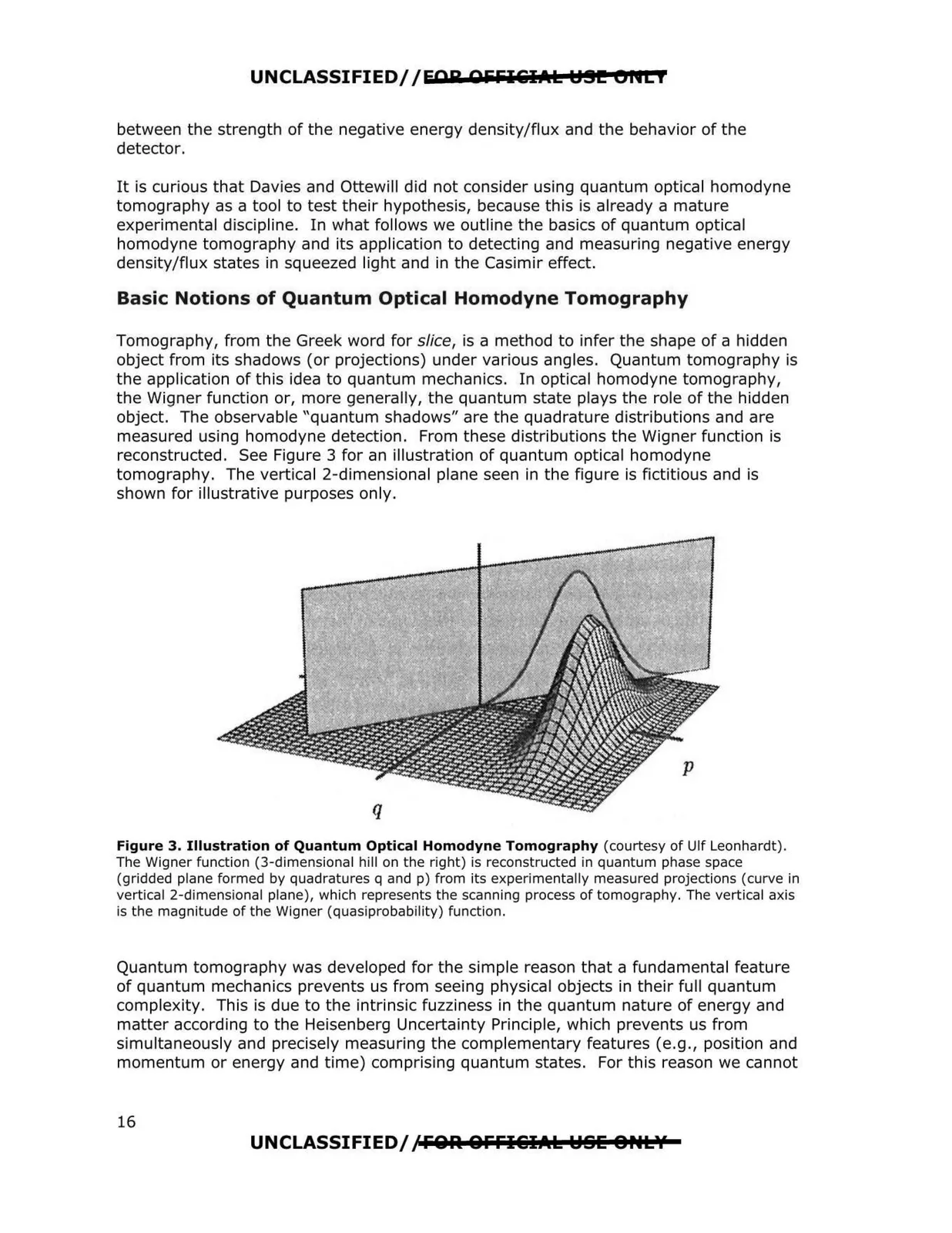
Tomography, from the Greek word for slice, is a method to infer the shape of a hidden
object from its shadows (or projections) under various angles. Quantum tomography is
the application of this idea to quantum mechanics. In optical homodyne tomography,
the Wigner function or, more generally, the quantum state plays the role of the hidden
object. The observable "quantum shadows" are the quadrature distributions and are
measured using homodyne detection. From these distributions the Wigner function is
reconstructed. See Figure 3 for an illustration of quantum optical homodyne
tomography. The vertical 2-dimensional plane seen in the figure is fictitious and is
shown for illustrative purposes only.
Figure 3. Illustration of Quantum Optical Homodyne Tomography (courtesy of Ulf Leonhardt).
The Wigner function (3-dimensional hill on the right) is reconstructed in quantum phase space
(gridded plane formed by quadratures q and p) from its experimentally measured projections (curve in
vertical 2-dimensional plane), which represents the scanning process of tomography. The vertical axis
is the magnitude of the Wigner (quasiprobability) function.
Quantum tomography was developed for the simple reason that a fundamental feature
of quantum mechanics prevents us from seeing physical objects in their full quantum
complexity. This is due to the intrinsic fuzziness in the quantum nature of energy and
matter according to the Heisenberg Uncertainty Principle, which prevents us from
simultaneously and precisely measuring the complementary features (e.g., position and
momentum or energy and time) comprising quantum states. For this reason we cannot
UNCLASSIFIED/;<fQA QFFl&l.t..k YSE 8,.L'&'
16