AAWSAP DIRD, Quantum Tomography of Negative Energy States in the Vacuum, January 2011
DOW-UAP-D153 · page 22 of 51
Text
This text came with the file. It may have mistakes. When the text and the image disagree, the image is right.
UNCLASSIFIED//POI\ OPPICIJIIL YSIE 8Hllf
must give the position or the momentum distribution, respectively. Furthermore, if one
performs a phase shift 8 all complex amplitudes aare shifted in phase, §§§ meaning that
the components q and p rotate in the 2-dimensional phase space (q,p). A classical
probability distribution for position and momentum values would rotate accordingly.
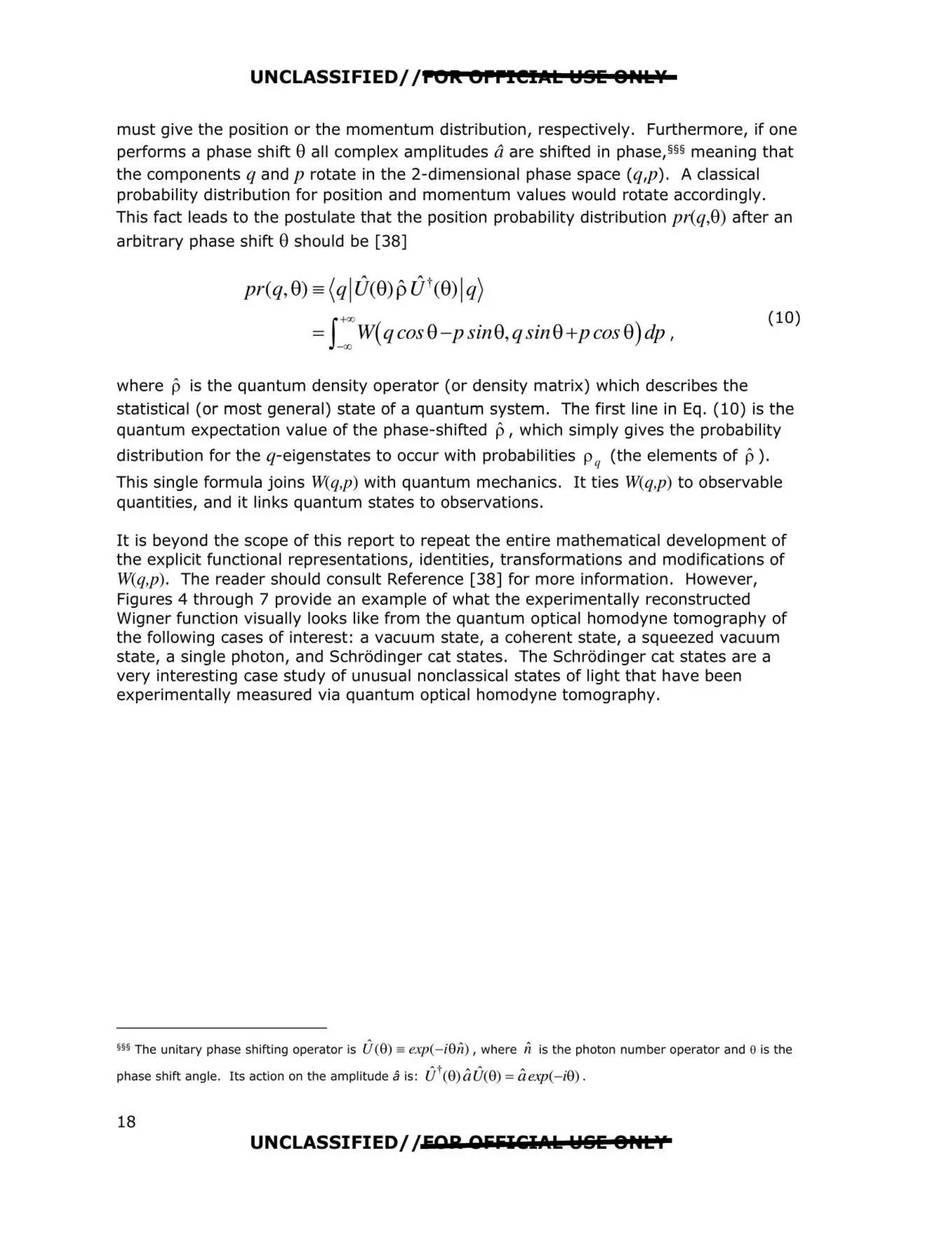
This fact leads to the postulate that the position probability distribution pr(q,8) after an
arbitrary phase shift 8 should be [38]
pr(q,0) =(qJOce)p 0\ e)J q)
(10)
=f: w(qcos0-psin0,qsin0+pcos0)dp,
where p is the quantum density operator (or density matrix) which describes the
statistical (or most general) state of a quantum system. The first line in Eq. (10) is the
quantum expectation value of the phase-shifted p, which simply gives the probability
distribution for the q-eigenstates to occur with probabilities p q (the elements of p).
This single formula joins W(q,p) with quantum mechanics. It ties W(q,p) to observable
quantities, and it links quantum states to observations.
It is beyond the scope of this report to repeat the entire mathematical development of
the explicit functional representations, identities, transformations and modifications of
W(q,p). The reader should consult Reference [38] for more information. However,
Figures 4 through 7 provide an example of what the experimentally reconstructed
Wigner function visually looks like from the quantum optical homodyne tomography of
the following cases of interest: a vacuum state, a coherent state, a squeezed vacuum
state, a single photon, and Schrtidinger cat states. The Schrtidinger cat states are a
very interesting case study of unusual nonclassical states of light that have been
experimentally measured via quantum optical homodyne tomography.
§§§ The unitary phase shifting operator is U(0) = exp(- i0ii), where ii is the photon number operator and e is the
phase shift angle. Its action on the amplitude ais: u \ 8)11U(8) = 11e.>.p(- i0) .
UNCLASSIFIED//FOR 0661CIAk W&IE 8HLY
18