AAWSAP DIRD, Quantum Tomography of Negative Energy States in the Vacuum, January 2011
DOW-UAP-D153 · page 34 of 51
Text
This text came with the file. It may have mistakes. When the text and the image disagree, the image is right.
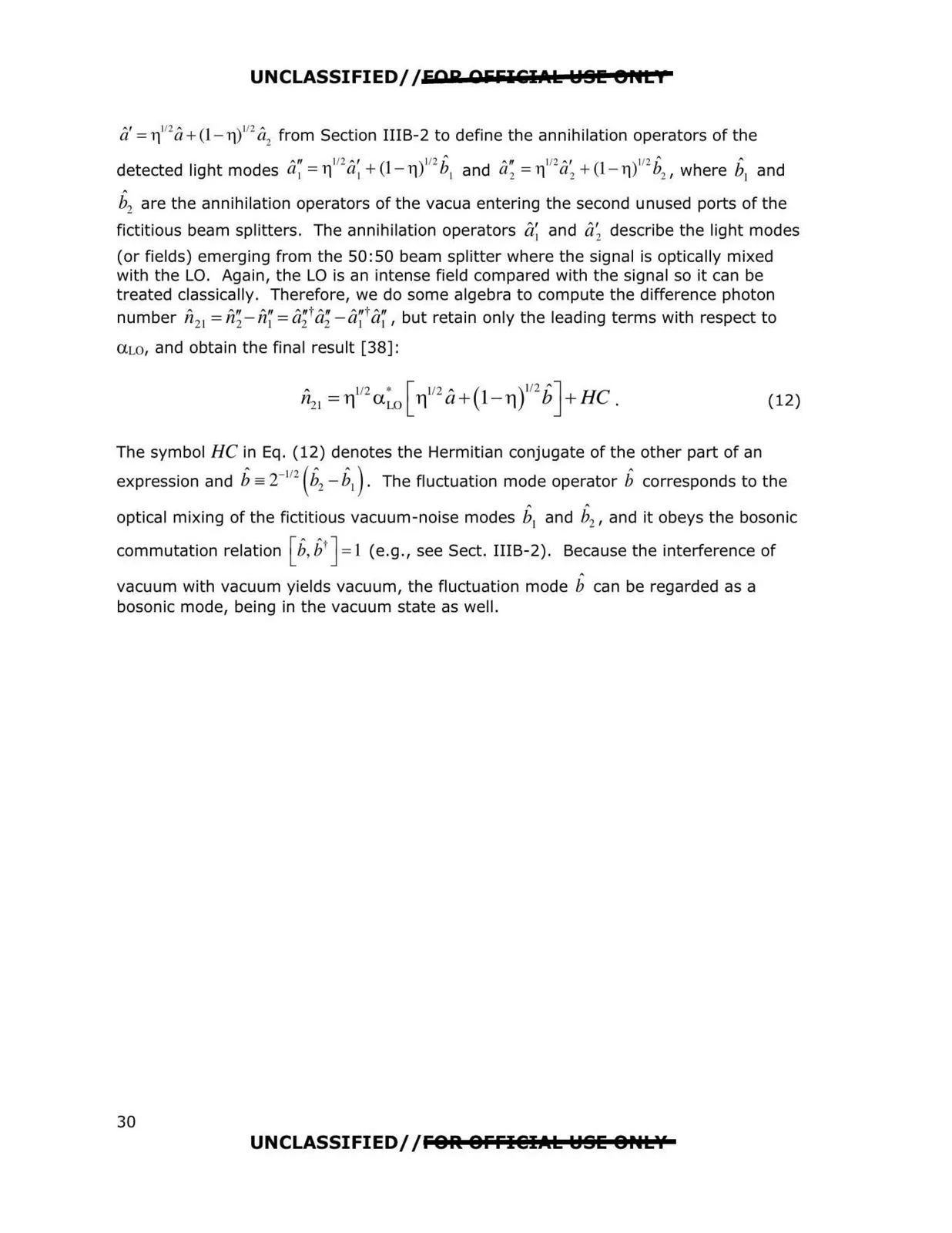
1 UNCLASSIFIED//FOR 055ICIAl 1481!! er•t I a'=rt\1 +(l - ri)1' 2 a2 from Section IIIB-2 to define the annihilation operators of the . , ,, 1/ 2 • 1 1/ 2 - - · 1/2 • 1 1/ 2 - detected light modes a 1 = ri a1 +(1- ri) b1 and a 2 =ri a2 +(1 - ri) b2 , where b, and b2 are the annihilation operators of the vacua entering the second unused ports of the fictitious beam splitters. The annihilation operators a; and a~ describe the light modes (or fields) emerging from the 50:50 beam splitter where the signal is optically mixed with the LO. Again, the LO is an intense field compared with the signal so it can be treated classically. Therefore, we do some algebra to compute the difference photon number ii21 = n; - n7= a;ta; - a7ta7 , but retain only the leading terms with respect to aw , and obtain the final result [38]: (12) The symbol H C in Eq. (12) denotes the Hermitian conjugate of the other part of an expression and b=i- 12(b2-b1) . The fluctuation mode operator b corresponds to the optical mixing of the fictitious vacuum-noise modes b1 and b2, and it obeys the bosonic commutation relation [ b,b']=1 (e.g., see Sect. 111B-2). Because the interference of vacuum with vacuum yields vacuum, the fluctuation mode b can be regarded as a bosonic mode, being in the vacuum state as well. UNCLASSIFIED//FOR OFFI@IAl YSfI or•t'&' 30