Gemini 4 Experiment Debriefing, 1967
NASA-UAP-D018 · page 18 of 224
Text
This text came with the file. It may have mistakes. When the text and the image disagree, the image is right.
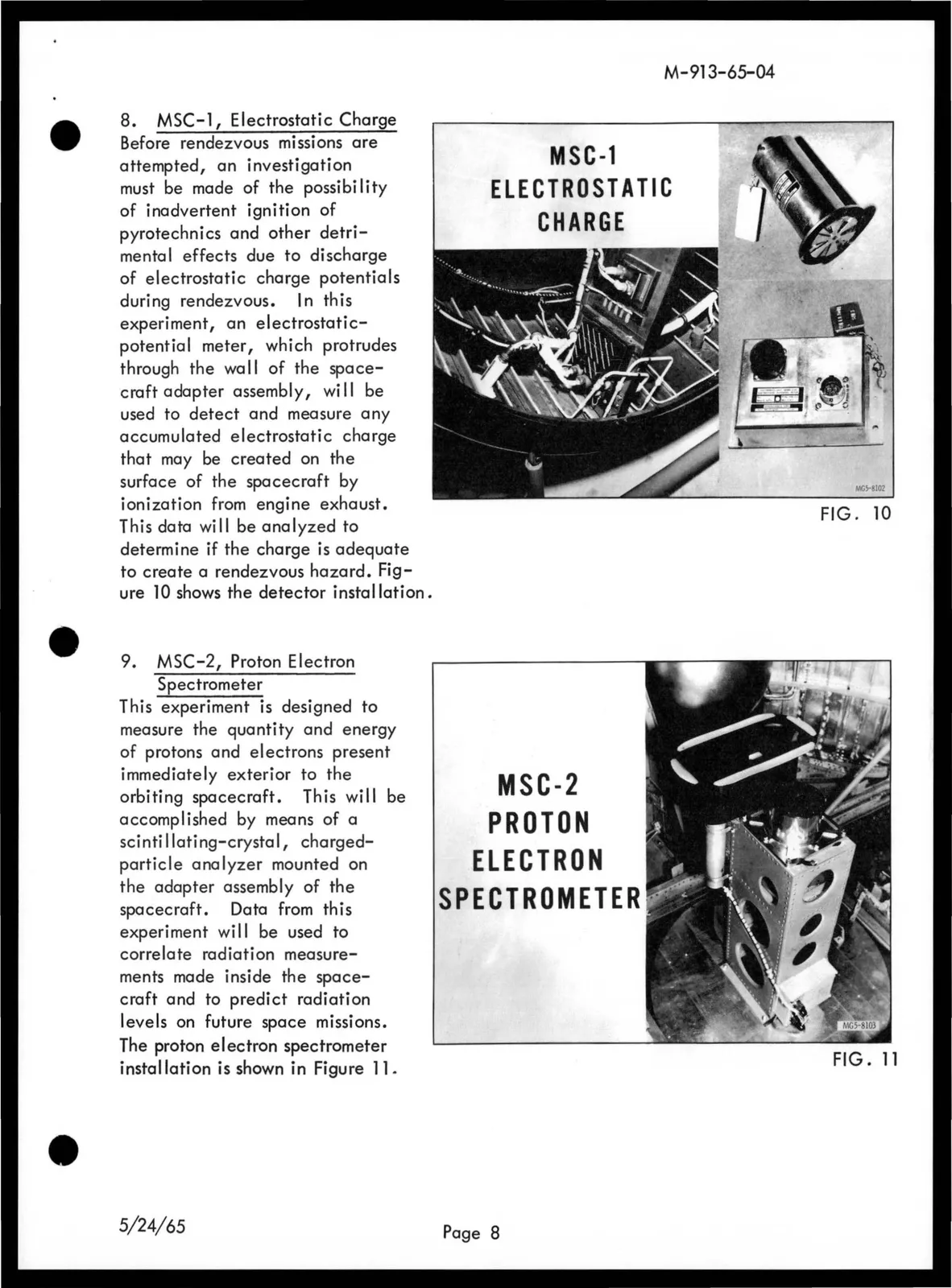
8. MSC-1, Electrostatic Charge Before rendezvous missions are attempted, an investigation must be made of the possibility of inadvertent ignition of pyrotechnics and other detri menta I effects due to discharge of electrostatic charge potentials during rendezvous. In this experiment, an electrostatic potential meter, which protrudes through the wa 11 of the space craft adapter assembly, wi 11 be used to detect and measure any accumulated electrostatic charge that may be created on the surface of the spacecraft by ionization from engine exhaust. This dota wi 11 be a no Iyzed to determine if the charge is adequate to create a rendezvous hazard. Fig ure 10 shows the detector instal lotion. 9. MSC-2, Proton Electron Spectrometer This experiment is designed to measure the quantity and energy of protons and electrons present immediately exterior to the orbiting spacecraft. This wil I be accomplished by means of a scintillating-crystal, charged particle analyzer mounted on the adapter assembly of the spacecraft. Data from this experiment wil I be used to correlate radiation measure ments made inside the space craft and to predict radiation levels on future space missions. The proton electron spectrometer instal lotion is shown in Figure 11 . MSC-1 ELECTROSTATIC CHARGE FIG. 10 M-913-65-04 MSC-2 PROTON ELECTRON SPECTROMETER FIG. 11 5/24/65 Page 8