Gemini 9 Debriefing, 1966
NASA-UAP-D022 · page 61 of 78
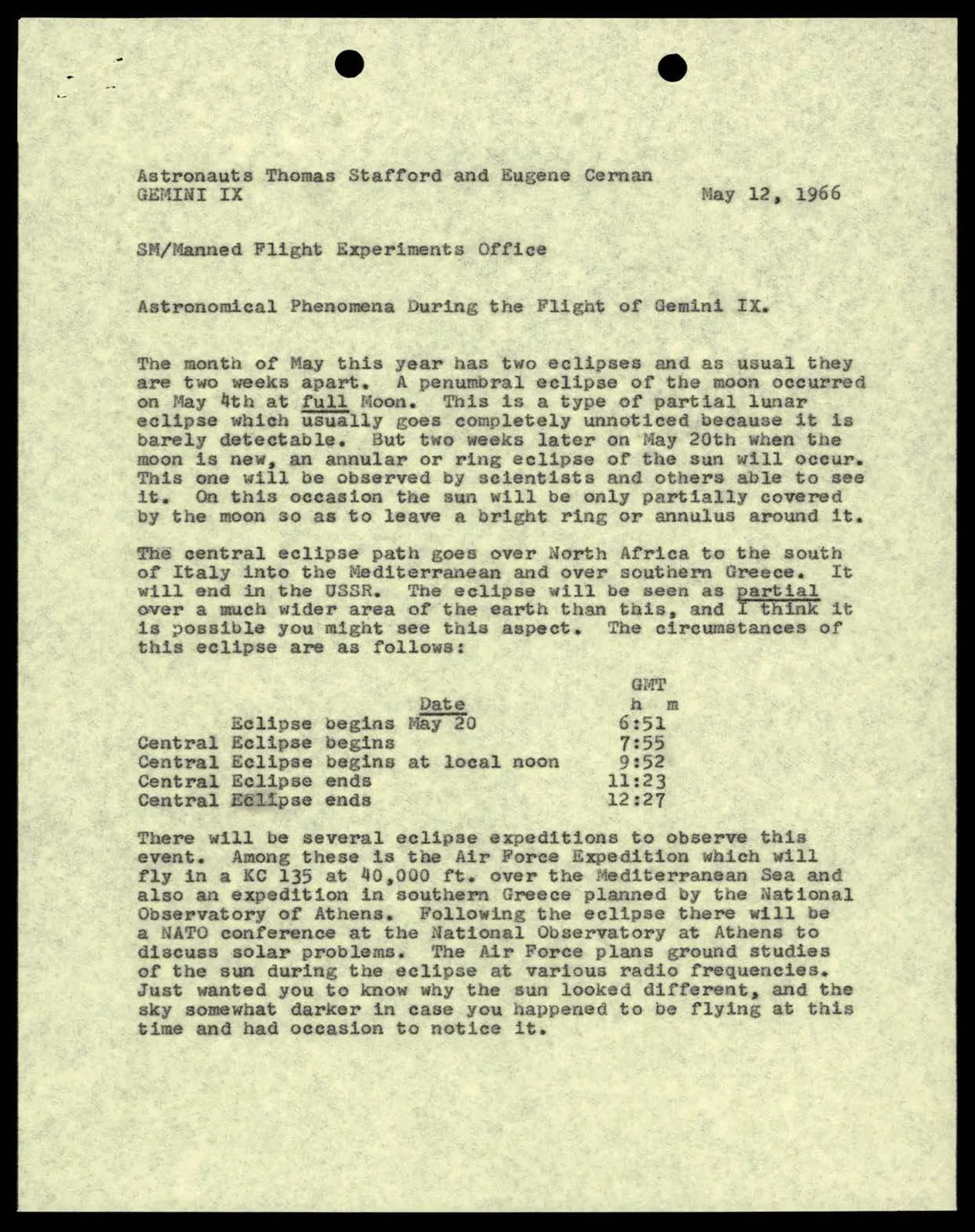
Text
A machine read this text from the scan. When the text and the image disagree, the image is right.
Astronauts Thomas Stafford and Eugene Cernan
GEMINI IX

May 12, 1966

SM/Manned Flight Experiments Office

Astronomical Phenomena During the Flight of Gemini IX.

The month of May this year has two eclipses and as usual they are two weeks apart. A penumbral eclipse of the moon occurred on May 4th at full Moon. This is a type of partial lunar eclipse which usually goes completely unnoticed because it is barely detectable. But two weeks later on May 20th when the moon is new, an annular or ring eclipse of the sun will occur. This one will be observed by scientists and others able to see it. On this occasion the sun will be only partially covered by the moon so as to leave a bright ring or annulus around it.

The central eclipse path goes over North Africa to the south of Italy into the Mediterranean and over southern Greece. It will end in the USSR. The eclipse will be seen as partial over a much wider area of the earth than this, and I think it is possible you might see this aspect. The circumstances of this eclipse are as follows:

| Date | GMT
h m
Eclipse begins | May 20 | 6:51
Central Eclipse begins |  | 7:55
Central Eclipse begins at local noon |  | 9:52
Central Eclipse ends |  | 11:23
Central Eclipse ends |  | 12:27

There will be several eclipse expeditions to observe this event. Among these is the Air Force Expedition which will fly in a KC 135 at 40,000 ft. over the Mediterranean Sea and also an expedition in southern Greece planned by the National Observatory of Athens. Following the eclipse there will be a NATO conference at the National Observatory at Athens to discuss solar problems. The Air Force plans ground studies of the sun during the eclipse at various radio frequencies. Just wanted you to know why the sun looked different, and the sky somewhat darker in case you happened to be flying at this time and had occasion to notice it.