38_143685_box_Incident_Summaries_173-233
38_143685_box7_incident_summaries_173-233 · page 54 of 144
Text
A machine read this text from the scan. When the text and the image disagree, the image is right.
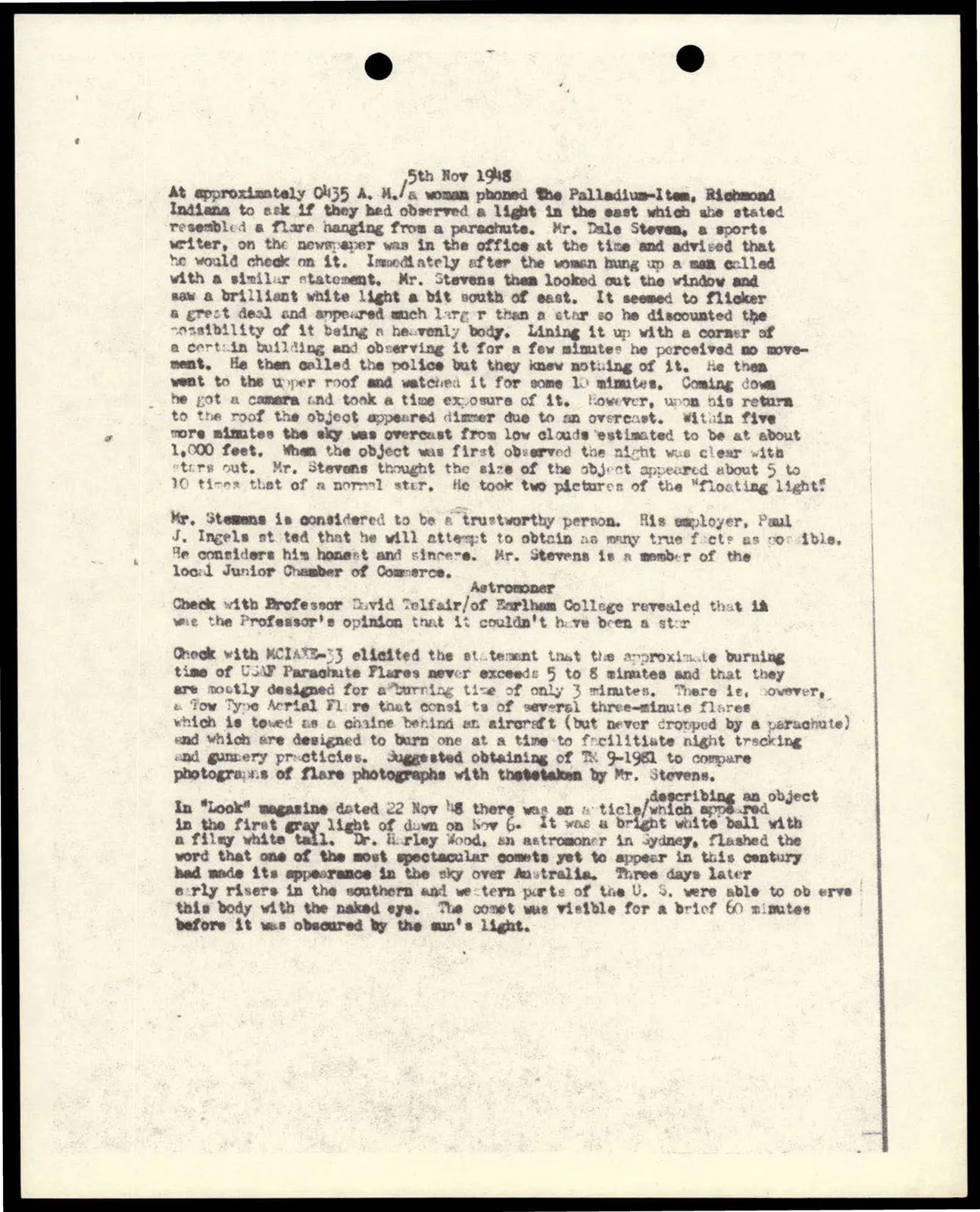
5th Nov 1948

At approximately 0435 A. M./a woman phoned the Palladium-Item, Richmond, Indiana to ask if they had observed a light in the east which she stated resembled a flare hanging from a parachute. Mr. Dale Stevens, a sports writer, on the newspaper was in the office at the time and advised that he would check on it. Immediately after the woman hung up a man called with a similar statement. Mr. Stevens then looked out the window and saw a brilliant white light a bit south of east. It seemed to flicker a great deal and appeared much larger than a star so he discounted the possibility of it being a heavenly body. Lining it up with a corner of a certain building and observing it for a few minutes he perceived no movement. He then called the police but they knew nothing of it. He then went to the upper roof and watched it for some 10 minutes. Coming down he got a camera and took a time exposure of it. However, upon his return to the roof the object appeared dimmer due to an overcast. Within five more minutes the sky was overcast from low clouds estimated to be at about 1,000 feet. When the object was first observed the night was clear with stars out. Mr. Stevens thought the size of the object appeared about 5 to 10 times that of a normal star. He took two pictures of the "floating light".

Mr. Stevens is considered to be a trustworthy person. His employer, Paul J. Ingels stated that he will attempt to obtain as many true facts as possible. He considers him honest and sincere. Mr. Stevens is a member of the local Junior Chamber of Commerce.

Astromonomer

Check with Professor David Telfair/of Earlham College revealed that in was the Professor's opinion that it couldn't have been a star

Check with MCIAXE-33 elicited the statement that the approximate burning time of USAF Parachute Flares never exceeds 5 to 8 minutes and that they are mostly designed for a burning time of only 3 minutes. There is, however, a Tow Type Aerial Flare that consists of several three-minute flares which is towed as a chain behind an aircraft (but never dropped by a parachute) and which are designed to burn one at a time to facilitate night tracking and gunnery practices. Suggested obtaining of TN 9-1981 to compare photographs of flare photographs with those taken by Mr. Stevens.

In "Look" magazine dated 22 Nov 48 there was an article/which appeared in the first gray light of dawn on Nov 6. It was a bright white ball with a filly white tail. Dr. Harley Wood, an astromonomer in Sydney, flashed the word that one of the most spectacular comets yet to appear in this century had made its appearance in the sky over Australia. Three days later early risers in the southern and western parts of the U. S. were able to observe this body with the naked eye. The comet was visible for a brief 60 minutes before it was obscured by the sun's light.