65_HS1-834228961_62-HQ-83894_Section_004
65_hs1-834228961_62-hq-83894_section_4 · page 178 of 214
Text
This text came with the file. It may have mistakes. When the text and the image disagree, the image is right.
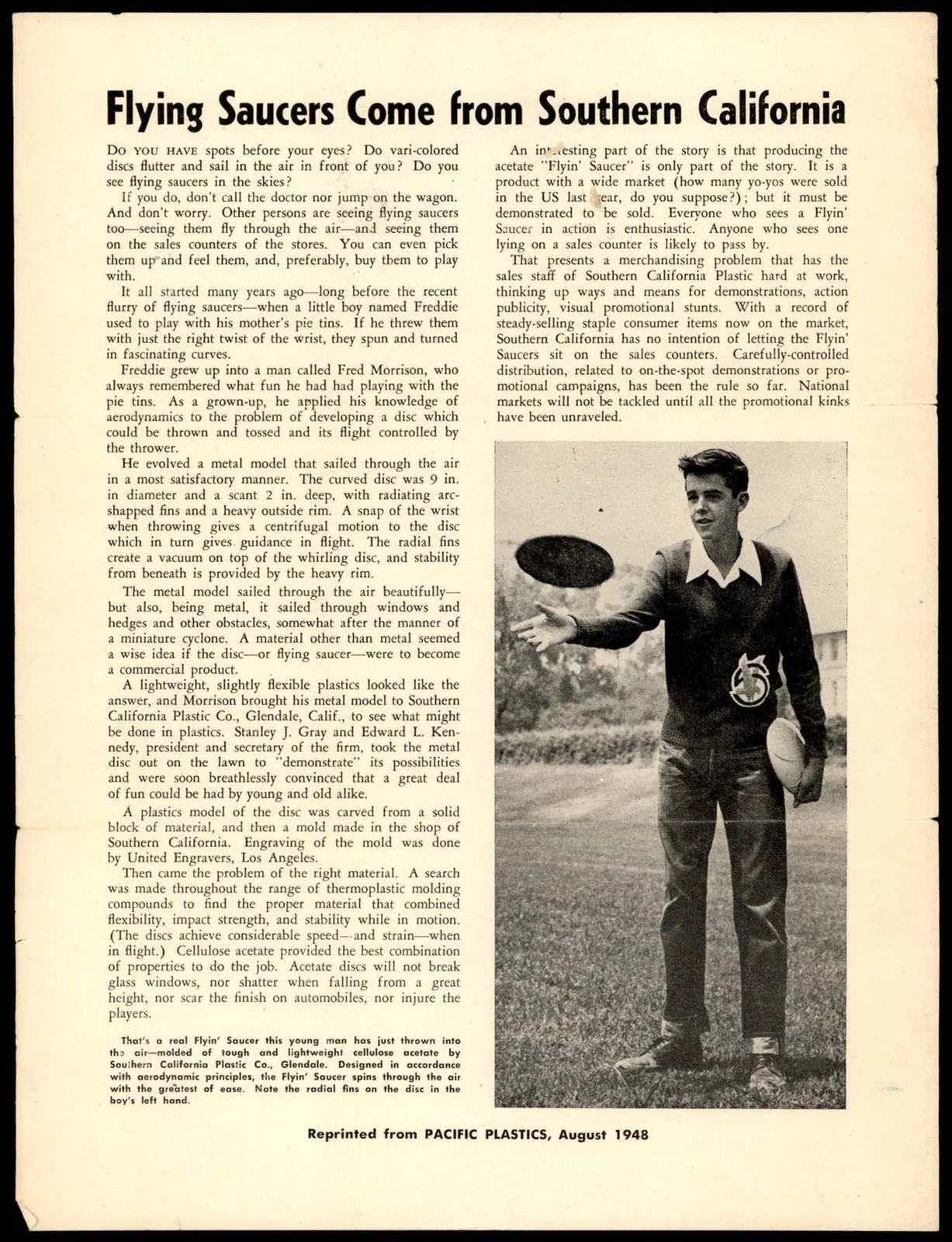
Flying Saucers Come from Southern California Do YOU HAVE spots before your eyes? Do vari-colored discs flutter and sail in the air in front of you? Do you see flying saucers in the skies ? If you do, don't call the doctor nor jump on the wagon. And don't worry. Other persons are seeing flying saucers too-seeing them fly through the air-an.:l seeing them on the sales counters of the stores. You can even pick them up and feel them, and, preferably, buy them to play with. It all started many years ago-long before the recent flurry of flying saucers- when a little boy named Freddie used to play with his mother's pie tins. If he threw them with just the right twist of the wrist, they spun and turned in fascinating curves. Freddie grew up into a man called Fred Morrison, who always remembered what fun he had had playing with the pie tins. As a grown-up, he applied his knowledge of aerodynamics to the problem of developing a disc which could be thrown and tossed and its flight controlled by the thrower. He evolved a metal model that sailed through the air in a most satisfactory manner. The curved disc was 9 in. in diameter and a scant 2 in. deep, with radiating arc shapped fins and a heavy outside rim. A snap of the wrist when throwing gives a centrifugal motion to the disc which in turn gives. guidance in flight. The radial fins create a vacuum on top of the whirling disc, and stability from beneath is provided by the heavy rim. The metal model sailed through the air beautifully but also, being metal, it sailed through windows and hedges and other obstacles, somewhat after the manner of a miniature cyclone. A material other than metal seemed a wise idea if the disc-or flying saucer-were to become a commercial product. . A lightweight, slightly flexible plastics looked like the answer, and Morrison brought his metal model to Southern California Plastic Co., Glendale, Calif., to see what might be done in plastics. Stanley J. Gray and Edward L. Ken nedy, president and secretary of the firm, took the metal disc out on the lawn to "demonstrate" its possibilities and were soon breathlessly convinced that a great deal of fun could be had by young and old alike. A plastics model of the disc was carved from a solid block of material, and then a mold made in the shop of Southern California. Engraving of the mold was done by United Engravers, Los Angeles. Then came the problem of the right material. A search was made throughout the range of thermoplastic molding compounds to find the proper material that combined flexibility, impact strength, and stability while in motion. (The discs achieve considerable speed--and strain- when in flight.) Cellulose acetate provided the best combination of properties to do the job. Acetate discs will not break glass windows, nor shatter when falling from a great height, nor scar the finish on automobiles, nor injure the players. That's a real Flyin' Saucer this young mon has just thrown into th, air-molded of tough and lightweight cellulose acetate by Soulhern California Plastic Co., Glendale. Designed in occordance with aerodynamic principles, the Flyin' Saucer spins through the air with the greatest of ease. Note the radial fons on the disc in the boy's left hand. An in• .,esting part of the story is that producing the acetate "Flyin' Saucer" is only part of the story. It is a product with a wide market (how many yo-yos were sold in the US last ·ear, do you suppose?) ; but it must be demonstrated to be sold. Everyone who sees a Flyin' Saucei in action is enthusiastic. Anyone who sees one lying on a sales counter is likely to p:iss by. That presents a merchandising problem that has the sales staff of Southern California Plastic hard at work, thinking up ways and means for demonstrations, action publicity, visual promotional stunts. With a record of steady-selling staple consumer items now on the market, Southern California has no intention of letting the Flyin' Saucers sit on the sales counters. Carefully-controlled distribution, related to on-the-spot demonstrations or pro motional campaigns, has been the rule so far. National markets will not be tackled until all the promotional kinks have been unraveled. . l Reprinted from PACIFIC PLASTICS, August 1948