65_HS1-834228961_62-HQ-83894_Section_006
65_hs1-834228961_62-hq-83894_section_6 · page 259 of 271
Text
This text came with the file. It may have mistakes. When the text and the image disagree, the image is right.
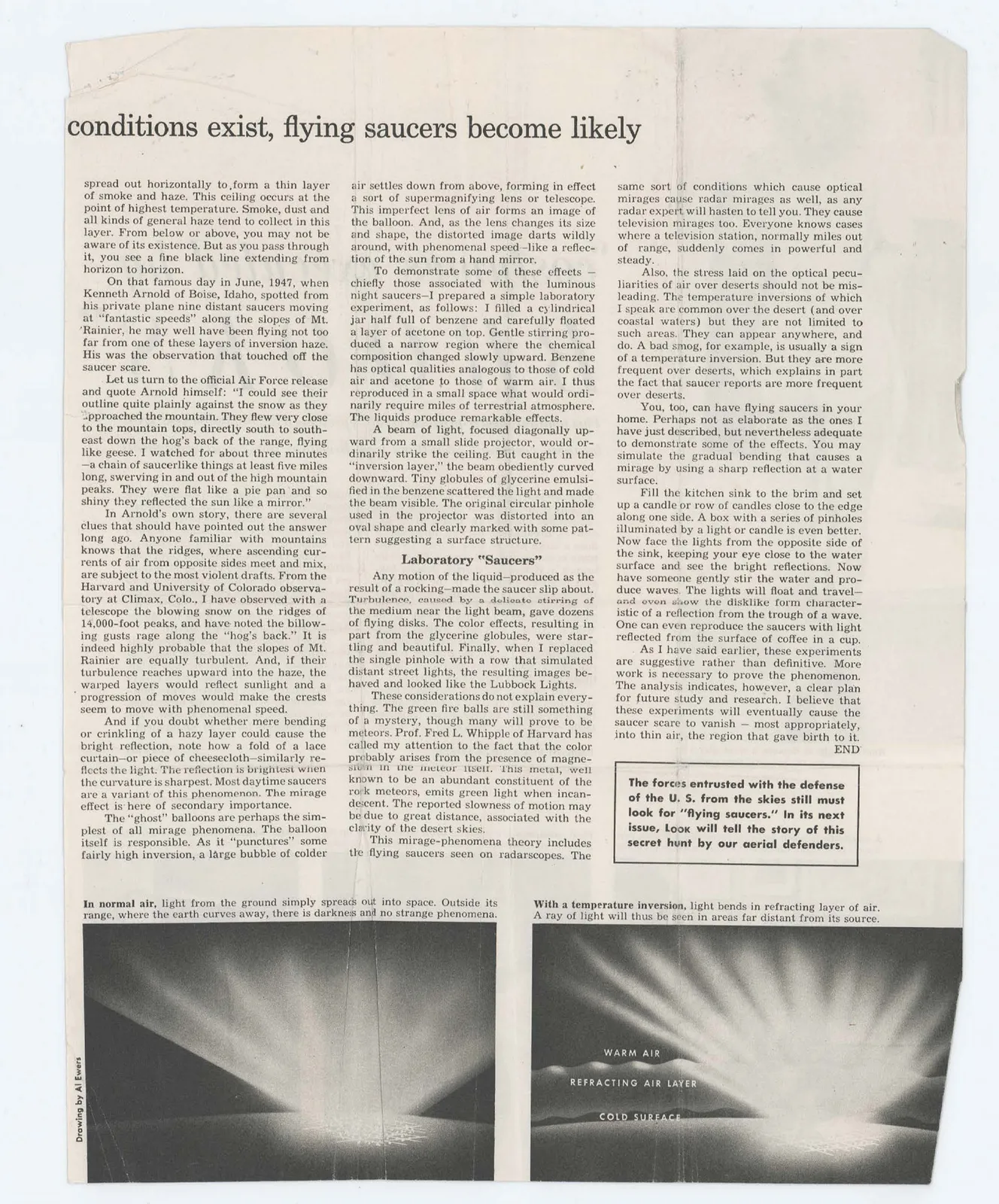
conditions exist, flying saucers become likely same so1·t of conditions which cause optical mirages cause radar mirages as well, as any radar expert will hasten to tell you. They cause television mirages too. Everyone knows cases where a television station, normally miles out of range, suddenly comes in powerful and steady. Also, the stress laid on the optical pecu liadties of air over deserts should not be mis leading. Th<? temperature inversions of which I speak arc common over the desert (and over coastal waters) but they are not limited to such areas. They can appear anywhere, and do. A bad smog, for example, is usually a sign of a temperature inversion. But they a-re more frequent over deserts, which explains in part the fact that saucer reports are more frequent over deserts. You, too, can have flying saucers in your home. Perhaps not as elaborate as the ones I have just described, but nevertheless adequate to demonstrate some of the effects. You may simulate the gradual bending that causes a mirage by using a sharp reflection at a water surface. Fill the kitchen sink to the brim and set up a candle or row of candles close to the edge along one side. A box with a series of pinholes illuminated by a light or candle is even better. Now face the lights from the opposite side of the sink, keeping your eye close to the water surface and see the bright reflections. Now have someone gently stir the water and pro duce waves The lights will float and travel and ovon s ;,ow the disklike form character istic of a reflection from the trough of a wave. One can even reproduce the saucers with light reflected from the surface of coffee in a cup. As I have said earlier, these experiments arc suggestive rather than definitive. More work is necessary to prove the phenomenon. The analysis indicates, however, a clear plan for tuturc study and research. I believe that these experiments will eventually cause the saucer scare to vanish - most appropriately, into thin air, the region that gave birth to it. END" The forc1?s entrusted with the defense of the U. S. from the skies still must look for "flying saucers." In its next issue, looK will tell the story of this secret hunt by our aerial defenders. In normal air, light from the ground siml?ly spreac.s out into space. Outside its With a temperature inversion, light bends in refracting layer of air. range, where the earth curves away, there 1s darkne:s antl no strange phenomena. A ray of light will thus be seen in areas far distant from its source. spread out horizontally to.form a thin layer of smoke and haze. This ceiling occurs at the point of highest temperature. Smoke, dust -and all kinds of gencrnl haze tend to collect in this layer. From below or above, you may not be aware of its existence. But as you pass through it, you see a fine black line extending from horizon to horizon. On that famous day in June, 1947, when Kenneth Arnold of Boise, Idaho, spotted from his private plane nine distant saucers moving at "fantastic speeds" along the slopes of Mt. 'Rainier, he may well have been flying not too far from one of these layers of inversion haze. His was the observation that touched off the saucer scare. Let us turn to the official Air Force release and quote Arnold himself: "I could !:lee their outline quite plainiy against the snow as they ...pproached the mountain. They fiew very close to the mountain tops, directly south to south east down the hog's back of the range, flying like geese. I watched for about three minutes -a chain of saucerlike things at least five miles long, swerving in and out of the high mountain peaks. They were flat like a pie pan and so shiny they reflected the sun like a mirror." In Arnold's own story, there are several clues that should have pointed out the answer long ago. Anyone familiar with mountains knows that the ridges, where ascending cur rents of air from oppol:lite sides meet and mix, arc subject to the most violent drafts. From the Harvard and University of Colorado observa tory at Climax, Colo.. I have observed with a telescope the blowing snow on the ridges of 14,000-foot peaks, and have- noted the billow ing gusts rage along the "hog's back." It is indeed highly prnbable that the slopes of Mt. Rainier are equally turbulent. And, if their turbulence reaches upward into the haze, the warped layers would reflect sunlight and a • progression of moves would make the crests seem to move with phenomenal speed. And if you doubt whether mere bending or crinkling of a hazy layer could cause the bright reflection, note how a fold of a lace curtain- or piece of cheesecloth- similarly re flect:; the light. The reflection is l.JrighLcs~ wnen the curvature is sharpest. Mostdaytime saucers are a variant of this phcnomc-nnn. The mirage effect is· here of secondary importance. The "ghost" balloons arc perhaps the sim plest of all mirage phenomena. The balloon itself is responsible. As it "punctures" some fairly high inversion, a lArge bubble of colder air settles down from above, forming in effect a sort of supermagnifying lens or telescope. This imperfect lens of air forms an image· of the balloon. And, as the Jens changes its size and shape, the distorted image darts wildly around, with phenomenal speed - like a reflec tion of the sun from a hand mirror. To demonstrate some of these efTects chiefly those associated with the luminous night saucers- I prepared a simple laboratory experiment, as follows: I filled a cylindrical jar half full of benzene and carefully floated a layer of acetone on top. Gentle stirring pro duced a narrow region where the chemical composition changed slowly upward. Benzene has optical qualities analogous to those of cold air and acetone to those of warm afr. I thus reproduced in a small space what would ordi narily require miles of terrestrial atmosphere. The liquids produce remarkable effects. A beam of light, focused diagonally up ward from a small slide projector, would or dinarily strike the ceiling. But caught in the "inversion layer." the beam obediently curved downward. Tiny globules of glycerine emulsi fied in the benzene.scattered the light and made the beam visible. The original circular pinhole used in the projector was distorted into an oval shape and clearly marked with some pat tern suggesting a surface structure. Laboratory "Saucers" Any motion of the liquid- produced as the result of a rocking- made the saucer slip about. T11rbulcnc", <'CTU«<'d by <> d.<>lioQto otirring of the medium near the light beam, gave dozens of flying disks. The color efiects, resulting in part from the glycerine globules, were star tling and beautiful. Finally, when I replaced the single pinhole with a row that simulated distant street lights, the resulting images be haved and looked like the Lubbock Lights. These considerationsdo not explain every thing. The green fire balls are still something of a mystery, though many will prove to be meteors. Prof. Fred L. Whipple of Harvard has called my attention to the fact that the color pr,ibably arises from the presence of magne :s1v 11 111 Lill! ,uctvvr lts CH. This rnctul, wcl! known to be an abundant constituent of the ro•·k meteors, emits green light when incan dc;cent. The reported slowness of motion may be due to great distance, associated with the cla1·ity of the desert skies. This mirage-phenomena theory includes U-c flying saucers seen on radarscopes. The