65_HS1-834228961_62-HQ-83894_Section_006
65_hs1-834228961_62-hq-83894_section_6 · page 260 of 271
Text
This text came with the file. It may have mistakes. When the text and the image disagree, the image is right.
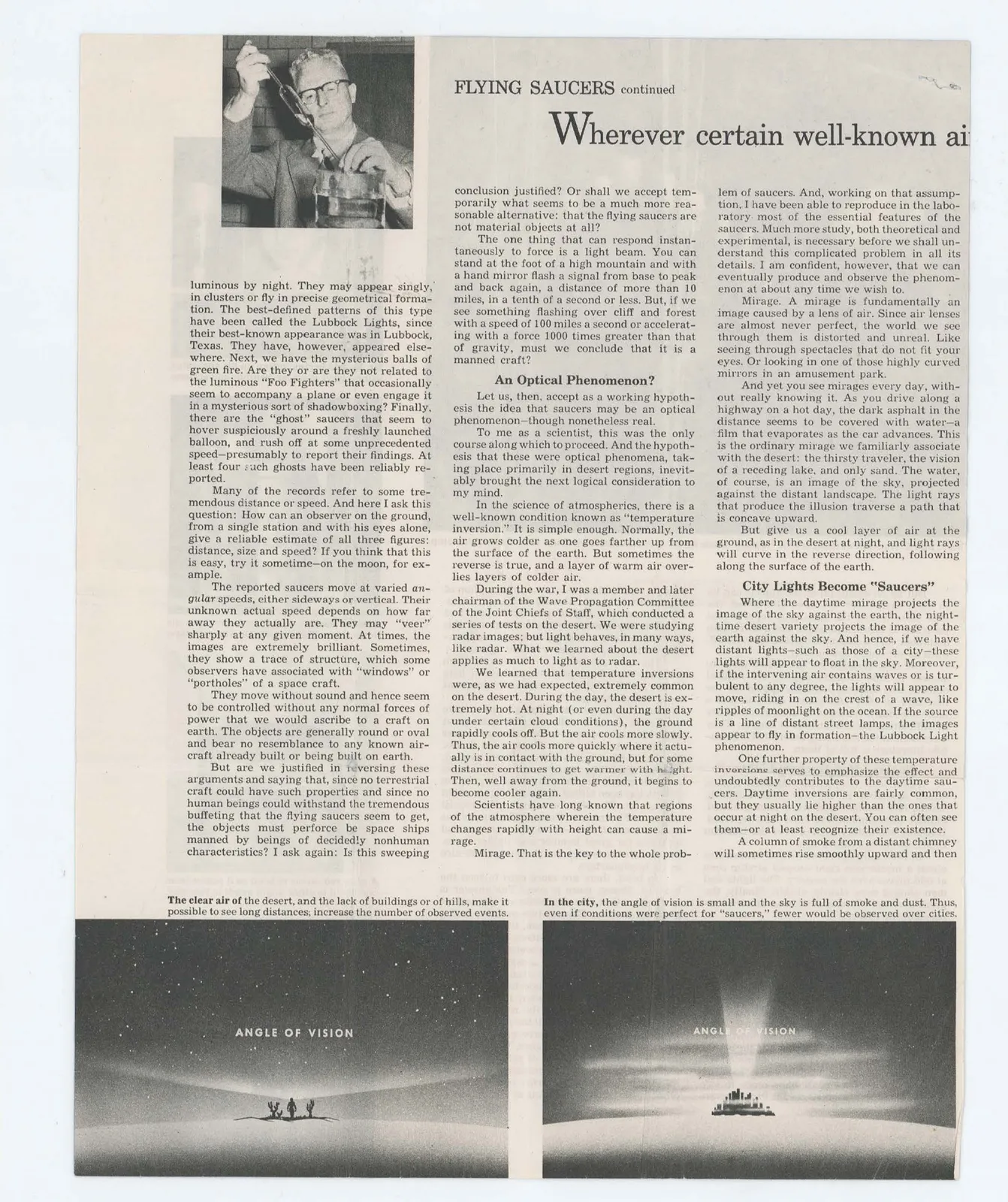
luminous by night. They may appear singly,· in clusters or fly in precise geometrical forma tion. The best-defined patterns of this type have been called the Lubbock Lights, since their best-known appearance was in Lubbock, Texas. They have, however, appeared else where. Next, we have the mysterious balls of green fire. Are they or are they not related to the luminous "Foo Fighters'' that occasionally seem to accompany a plane or even engage it in a mysterious sort of shadowboxing? Finally, there are the "ghost" saucers that seem to hover suspiciously around a freshly launched balloon, and rush off at some unprecedented speed-presumably to report their findings. At least four , ..ich ghosts have been reliably re ported. Many of the records refer to some tre mendous distance or speed. And here I ask this question: How can an observer on the ground, from a single station and with his eyes alone, give a reliable estimate of all three figures: distance, size and speed? If you think that this is easy, try it sometime-on the moon, for ex ample. The reported saucers move at varied a1t gtdar speeds, either sideways or vertical. Their unknown actual speed depends on how far away they actually arc. They may "veer" sharply at any given moment. At times, the images arc extremely brilliant. Sometimes, they show a trace of structure, which some observers have associated with "windows" or "portholes" of a space craft. They move without sound and hence seem to be controlled without any normal forces of power that we would ascribe to a craft on earth. The objects are generally round or oval and bear no 1·esemblance to any known air craft already built or being built on earth. But are we justified in , versing these arguments and saying that, since no terrestrial craft could have such properties and since no human beings could withstand the tremendous buffeting that the flying saucers seem to get, the objects mLtst perforce be space ships manned by beings of decidedly nonhuman characteristics? I ask again: Is this sweeping FLYING SAUCERS continued Wherever certain well-known ai: conclusion justified'? Or shall we accept tem porarily what seems to be a much more rea sonable alternative: that the flying saucers are not material objects at all? The one thing that can rcspoBd instan taneously to fo1·ce is a light beam. You can stand at the foot of a high mountain and with a hand mirror flash a signal from base to peak and back again, a distance of more than 10 miles, in a tenth of a second or less. But, if we see something fla~hing over cliff and forest with a speed of 100 miles a second or accelerat ing with a force 1000 times greater than that of gravity, must we conclude that it is a manned craft? An Optical Phenomenon? Let us, then, accept as a working hypoth esis the idea that saucers may be an optical phenomenon- though nonetheless real. To me as a scientist, this was the only course along which to proceed. And the hypoth esis that these were optical phenomena, tak ing place primarily in desert regions, inevit ably brought the next logical consideration to my mind. In the science of atmospherics. there is a well-known condition known as "temperature inversion." It is simple enough. Normally, the air grows colder as one goes farther up from the surface of the ea1·th. But sometimes the reverse is true, a.nd a layer of warm air over lies laye1s of colder air. During the war, I was a member and later chairman of the Wave Propagation Committee of the Joint Chiefs of Staff, which conducted a series of tests on the desert. We were studying radar images: but light behaves, in many ways, like radar. What we learned about the desert applies as much to light as to radar. We learned that temperature inversions were, as we had expected, extremely common on the desert. During the day, the desert is ex tremely hot. At night (or even during the day under certain cloud conditions), the ground rapidly cools olT. But the air cools more slowly. Thus, the air cools more quickly where it actu ally is in contact with the ground, but for some distance continues to get wa,·mer wilh h ·ght. Then, well away from the ground, it begins to become cooler again. Scientists have long known that regions of the atmosphere wherein the temperature changes rapidly with height can cause a mi rage. Mirage. That is the key to the whole prob lem of saucers. And, working on that assump tion. I have been able to reproduce in the labo ratory- most of the essential features of the saucers. Much more study, both theoretical and experimental, is necessary before we shall un derstand this complicated problem in all its details. I am confident, however, that we can eventually pl'Oduce and observe the phenom enon at about any time we wish to. Mirage. A mirage is fundamentally an image caused by a lens of air. Since air lenses are almost never perfect, the world we sec tht·ough them is distorted and unreal. Like seeing through spectacles that no not fit your eyes. Or looking in one of those highly curved minors in an amusement park. And yet you see mirages every day, with out really knowing it. As you drive along a h ighway on a hot day, the dark asphalt in the distance seems to be covered with water-a :film that evaporates as the car advances. This is the ordinary mirage we familiarly associate with the desert: the thirsty traveler, the vision of a receding lake, and only sand. The water, of course, is an image of the sky, projected against the distant landscape. The light rays that produce the illusion traverse a path that is concave upward. But give us a cool layer of air at the ground, as in the desert at night, and light rays will cmve in the reverse direction, following along the smface of the earth. City Lights Become "Saucers" Where the daytime mirage projects the image of the sky against the earth. the night time desert variety projects the image of the earth against the sky. And hence, if we have distant lights- such as those of a city-these lights will appear to float in lhc sky. Moreover, if the intervening air contains waves or is tur bulent to any degree, the lights will appear to move, riding in on the crest of a wave, like l'ipples of moonlight on the ocean. If the source is a line of distant street lamps, the images appear to fly in formation- the Lubbock Light phenomenon. One further property of these temperature invors:iom, ~.,,·vcs to emphasize the effect and undoubtedly contributes to the daytime sau cers. Daytime inversions are fairly common, but they usually lie higher than the ones that occur at night on the desert. You can often see them- or at least recognize their existence. A column of smoke from a distantchimney will sometimes rise smoothly upward and then The clear air of the desert, and the lack of buildings or of hills, make it In the city, the angle of vision is small and the sky is full of smoke and dust. Thus, possible to see long distances; increase the number of observed events. even if conditions were perfect for "saucers,'' fewer would be observed over cities. .. • • • 1 • .. ' • .,, ' • "J. '