65_HS1-834228961_62-HQ-83894_Section_008
65_hs1-834228961_62-hq-83894_section_8 · page 124 of 217
Text
A machine read this text from the scan. When the text and the image disagree, the image is right.
SUBJECT: Interview with Senator Richard B. Russell.

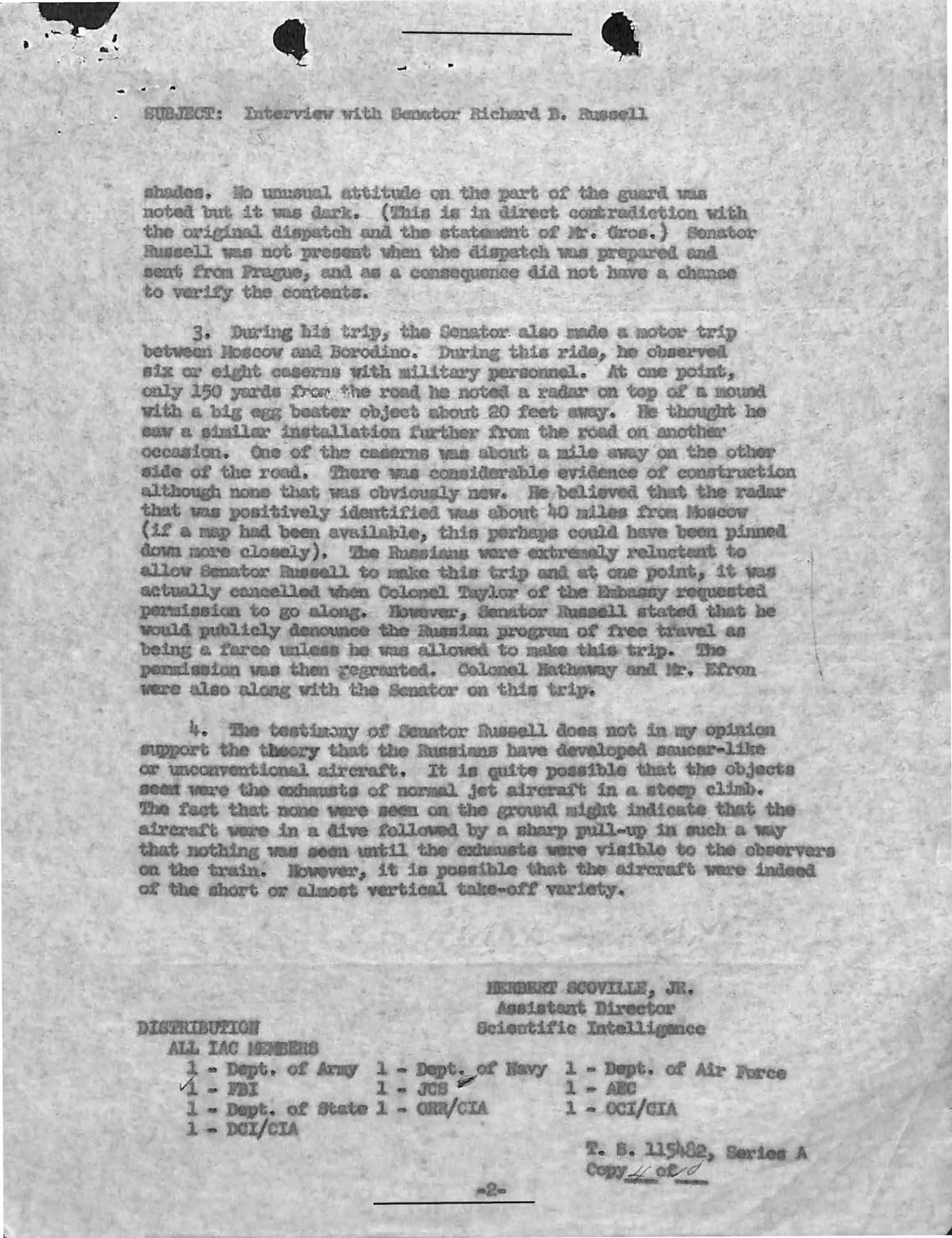
shades. No unusual attitude on the part of the guard was noted but it was dark. (This is in direct contradiction with the original dispatch and the statement of Mr. Gros.) Senator Russell was not present when the dispatch was prepared and sent from Prague, and as a consequence did not have a chance to verify the contents.

3. During his trip, the Senator also made a motor trip between Moscow and Borodino. During this ride, he observed six or eight caserns with military personnel. At one point, only 150 yards from the road he noted a radar on top of a mound with a big egg beater object about 20 feet away. He thought he saw a similar installation further from the road on another occasion. One of the caserns was about a mile away on the other side of the road. There was considerable evidence of construction although none that was obviously new. He believed that the radar that was positively identified was about 40 miles from Moscow (if a map had been available, this perhaps could have been pinned down more closely). The Russians were extremely reluctant to allow Senator Russell to make this trip and at one point, it was actually cancelled when Colonel Taylor of the Embassy requested permission to go along. However, Senator Russell stated that he would publicly denounce the Russian program of free travel as being a farce unless he was allowed to make this trip. The permission was then granted. Colonel Hathaway and Mr. Efron were also along with the Senator on this trip.

4. The testimony of Senator Russell does not in my opinion support the theory that the Russians have developed saucer-like or unconventional aircraft. It is quite possible that the objects seen were the exhausts of normal jet aircraft in a steep climb. The fact that none were seen on the ground might indicate that the aircraft were in a dive followed by a sharp pull-up in such a way that nothing was seen until the exhausts were visible to the observers on the train. However, it is possible that the aircraft were indeed of the short or almost vertical take-off variety.

HERBERT SCOVILLE, JR.
Assistant Director
Scientific Intelligence

DISTRIBUTION

ALL IAC MEMBERS

1 - Dept. of Army 1 - Dept. of Navy 1 - Dept. of Air Force
1 - FBI 1 - JCS 1 - AEC
1 - Dept. of State 1 - ORR/CIA 1 - OCI/CIA
1 - DCI/CIA

T. S. 115482, Series A
Copy of

-2-