The Central Intelligence Agency and Overhead Reconnaissance; The U-2 and OXCART Programs, 1954-1974
CIA-UAP-003 · page 184 of 406
Text
This text came with the file. It may have mistakes. When the text and the image disagree, the image is right.
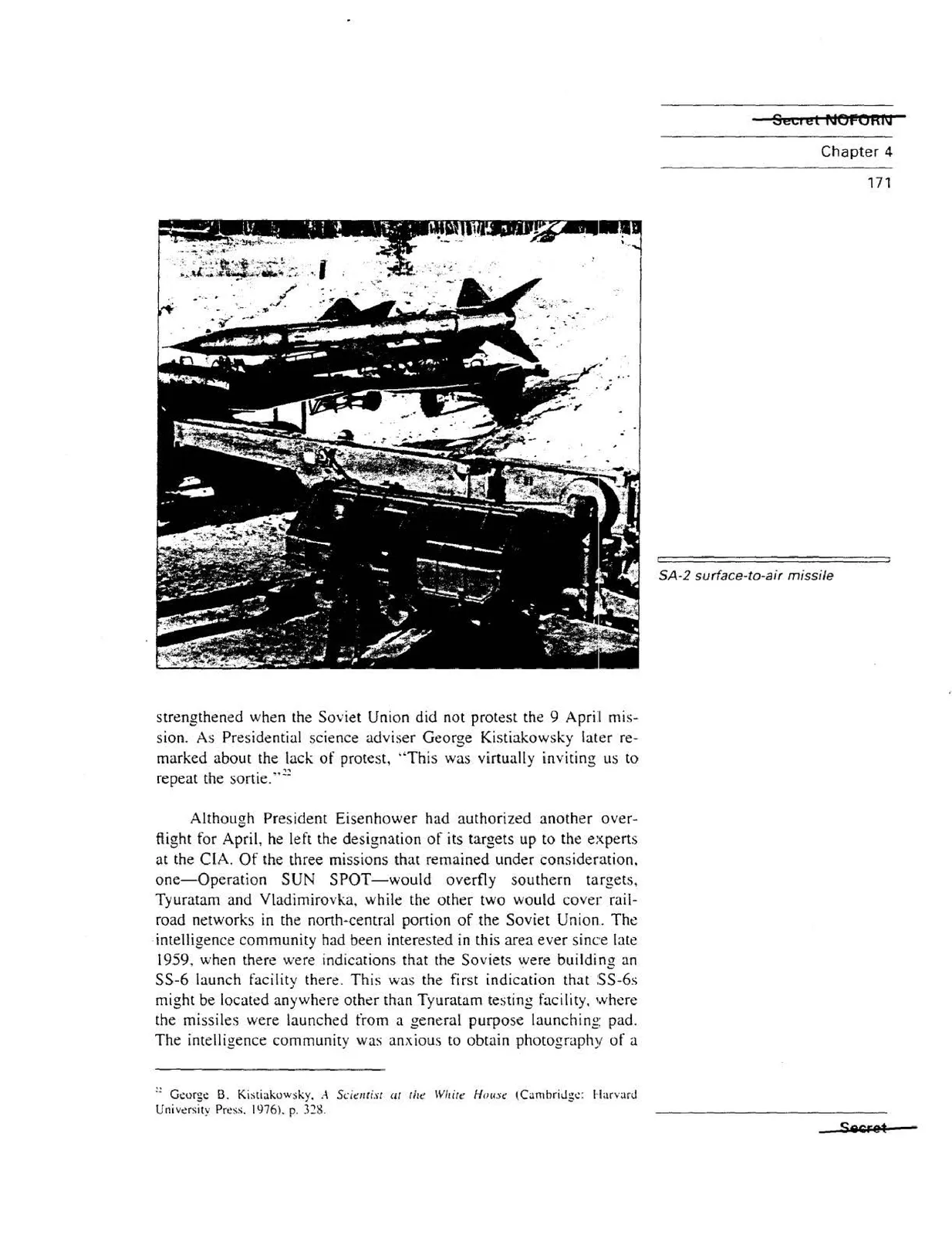
171 Sec, et NOPORICJ Chapter 4 strengthened when the Soviet Union did not protest the 9 April mis sion. As Presidential science adviser George Kistiakowsky later re marked about the lack of protest, ''This was virtually inviting us to repeat the sortie ... ~= Although President Eisenhower had authorized another over flight for April, he left the designation of its targets up to the experts at the ClA. Of the three missions that remained under consideration. one-Operation SUN SPOT-would overfly southern targets, Tyuratam and Vladimirovka, while the other two would cover rail road networks in the north-central portion of the Soviet Union. The intelligence community had been interested in this area ever since late 1959, when there were indications that the Soviets were building an SS-6 launch facility there. This was the first indication that :SS-6s might be located anywhere other than Tyuratam testing facility. where the missiles were launched from a general purpose launching pad. The intelligence community was anxious to obtain photography of a " George B. Kistiakowsky. A Scientist lll rlie \¥/,ire House (CamhriJg.:: l·t.1rvarJ Univ.:rsity Press. 1976). p. 3::8. SA-2 surface-to-air missile SeG:ret