The Central Intelligence Agency and Overhead Reconnaissance; The U-2 and OXCART Programs, 1954-1974
CIA-UAP-003 · page 223 of 406
Text
This text came with the file. It may have mistakes. When the text and the image disagree, the image is right.
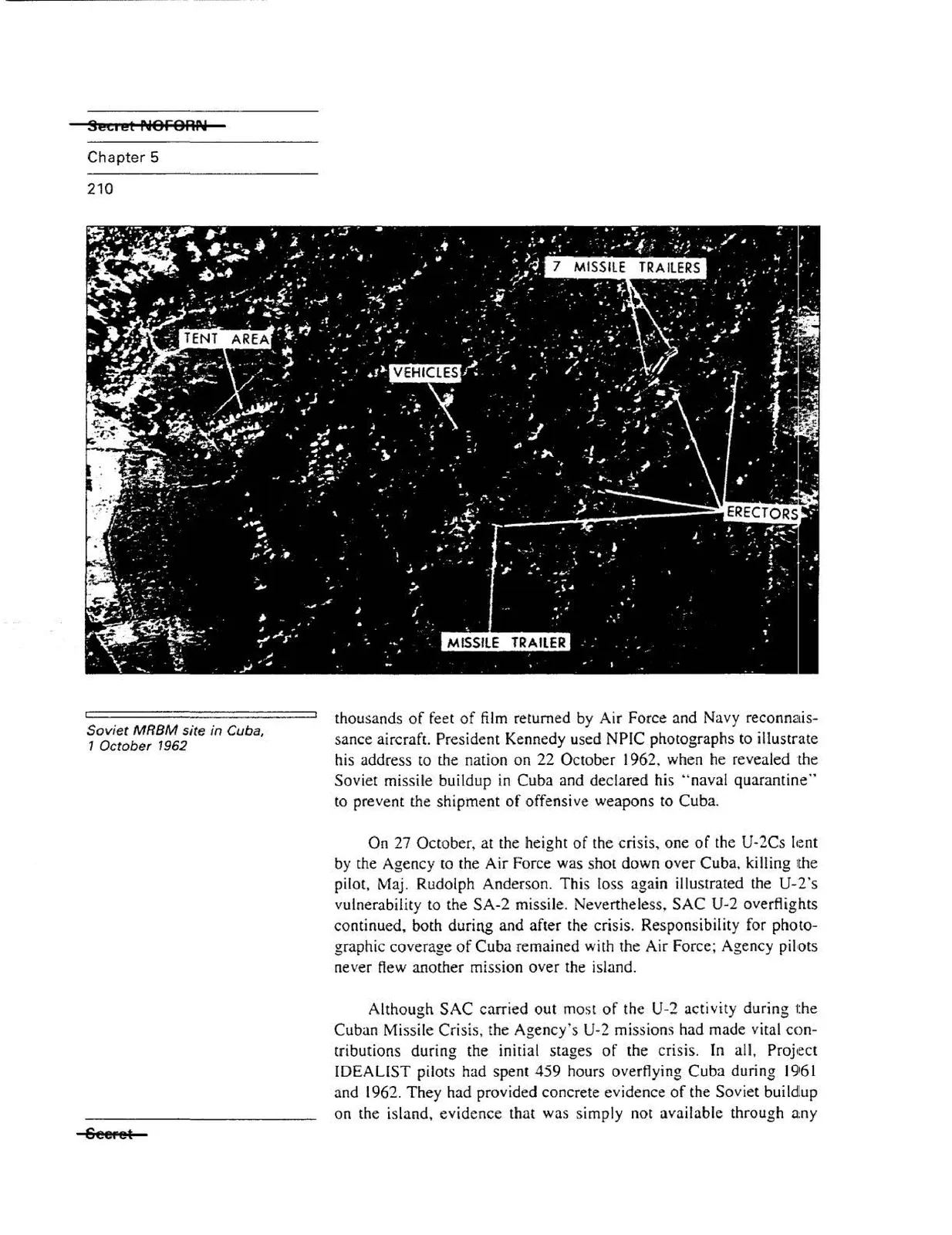
210 Sec. et NOFORN Chapter 5 Soviet MRBM site in Cuba, 1 October 1962 thousands of feet of film returned by Air Force and Navy reconnais sance aircraft. President Kennedy used NPIC photographs to illustrate his address to the nation on 22 October I 962. when he revealed lhe Soviet missile buildup in Cuba and declared his " naval quarantine" to prevent the shipment of offensive weapons to Cuba. On 27 October, at the height of the crisis, one of the U-2Cs knt by the Agency to the Air Force was shot down over Cuba. killing rthe pilot, Maj. Rudolph Anderson. This loss again illustrated the U-2's vulnerability to the SA-2 missile. Nevertheless, SAC U-2 overflights continued, both during and after the crisis. Responsibility for photo graphic coverage of Cuba remained with the Air Force; Agency pil,ots never flew another mission over the island. Although SAC carried out most of the U-2 activity during the Cuban Missile Crisis, the Agency's U-2 missions had made vital con tributions during the initial stages of the crisis. In all. Proj,ect IDEALIST pilots had spent 459 hours overflying Cuba during 19161 and 1962. They had provided concrete evidence of the Soviet buildlup on the island, evidence that was simply not available through any Seeret