The Central Intelligence Agency and Overhead Reconnaissance; The U-2 and OXCART Programs, 1954-1974
CIA-UAP-003 · page 23 of 406
Text
This text came with the file. It may have mistakes. When the text and the image disagree, the image is right.
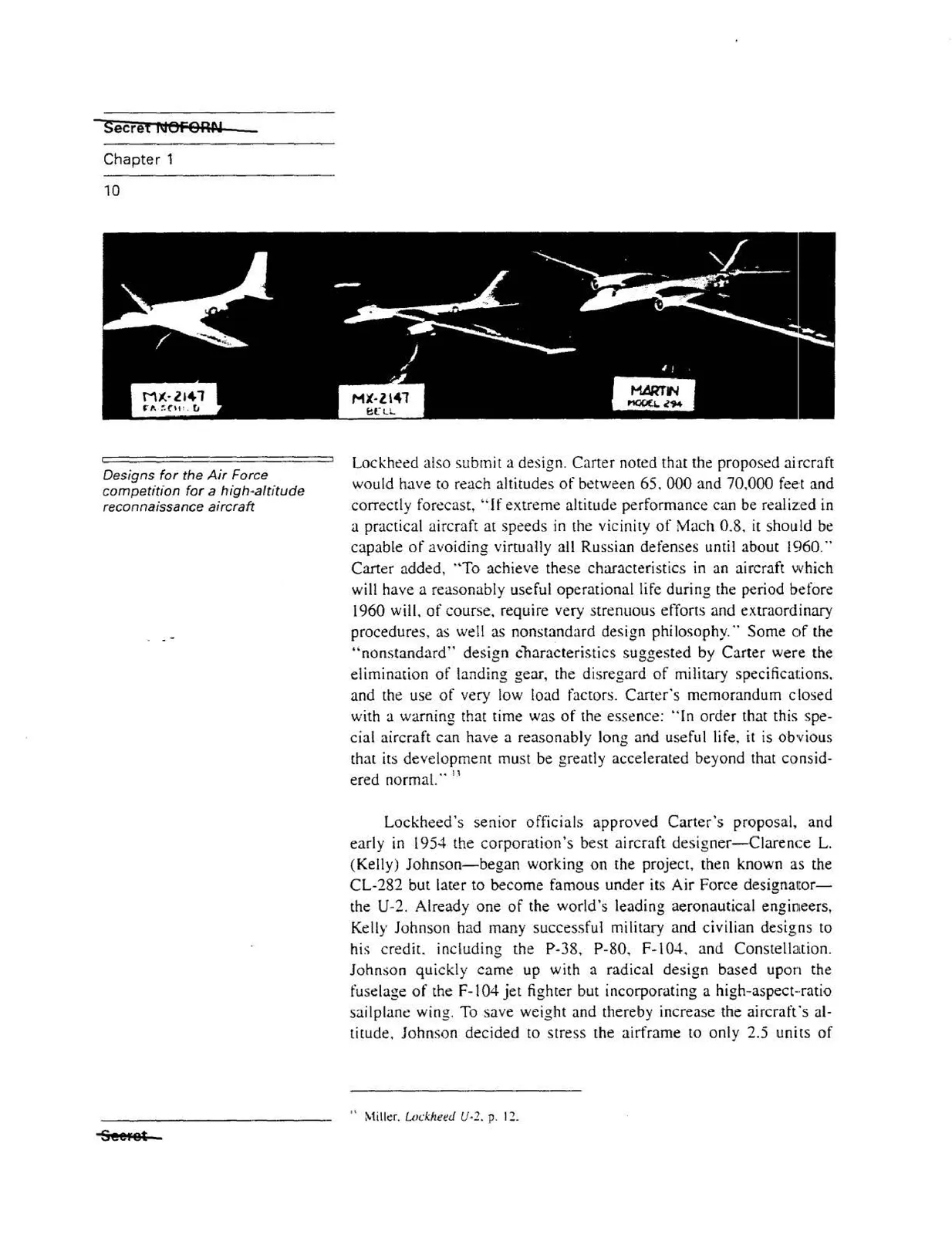
10 Secret ld0F8RN Chapter 1 Lockheed also submit a design. Carter noted that the proposed aircraft Designs for the Air Force would have co reach altitudes of between 65. 000 and 70,000 feet and competition for a high-altitude reconnaissance aircraft correctly forecast, "If extreme altitude performance can be realiz:ed in a practical aircraft at speeds in the vicinity of Mach 0.8. it should be capable of avoiding virtually all Russian defenses until about 1960." Carter added, ··To achieve these characteristics in an aircraft which will have a reasonably useful operational life during the period before 1960 will. of course, require very strenuous efforts and extraordinary procedures, as well as nonstandard design philosophy." Some of the "nonstandard" design cnaracteristics suggested by Carter were the elimination of landing gear, the disregard of military specifications. and the use of very low load factors. Carter's memorandum closed with a warning that time was of the essence: " In order that this spe cial aircraft can have a reasonably long and useful life, it is obvious that its development must be greatly accelerated beyond that consid ered normal. .. 1 • 1 Lockheed's senior officials approved Carter's proposal, and early in 1954 the corporation's best aircraft designer-Clarence L. (Kelly) Johnson-began working on the project, then known as the CL-282 but later to become famous under its Air Force designa1tor the U-2. Already one of the world's leading aeronautical engirneers, Kelly Johnson had many successful military and civilian designs to his credit. including the P-38, P-80, F-I04. and Constellmtion. Johnson quickly came up with a radical design based upon the fuselage of the F-I04 jet fighter but incorporating a high-aspect--ratio sailplane wing. To save weight and thereby increase the aircraft"s al titude. Johnson decided to stress the airframe to only 2.5 units of " Milkr. U1''kheed U-2. p. 12. -See,oc