The Central Intelligence Agency and Overhead Reconnaissance; The U-2 and OXCART Programs, 1954-1974
CIA-UAP-003 · page 24 of 406
Text
This text came with the file. It may have mistakes. When the text and the image disagree, the image is right.
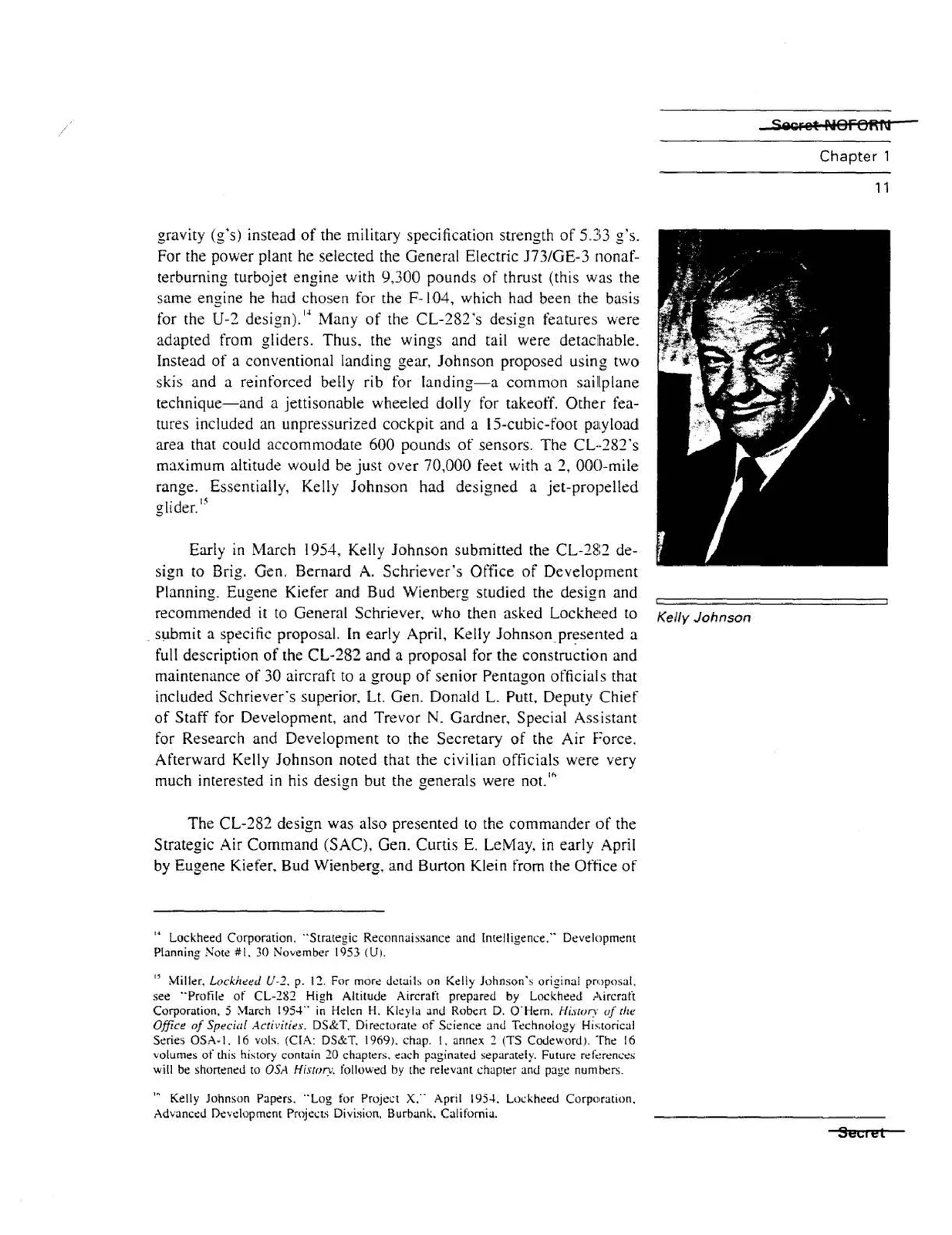
11 / Chapter 1 gravity (g's) instead of the military specification strengLh of 5.33 g's. For the power plant he selected the General Electric 173/GE-3 nonaf terburning turbojet engine with 9,300 pounds of thrust (this was the same engine he had chosen for the F- 104, which had been the basis for the U-2 design). 1 " Many of the CL-282's design features were adapted from gliders. Thus, the wings and tail were detacihable. Instead of a conventional landing gear, Johnson proposed using two skis and a reinforced belly rib for landing- a common saillplane technique-and a jettisonable wheeled dolly for takeoff. Other tea tures included an unpressurized cockpit and a 15-cubic-foot prnyload area that could accommodate 600 pounds of sensors. The CL--282's maximum altitude would be just over 70,000 feet with a 2, 000-mile range. Essentially, Kelly Johnson had designed a jet-propelled gl"d I er. .~• Early in March 1954, Kelly Johnson submitted the CL-282 de sign to Brig. Gen. Bernard A. Schriever's Office of Development Planning. Eugene Kiefer and Bud Wienberg studied the design and recommended it to General Schriever. who then asked Lockheed to Kelly Johnson . sµbmit a specific proposal. In early April, Kelly Johnson _presented a full description of the CL-282 and a proposal for the construction and maintenance of 30 aircraft to a group of senior Pentagon officials that included Schriever·s superior. Lt. Gen. Donald L. Putt, Deputy Chief of Staff for Development, and Trevor N. Gardner, Special Assistant for Research and Development to the Secretary of the Air Force. Afterward Kelly Johnson noted that the civilian officials were very much interested in his design but the generals were not. 16 The CL-282 design was also presented to the commander of the Strategic Air Command (SAC), Gen. Curtis E. LeMay. in early April by Eugene Kiefer. Bud Wienberg, and Burton Klein from the Office of " Lockheed Corporation. ··strategic Reconnaissance and Intelligence ... Development Planning Note #I. 30 November 1953 (U). " Miller. locklctted U-2. p. 12. For more: J.:tails on Kdly Johnson's original pr,:,posal. see '"Profile of CL-282 High Altitude Aircraft prepared by Lockheed Aircrati Corporation. 5 March 1954'" in Helen H. Kkyla and Robert D. o ·Hem. Hiswrv of the Office of Special Activities. DS&T. Directorate of Science an<l Technology Hi~:torical Series OSA-1. 16 vols. (CIA: DS&T. 1969). chap. I. annex 2 (TS Codeword). Th,: 16 volumes of this history contain 20 chaptr:rs . .:ach paginated separately. Future rd,:rcm;,;;s will be shorten,:d to OSA Hiswry. follow<:!d by the rekvant chapter and pag<:! numbers. •· Kelly Johnson Papers. ··Log for Project x:· April 1954. Lo.:khec:d Corporation. Advanced Devdopmcnt Projec:ts Divi~ion. Burbank. California. Sec,et