The Central Intelligence Agency and Overhead Reconnaissance; The U-2 and OXCART Programs, 1954-1974
CIA-UAP-003 · page 25 of 406
Text
This text came with the file. It may have mistakes. When the text and the image disagree, the image is right.
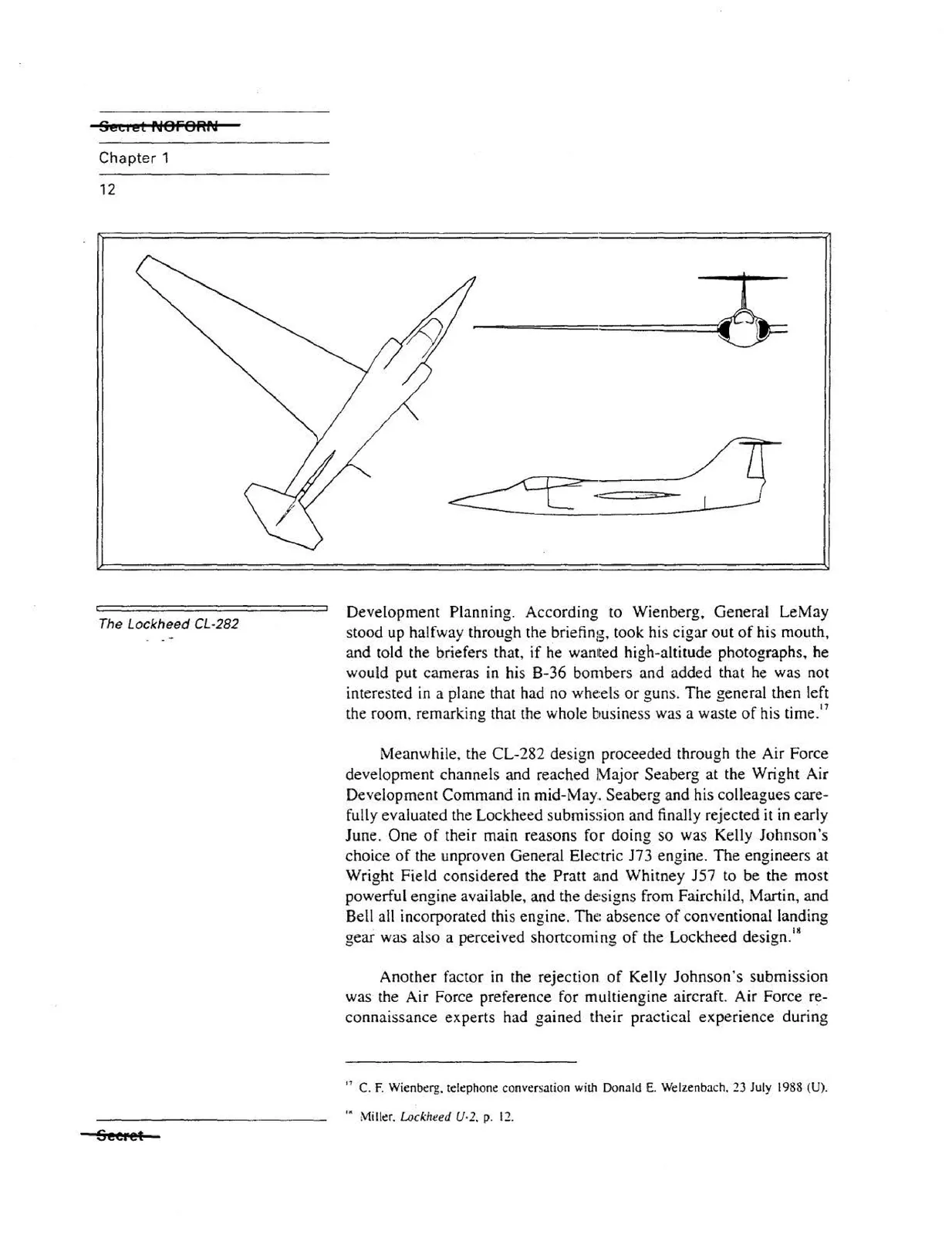
. 12 Sec,et NOFORN Chapter 1 The Lockheed CL-282 Development Planning. According to Wienberg, General LeMay stood up halfway through the briefing, took his cigar out of his mouth, and told the briefers that, if he wan1ted high-altitude photographs, he would put cameras in his B-36 bombers and added that he was not interested in a plane that had no whe:els or guns. The general then left the room, remarking that the whole business was a waste of his time." Meanwhile, the CL-282 design proceeded through the Air Force development channels and reached Major Seaberg at the Wright Air Development Command in mid-May. Seaberg and his colleagues care fully evaluated the Lockheed submission and finally rejected it in early June. One of their main reasons for doing so was Kelly Johnson's choice of the unproven General Electric J73 engine. The engineers at Wright Field considered the Pratt aind Whitney J57 to be the most powerful engine available, and the de:signs from Fairchild, Martin, and Bell all incorporated this engine. The: absence of conventional landing gear was also a perceived shortcoming of the Lockheed design." Another factor in the rejection of Kelly Johnson's submission was the Air Force preference for multiengine aircraft. Air Force re connaissance experts had gained their practical experience during " C. F. Wienb<!rg. telephone conversation with Donald E. Welzenbach. 23 July 1988 (U). " Miller. Lockheed U-2. p. 12. See1et