The Central Intelligence Agency and Overhead Reconnaissance; The U-2 and OXCART Programs, 1954-1974
CIA-UAP-003 · page 27 of 406
Text
This text came with the file. It may have mistakes. When the text and the image disagree, the image is right.
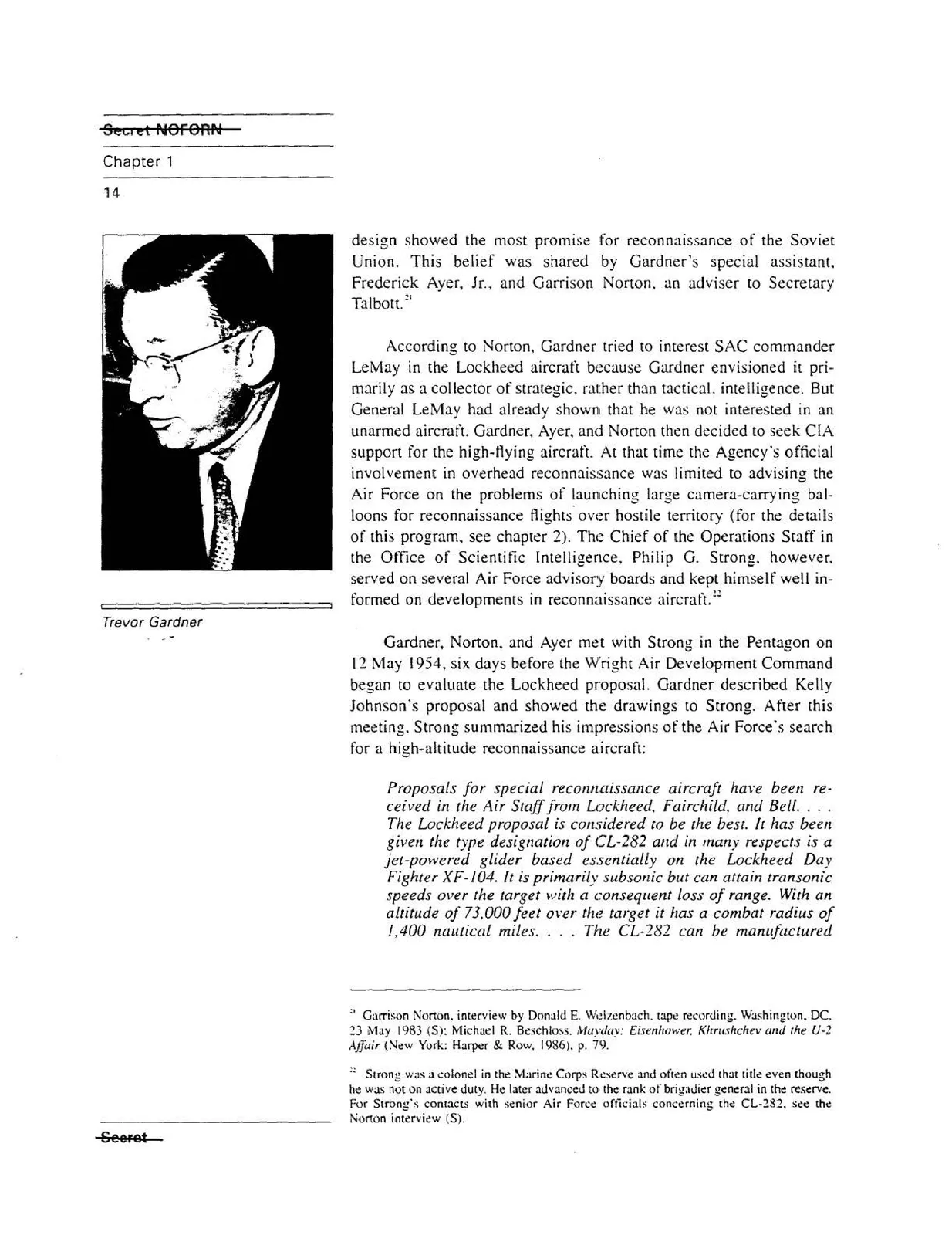
14 Sec, et NOFOAN Chapter 1 Trevor Gardner design showed the most promise for reconnaissance of the Soviet Union. This belief was shared by Gardner's special assistant, Frederick Ayer, Jr., and Garrison Norton. an adviser to Secretary Talbott.~' According to Norton, Gardner tried to interest SAC commander LeMay in the Lockheed aircraft because Gardner envisioned it pri marily as a collector of strategic. rather than tactical. intelligence. But General LeMay had already showni that he was not interested in an unarmed aircraft. Gardner, Ayer, and Norton then decided to seek CIA support for the high-flying aircraft. At that rime the Agency·s official involvement in overhead reconnaissance was limited to advising the Air Force on the problems of launiching large camera-carrying bal loons for reconnaissance flights· over hostile territory (for the details of this program. see chapter 2). The Chief of the Operations Staff in the Office of Scientific Intelligence, Philip G. Strong. however. served on several Air Force advisory boards and kept himself well in formed on developments in reconnaissance aircraft.!! Gardner, Norton, and Ayer met with Strong in the Pentagon on 12 May 1954, six clays before the Wright Air Development Command began to evaluate the Lockheed proposal. Gardner described Kelly Johnson's proposal and showed the drawings to Strong. After this meeting. Strong summarized his impressions of the Air Force·s search for a high-altitude reconnaissance aircraft: Proposals for special reconnaissance aircraft have been re ceived in the Air Staff from Lockheed. Fairchild. and Bell . ... The Lockheed proposal is considered to be the best. It has been given the type designation of CL-282 and in many respects is a jet-powered glider based essentially on the Lockheed Day Fighter XF-104. It is primarily subsonic but can attain transonic speeds over the target with a consequent loss of range. With an altitude of 73,000 feet over the target it has a combat radius of 1,400 nautical miles . ... The CL-282 can be manufactured " Garrison Norton. interview by Donald E. Wt!lzcnbach. tape recording. Wa.shington. DC. 23 May 1983 (S): Michael R. Beschloss. Mayd"y: Eisenhower. Kltrmhchev and the U-2 Affuir (New York: Harper & Row. 1986). p. 79. " Strong was a colonel in the Marine Corps Reserve and often used that tille even though he was not on active duty. He later ad,·anced to• the rank or brigadier general in the reserve. For S1rong·.~ contacts with senior Air Force officials concerning 1he CL-282. see the Norton interview (S). 6ee,ot