The Central Intelligence Agency and Overhead Reconnaissance; The U-2 and OXCART Programs, 1954-1974
CIA-UAP-003 · page 28 of 406
Text
This text came with the file. It may have mistakes. When the text and the image disagree, the image is right.
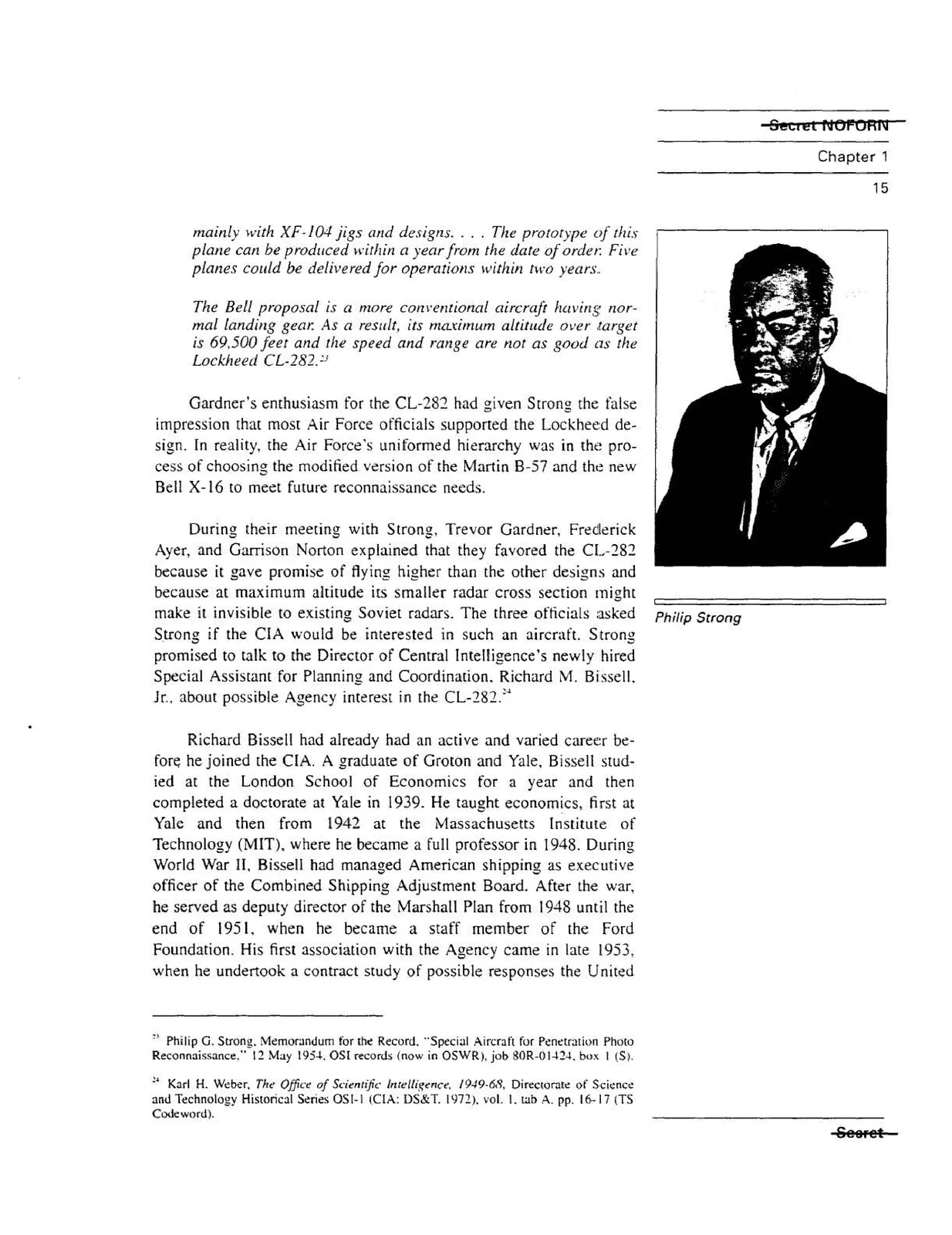
Set1 el NOP'OAN Chapter 1 15 mainly with XF-104 jigs and designs . ... The prototype of this plane can be produced within a year from the date oforder: Five planes could be delivered for operations within two years.. The Bell proposal is a more conventional aircrai having nor mal landing gear. As a result, its maximum altiwde over .rarget is 69,500 feet and the speed and range are not as good as the Lockheed CL-282. :; Gardner's enthusiasm for the CL-282 had given Strong the false impression that most Air Force officials supported the Lockhee:d de sign. (n reality, the Air Force's uniformed hierarchy was in the pro cess of choosing the modified version of the Martin B-57 and the new Bell X-16 to meet future reconnaissance needs. During their meeting with Strong, Trevor Gardner, Fredlerick Ayer, and Garrison Norton explained that they favored the CL-282 because it gave promise of flying higher than the other designs and because at maximum altitude its smaller radar cross section might make it invisible to existing Soviet radars. The three officials :asked S.trong if the CIA would be interested in such an aircraft. Strong promised to talk to the Director of Central Intelligence's newly hired Special Assistant for Planning and Coordination. Richard M. Bissell. Jr., about possible Agency interest in the CL-282.:"' Philip Strong Richard Bissell had already had an active and varied career be fore he joi ned the CIA. A graduate of Groton and Yale, Bissell stud ied at the London School of Economics for a year and then completed a doctorate at Yale in 1939. He taught economics, first at Yale and then from 1942 at the Massachusetts Institute of Technology (MIT), where he became a full professor in 1948. During World War II. Bissell had managed American shipping as executive officer of the Combined Shipping Adjustment Board. After the war, he served as deputy director of the Marshall Plan from 1948 until the end of 1951, when he became a staff member of the Ford Foundation. His first association with the Agency came in late 1953, when he undertook a contract study of possible responses the United '·' Philip G. Strong. Memorandum for the Record . ..Special Aircraft for Penetr:nion Photo Reconnaissance," 12 May 1954. OSI records (now in OSWR). job 80R-0l424. box I (Sl. '' Karl H. Weber. The Office of Scientific /r11elligence. /949-68. Directorate of Science and Technology Historical Series OSI-I (CIA: DS&T. I 971). vol. I. tab A. pp. 16- 17 (TS Codeword). Gee,et