The Central Intelligence Agency and Overhead Reconnaissance; The U-2 and OXCART Programs, 1954-1974
CIA-UAP-003 · page 30 of 406
Text
This text came with the file. It may have mistakes. When the text and the image disagree, the image is right.
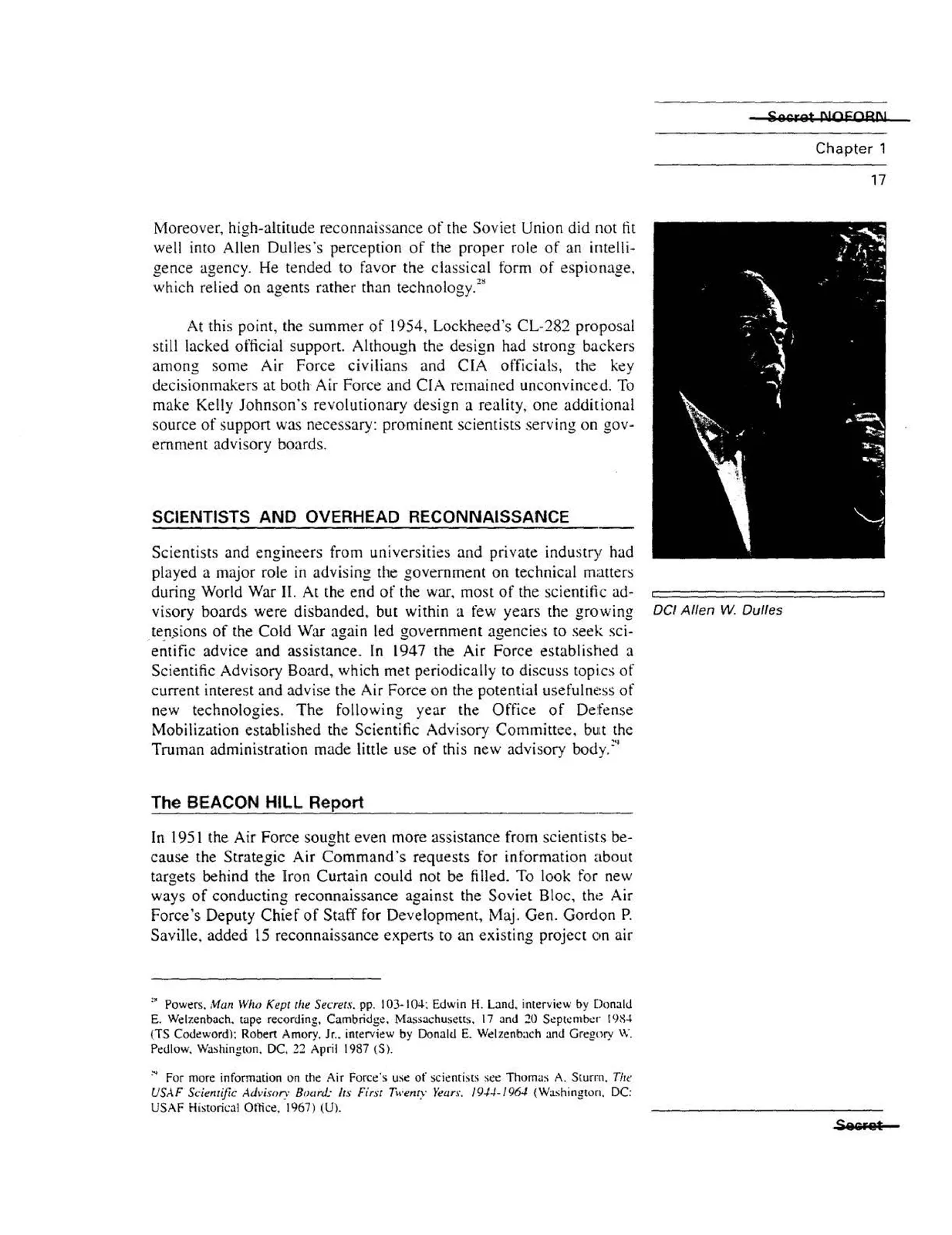
iac;ret l)IQFORL'I Chapter 1 17 Moreover, high-altitude reconnaissance of the Soviet Union did not fit well into Allen Dulles·s perception of the proper role of an intelli gence agency. He tended to favor the classical form of espionage, which relied on agents rather than technology. 1 s At this point, the summer of 1954, Lockheed's CL-282 proposal still lacked official support. Although the design had strong backers among some Air Force civilians and CIA officials, the key decisionmakers at both· Air Force and CIA remained unconvinced. To make Kelly Johnson's revolutionary design a reality, one additional source of support was necessary: prominent scientists serving on gov ernment advisory boards. SCIENTISTS AND OVERHEAD RECONNAISSANCE Scientists and engineers from universities and private industry had played a major role in advising the government on technical matters during World War II. At the end of the war, most of the scientific ad visory boards were disbanded, but within a few years the growing te_n_sions of the Cold War again led governmen t agencies to seek sci entific advice and assistance. In 1947 the Air Force established a Scientific Advisory Board, which met periodically to discuss topics of current interest and advise the Air Force on the potential usefulne:ss of new technologies. The following year the Office of Defense Mobilization established the Scientific Advisory Committee, bU1t the Truman administration made little use of this new advisory body.=-• DC/ Allen W. Dulles The BEACON HILL Report In 1951 the Air Force sought even more assistance from scientists be cause the Strategic Air Command's requests for information about targets behind the Iron Curtain could not be fl tied. To look for new ways of conducting reconnaissance against the Soviet Bloc, the Air Force's Deputy Chief of Staff for Development, Maj. Gen. Gordon P. Saville, added 15 reconnaissance experts to an existing project on air " Powers. Man Who Kept rhe Secrets. pp. 103-104: Edwin H. Land. interview by Donald E. Welzenbach. tape recording. Cambridge. Massachusetts. 17 and '.!0 Septembc:r 198.t (TS Codeword): Robert Amory. Jr .. interview by Donald E. Welzenbach and Gregory W. Pedlow. Washingt0n. DC. 22 April 1987 (S}. "' For more informa1ion on the Air Force·s use of sciemisL~ see Thomas A. Sturm. Tit<' USAF Scienrific Advisorv Board: Its First Twenty Years. /9.J.J. /964 (Washington. DC: USAF Historical Oftice. 1967) (U).