The Central Intelligence Agency and Overhead Reconnaissance; The U-2 and OXCART Programs, 1954-1974
CIA-UAP-003 · page 29 of 406
Text
This text came with the file. It may have mistakes. When the text and the image disagree, the image is right.
16
Chapter 1
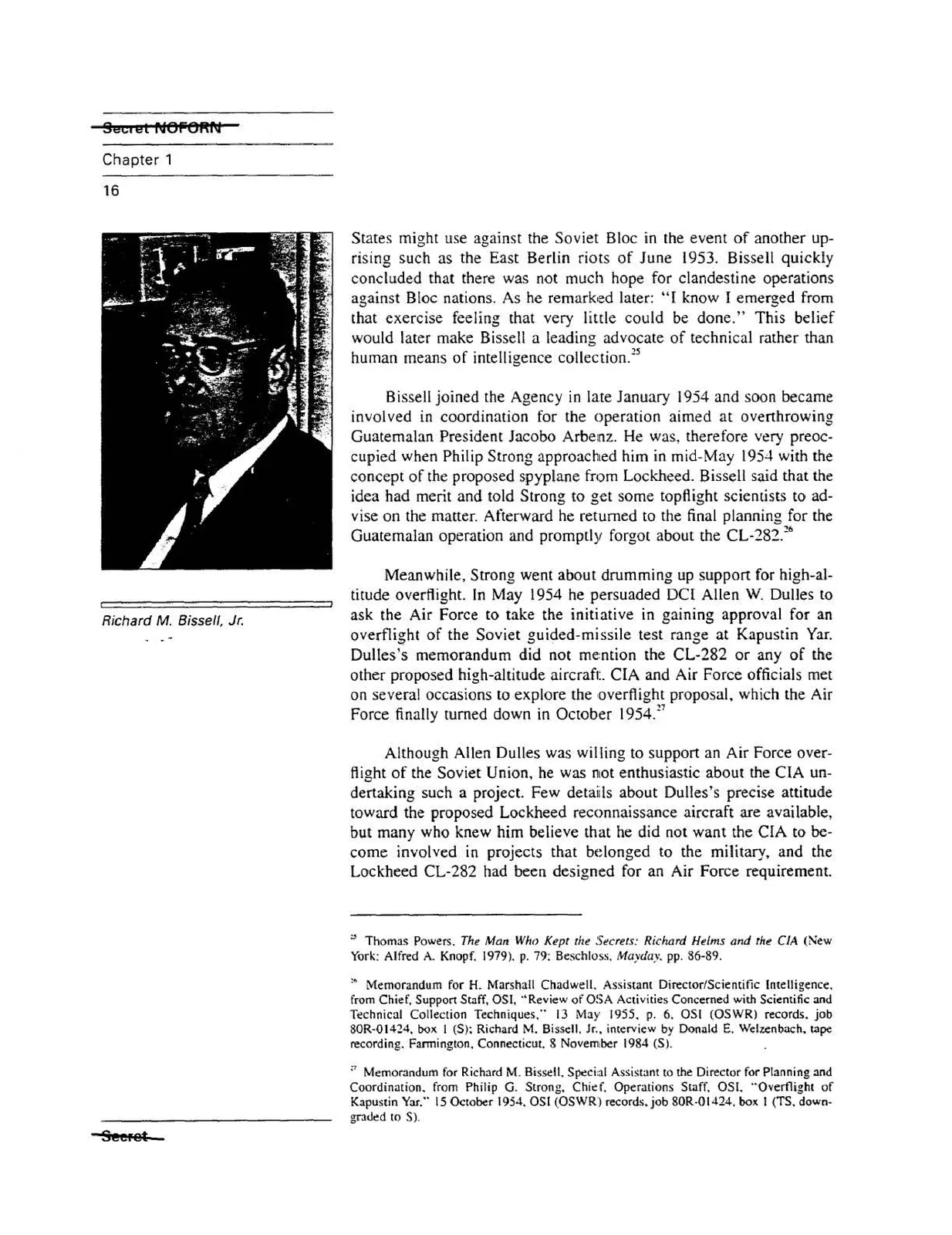
Richard M. Bissell, Jr.
States might use against the Soviet Bloc in the event of another up
rising such as the East Berlin riots of June 1953. Bissell quickly
concluded that there was not much hope for clandestine operations
against Bloc nations. As he remark,ed later: "I know I emerged from
that exercise feeling that very little could be done." This belief
would later make Bissell a leading advocate of technical rather than
human means of intelligence collection.
25
Bissell joined the Agency in late January 1954 and soon became
involved in coordination for the operation aimed a t overthrowing
Guatemalan President Jacobo Arbe1nz. He was, therefore very preoc
cupied when Philip Strong approached him in mid-May 1954 with the
concept of the proposed spyplane from Lockheed. Bissell said that the
idea had merit and told Strong to get some topflight scientists to ad
vise on the matter. Afterward he returned to the final planning for the
Guatemalan operation and promptly forgot about the CL-282.!
0
Meanwhile, Strong went about drumming up support for high-al
titude overflight. In May 1954 he persuaded DCI Allen W. Dulles to
ask the Air Force to take the initiative in gaining approval for an
overflight of the Soviet guided-missile test range at Kapustin Yar.
Dulles's memorandum did not me,ntion the CL-282 or any of the
other proposed high-altitude aircraft. CIA and Air Force officials met
on several occasions to explore the ,overflight proposal, which the Air
Force finally turned down in October I 954. !'
Although Allen Dulles was willing to support an Air Force over
flight of the Soviet Union, he was mot enthusiastic about the CIA un
dertaking such a project. Few detaiils about Dulles's precise attitude
toward the proposed Lockheed reconnaissance aircraft are available,
but many who knew him believe that he did not want the CIA to be
come involved in projects that belonged to the military, and the
Lockheed CL-282 had been designed for an Air Force requirement.
" Thomas Powers. The Man Who Kept the Secrets: Richard Helms and the CIA (New
York: Alfred A. Knopf. 1979). p. 79; Beschloss. Mayday. pp. 86-89.
,. Memorandum for H. Marshall Chadwell. Assistant Director/Scientific Intelligence.
from Chief. Support Staff, OSI. " Review of OSA Activities Concerned with Scientific and
Technical Collection Techniques:· 13 May 1955. p. 6. OSI (OSWR) records. job
S0R-0 1424. bo" I (S); Richard M. Bissell. Jr., interview by Donald E. Welzenbach. tape
recording. Farmington. Connecticut. 8 November 1984 {S).
" Memorandum for Richard M. Bissell. Speci,al Assistant to the Director for Planning and
Coordination. from Philip G. Strong, Chief. Operations Staff. OSI. --overflight of
Kapustin Yar.'' 15 October 1954. OSI (OSWR) records, job S0R-01424. bo" I (TS. down
graded 10 S).
Secret