The Central Intelligence Agency and Overhead Reconnaissance; The U-2 and OXCART Programs, 1954-1974
CIA-UAP-003 · page 302 of 406
Text
This text came with the file. It may have mistakes. When the text and the image disagree, the image is right.
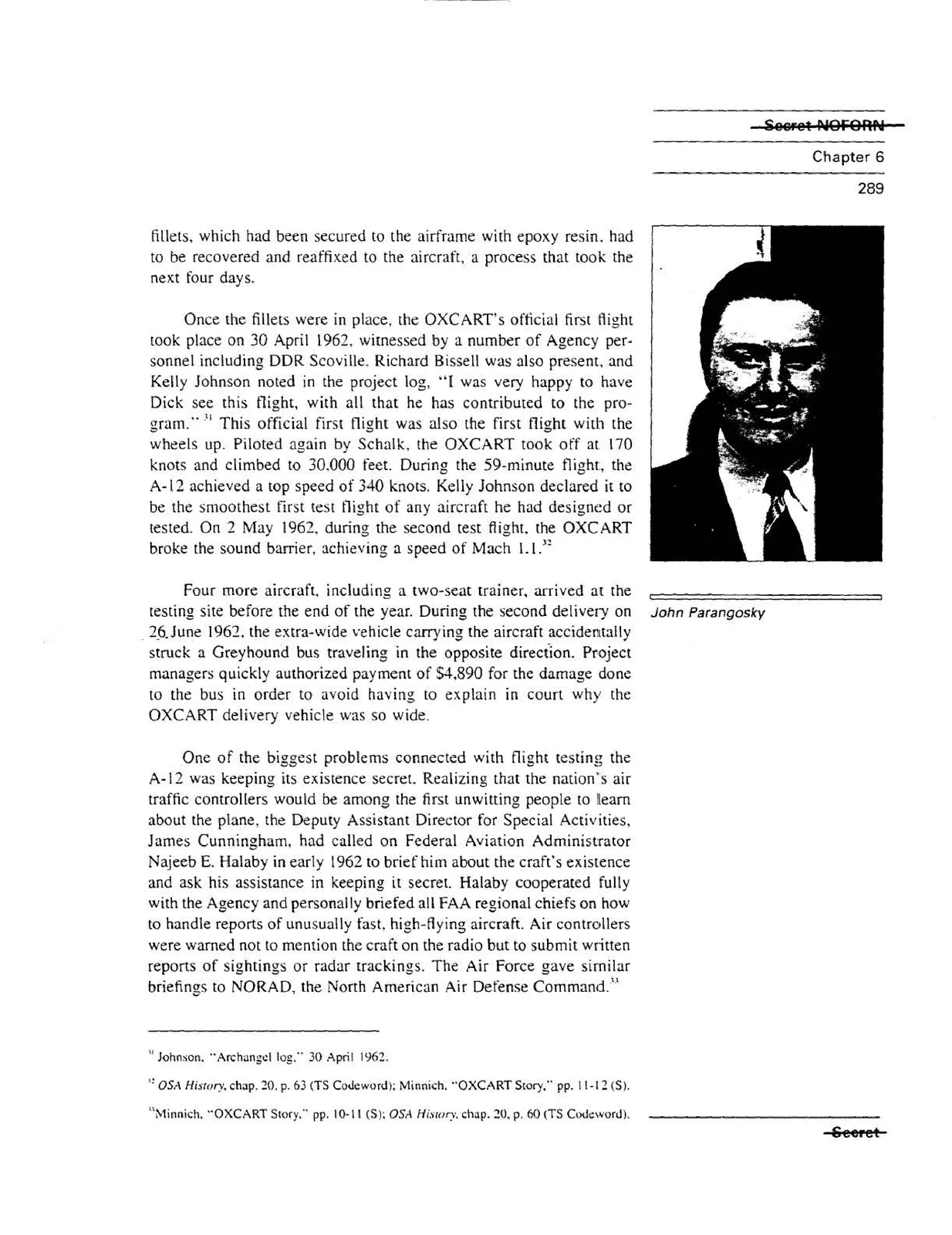
289 ieeret NOFORN Chapter 6 fillets, which had been secured to the airframe with epoxy resin. had to be recovered and reaffixed to the aircraft, a process that took the next four days. Once the fillets were in place, the OXCART'S official first flight t0ok place on 30 April 1962, witnessed by a number of Agency per sonnel including DOR Scoville. Richard Bissell was also present, and Kelly Johnson noted in the project log, ·•1 was very happy to have Dick see this flight, with all that he has contributed to the pro gram ... ·'' This official first flight was also the first flight with the wheels up. Piloted again by Schalk, the OXCART took off at 170 knots and climbed to 30.000 feet. During the 59-minute flight, the A-I2 achieved a top speed of 340 knots. Kelly Johnson declared it to be the smoothest first test flight of any aircraft he had designed or tested. On 2 May 1962, during the second test flight, the OXCART broke the sound barrier, achieving a speed of Mach l.1.) 1 Four more aircraft. including a two-seat trainer, arrived at the testing site before the end of the year. During the second delive,y on John Parangosky . 2~.June 1962. the extra-wide vehicle carrying the aircraft acciderntally struck a Greyhound bus traveling in the opposite direction. Pr-oject managers quickly authorized payment of $4,890 for the damage done to the bus in order to avoid having to explain in court why the OXCART delivery vehicle was so wide. One of the biggest problems connected with flight testing the A-I2 was keeping its existence secret. Realizing that the nation's air traffic controllers would be among the first unwitting people to llearn about the plane, the Deputy Assistant Director for Special Activities, James Cunningham, had called on Federal Aviation Administrator Najeeb E. Halaby in early 1962 to brief him about the craft's existence and ask his assistance in keeping it secret. Halaby cooperated fully with the Agency and personally briefed all FAA regional chiefs on how to handle reports of unusually fast, high-tlying aircraft. Air contrcillers were warned not to mention the craft on the radio but to submit written reports of sightings or radar truckings. The Air Force gave similar briefings to NORAD, the North American Air Defense Command:'' '' Johnson. •• Archangel log:· 30 April 1962. '' OSA History. chap. 20. p. 63 (TS CoJewor<l); Minnich. "OXCART Story:· pp. 11-12 (S). "Minnich. ··OXCART Story:· pp. 10-11 (S): OSA Hiswry. chap. 20. p. 60 (TS Co<lcworJ). Gee,et