The Central Intelligence Agency and Overhead Reconnaissance; The U-2 and OXCART Programs, 1954-1974
CIA-UAP-003 · page 40 of 406
Text
This text came with the file. It may have mistakes. When the text and the image disagree, the image is right.
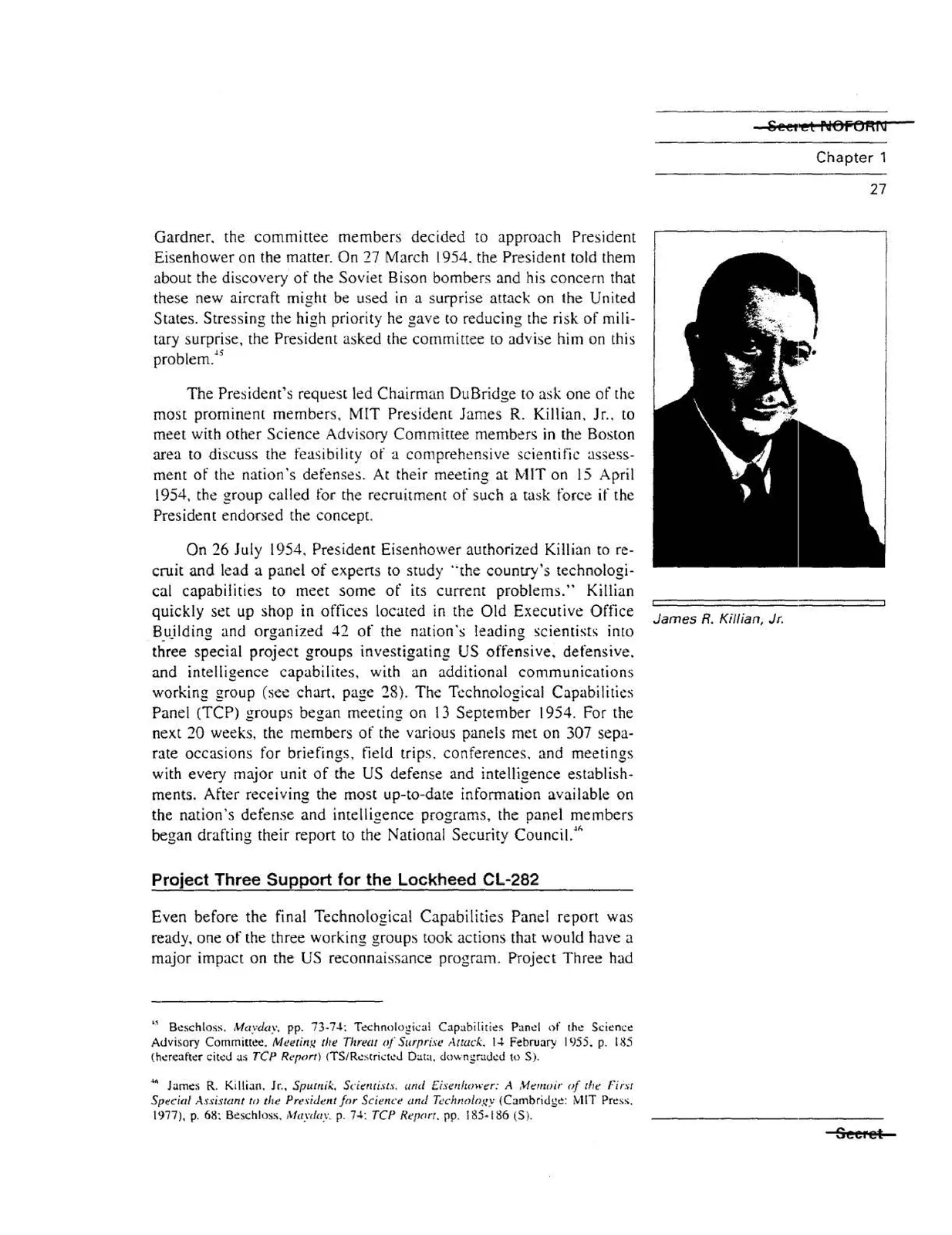
27 ~ et PdOfiOP\r\J Gardner. the committee members decided to approach President Eisenhower on the matter. On 27 March l 954. the President told them about the discovery of the Soviet Bison bombers and his concern that these new aircraft might be used in a surprise attack on the United States. Stressing the high priority he gave to reducing the risk of mili tary surprise, the President asked the committee to advise him on this problem.is T he President's request led Chairman DuBridge to ask one of the most prominent members. MIT President James R. Killian. Jr., to meet with other Science Advisory Committee members in the Boston area to discuss the feasibility of a comprehensive scientific assess ment of the nation's defenses. At their meeting at MIT on 15 April 1954, the group called for the recruitment of such a task force if the President endorsed the concept. On 26 July 1954. President Eisenhower authorized Killian to re cruit and lead a panel of experts to study "' the country's technologi cal capabilities to meet some of its current problems." Killian quickly set up shop in offices located in the Old Executive Office B_u_ilding and organized 42 of the nation's leading scientists into three special project groups investigating US offensive, defensive. and intelligence capabilites. with an additional communications working group (see chart. page 28). The Technological Capabilities Panel (TCP) groups began meeting on 13 September 1954. For the next 20 weeks, the members of the various panels met on 307 sepa rate occasions for briefings. field trips. conferences. and meetings with every major unit of the US defense and intelligence establish ments. After receiving the most up-to-date information available on the nation's defense and intelligence programs, the panel members began drafting their report to the National Security Council.'A Project Three Support for the Lockheed CL-282 Chapter 1 James R. Killian, Jr. Even before the final Technological Capabilities Panel report was ready. one of the three working groups took actions that would have a major impact on the US reconnaissance program. Project Three had " Beschloss. MC1ydav. pp. 73-7-': Technologii:al C:1pabili1ies Pan.:I of 1he Science Advisory Committee. Meeting the Threat of Surprise Auack. I-i February 1955. p. 185 (hereafter cited as TCP Report) CTS/Rcs1ri<:1eJ Dat:1. <lowngrnJed to S) . .. Jamc:s R. Killian. Jr.. Spmnik. Scie111ists. and Eisettlww,:r: A Memoir of the r;;_~t Special Assiswnr to the Pre.~ide11t for Science and Technology (Cambridge: MIT Press. 1977), p. 68: Beschloss. ,W<1yJay. p. 7-i: TCP Reporr. pp. 185- 186 (S). Secret