The Central Intelligence Agency and Overhead Reconnaissance; The U-2 and OXCART Programs, 1954-1974
CIA-UAP-003 · page 42 of 406
Text
This text came with the file. It may have mistakes. When the text and the image disagree, the image is right.
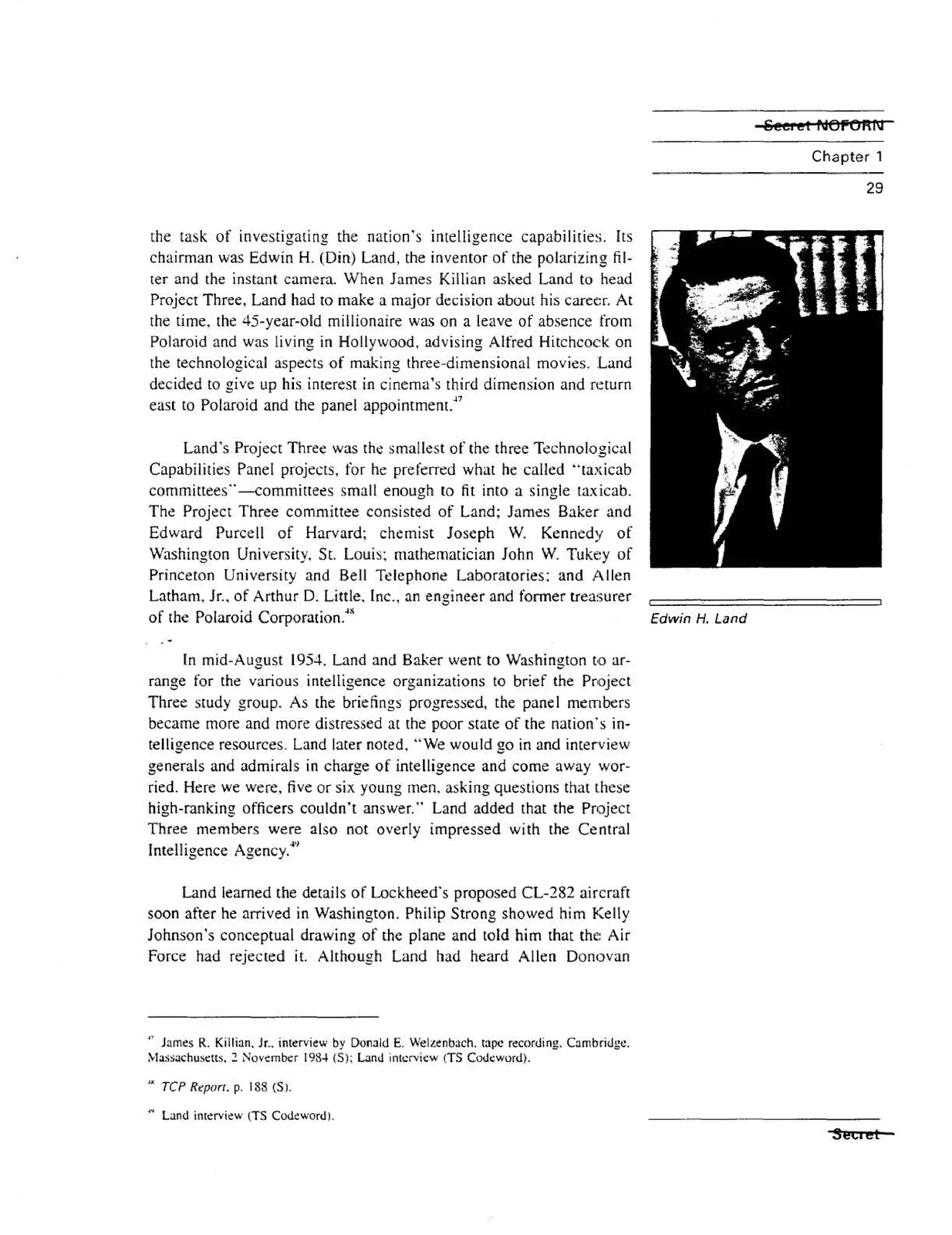
29 Sec, ct NOl'OP\111 Chapter 1 the task of investigating the nation's intelligence capabilities. Its chairman was Edwin H. (Din) Land, the inventor of the polarizing fil ter and the instant camera. When James Killian asked Land to head Project Three, Land had to make a major decision about his caree:r. At the time, the 45-year-old millionaire was on a leave of absence from Polaroid and was living in Hollywood, advising Alfred Hitchcock on the technological aspects of making three-dimensional movies. Land decided to give up his interest in cinema's third dimension and return east to Polaroid and the panel appointmem! 1 Land's Project Three was the smallest of the three Technological Capabilities Panel projects, for he preferred what he called " taxicab committees··-committees small enough to fit into a single taxicab. The Project Three committee consisted of Land; James Baker and Edward Purcell of Harvard; chemist Joseph W. Kennedy of Washington University, St. Louis: mathematician John W. Tuke:y of Princeton University and Bell Telephone Laboratories: and A llen Latham, Jr .. of Arthur D. Little. lnc., an engineer and former treasurer of the Polaroid Corporation:~ Edwin H. Land [n mid-August 1954. Land and Baker went to Washington t,o ar range for the various intelligence organizations to brief the Project Three study group. As the briefings progressed. the panel members became more and more distressed at the poor state of the nation's in telligence resources. Land later noted, "We would go in and interview generals and admirals in charge of intelligence and come away wor ried. Here we were, five or six young men. asking questions that these high-ranking officers couldn't answer." Land added that the Prnject Three members were also not overly impressed with the Central Intelligence Agency.~· 1 Land learned the details of Lockheed's proposed CL-282 aircraft soon after he arrived in Washington. Philip Strong showed him Kelly Johnson's conceptual drawing of the plane and told him that the: Air Force had rejected it. Although Land had heard Allen Donovan '' James R. Killian. Jr .. interview by Donald E. Welzenbach. tape recording. C:imbridgc. Massachusetts. 2 November 198-' (S); Land interview (TS Codcword). " TCP Report. p. 188 (S). ,., Land interview (TS Codeword). Sec,et