The Central Intelligence Agency and Overhead Reconnaissance; The U-2 and OXCART Programs, 1954-1974
CIA-UAP-003 · page 62 of 406
Text
This text came with the file. It may have mistakes. When the text and the image disagree, the image is right.
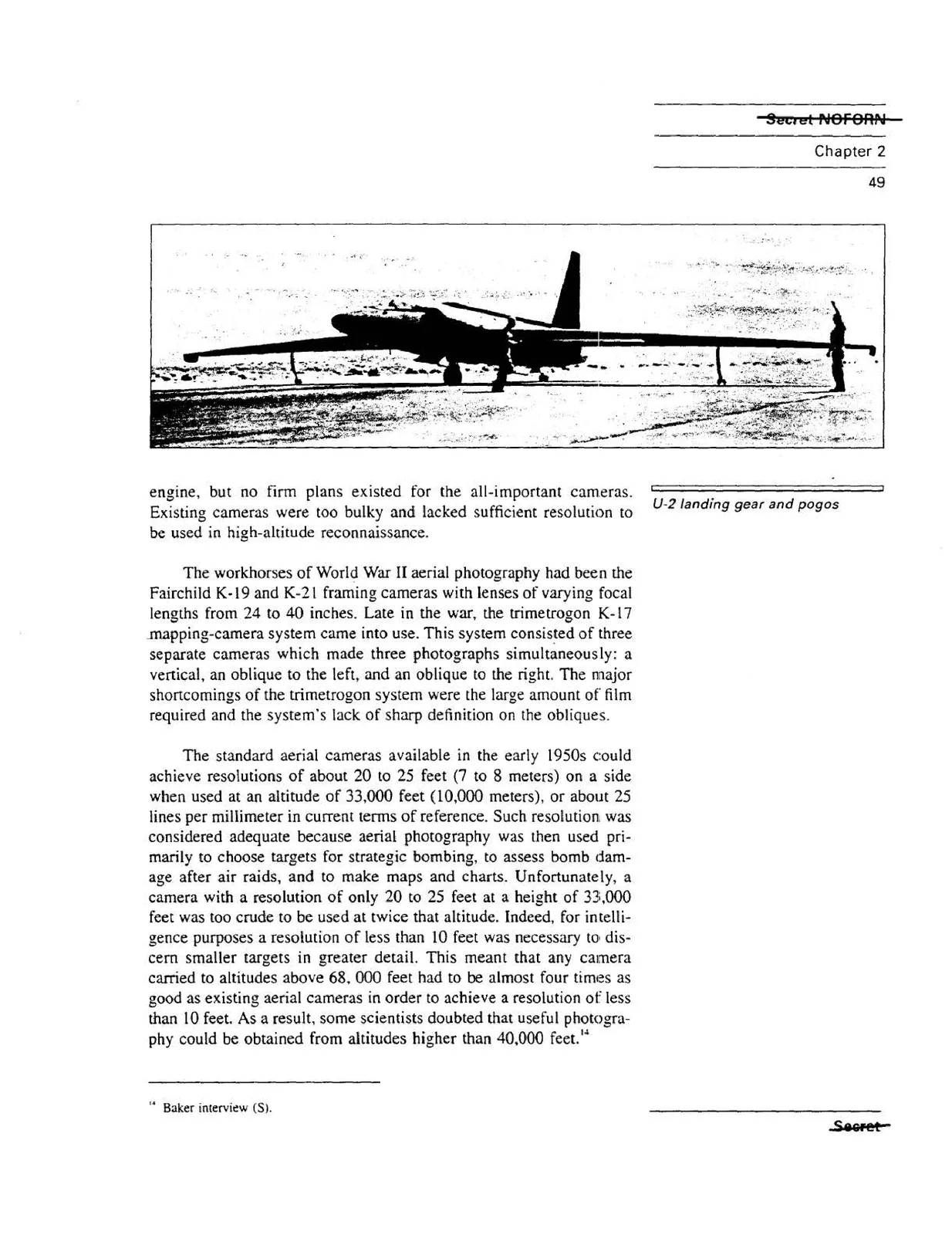
49 Sec. et NOFOAN Chapter 2 .. · . ·.• ,• .. • ~:; ..:. ~ .::,, ,',t •... . ," •. .:;~~~~;.\i ~1i: h -;.: .. . ... :~·-'~•-· . ___.-:.:.~~- ,:..-.... : .~:~~·~-~~~~:~;\ ~f~ '• .. :-'·· ~::....:,,.;_:,-:/~~ ~- :·.'.:~-:---·~,... engine, but no firm plans existed for the all-important cameras. Existing cameras were too bulky and lacked sufficient resolution to be used in high-altitude reconnaissance. The workhorses of World W'ilf II aerial photography had been the Fairchild K-19 and K-21 framing cameras with lenses of varying focal lengths from 24 to 40 inches. Late in the war, the trimetrogon K-17 .mapping-camera system came into use. This system consis~ed of lhree separate cameras which made three photographs simultaneously: a vertical, an oblique to the left, and an oblique to the right The major shortcomings of the trimetrogon system were the large amount of film required and the system's lack of sharp definition on the obliques. The standard aerial cameras available in the e'ilfly 1950s c:ould achieve resolutions of about 20 to 25 feet (7 to 8 meters) on a side when used at an altitude of 33,000 feet (10,000 meters), or about 25 lines per millimeter in current tenns of reference. Such resolution was considered adequate because aerial photography was then used pri marily to choose targets for strategic bombing, to assess bomb dam age after air raids, and to make maps and charts. Unfortunately, a camera with a resolution of only 20 to 25 feet at a height of 33,000 feet was too crude to be used at twice that altitude. lndeed, for intelli gence purposes a resolution of less than 10 feet was necessary to dis cern smaller targets in greater detail. This meant that any camera carried to altitudes above 68, 000 feet had to be almost four times as good as existing aerial cameras in order to achieve a resolution of less than 10 feet As a result, some scientists doubted that useful photogra phy could be obtained from altitudes higher than 40,000 feet.'" " Baker imervil!w (S). U-2 landing gear and pogos .Sea,et