The Central Intelligence Agency and Overhead Reconnaissance; The U-2 and OXCART Programs, 1954-1974
CIA-UAP-003 · page 63 of 406
Text
This text came with the file. It may have mistakes. When the text and the image disagree, the image is right.
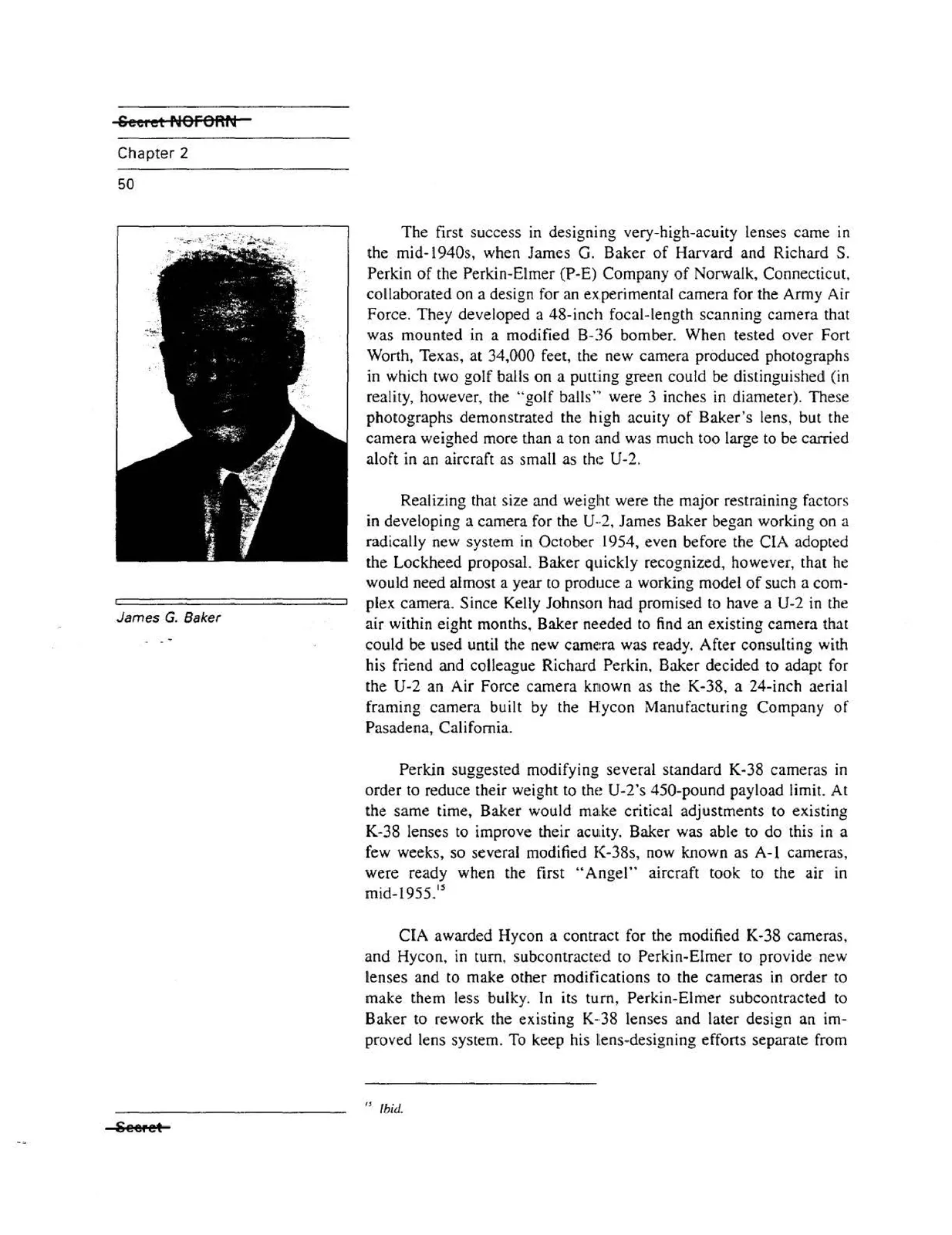
~ 50 Seeret NOFORN Chapter 2 + ·~;~ ,·\·~~:f~: .i ~ ~~\ ~ ;.;.,-::., . James G. Baker The first success in designing very-high-acuity lenses came in the mid- I940s, when James G. Baker of Harvard and Richard S. Perkin of the Perkin-Elmer (P-E) Company of Norwalk, Connecticut, collaborated on a design for an ex.perimental camera for the Army Air Force. They developed a 48-inch focal-length scanning camera that was mounted in a modified B-36 bomber. When tested over Fort Worth, Texas, at 34,000 feet, the new camera produced photographs in which two golf balls on a putting green could be distinguished (in reality. however, the "golf balls··· were 3 inches in diameter). These photographs demonstrated the high acuity of Baker's lens, but the camera weighed more than a ton and was much too large to be carried aloft in an aircraft as small as the U-2. Realizing that size and weiglht were the major restraining factors in developing a camera for the U--2. James Baker began working on a radically new system in October 1954, even before the CIA adopted the Lockheed proposal. Baker quickly recognized, however, that he would need almost a year to produce a working model of such a com plex camera. Since Kelly Johnson had promised to have a U-2 in the air within eight months, Baker needed to find an existing camera that could be used until the new came:ra was ready. After consulting with his friend and colleague Richard Perkin. Baker decided to adapt for the U-2 an Air Force camera krnown as the K-38. a 24-inch aerial framing camera built by the Hycon Manufacturing Company of Pasadena, California. Perkin suggested modifying several standard K-38 cameras in order to reduce their weight to the U-2's 450-pound payload limit. At the same time, Baker would ma:ke critical adj ustments to existing K-38 lenses to improve their acuiity. Baker was able to do this in a few weeks, so several modified K-38s, now known as A-1 cameras, were ready when the first "Angel" aircraft took to the air in mid-1955. 15 CIA awarded Hycon a contract for the modified K-38 cameras, and Hycon, in tum. subcontracte:d to Perkin-Elmer to provide new lenses and to make other modifications to the cameras in order to make them less bulky. In its tum, Perkin-Elmer subcontracted to Baker to rework the existing K-38 lenses and later design an im proved lens system. To keep his liens-designing efforts separate from " Ibid. See,et