The Central Intelligence Agency and Overhead Reconnaissance; The U-2 and OXCART Programs, 1954-1974
CIA-UAP-003 · page 94 of 406
Text
This text came with the file. It may have mistakes. When the text and the image disagree, the image is right.
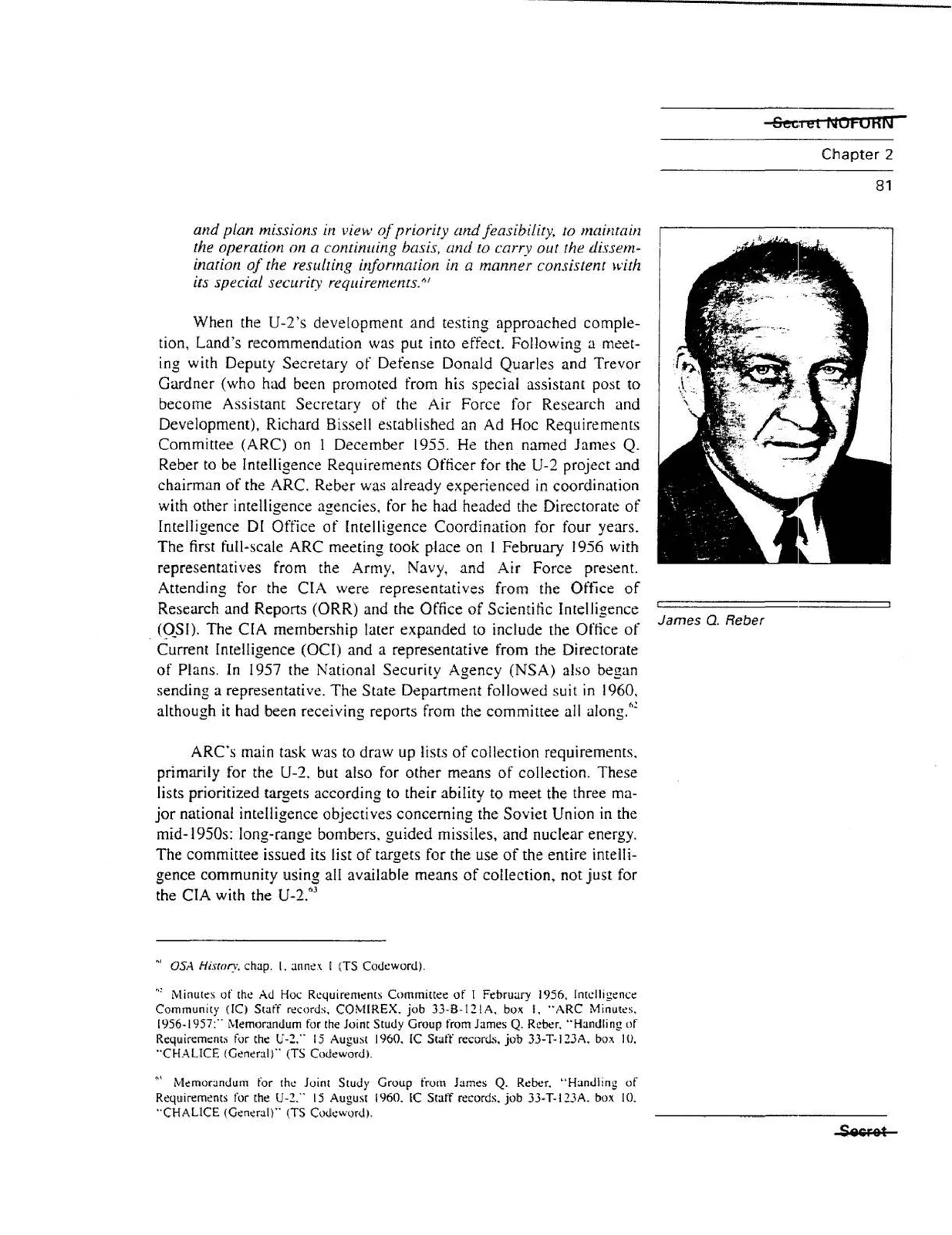
81 -&ec:t et rc:iOFORN and plan missions in view ofpriority and feasibility, to maintain the operation on a continuing basis, and to carry out the dissem ination of rhe resulting information in a manner consistent with its special security requirementsY When the U-2's development and testing approached comple tion, Land's recommendation was put into effect. Following a mt!et ing with Deputy Secretary of Defense Donald Quarles and Trevor Gardner (who had been promoted from his special assistant post co become Assistant Secretary of the Air Force for Research and Development), Richard Bissell established an Ad Hoc Requirements Committee (ARC) on I December 1955. He then named James Q. Reber to be Intelligence Requirements Officer for the U-2 project and chairman of the ARC. Reber was already experienced in coordination with other intelligence agencies, for he had headed the Directorate of Intelligence DI Office of Intelligence Coordination for four years. The first full-scale ARC meeting took place on I February 1956 with representatives from the Army, Navy, and Air Force present. Attending for the CIA were representatives from the Office of Research and Reports (ORR) and the Office of Scientific Intelligence . (QS I). The CIA membership later expanded to include the Office of Current Intelligence (OCI) and a representative from the Directorate of Plans. In 1957 the National Security Agency (NSA) also began sending a representative. The State Department followed suit in 1960. although it had been receiving reports from the committee all along.'~ AR C's main task was to draw up lists of collection requirements. primarily for the U-2. but also for other means of collection. These lists prioritized targets accordi ng to their ability to meet the three ma jor national intelligence objectives concerning the Soviet Union in the mid-1950s: long-range bombers, guided missiles, and nuclear energy. The committee issued its list of cargets for the use of the entire intelli gence community using all available means of collection, not j ust for the CIA with the U-2. 63 " OSA History. chap. I. annex I (TS Codeword). ' ' Minu1es of lh<! Ad Hoc Rcquiremc:n1s Commiuc:e of I February 1956. lmclligence Communi1y (IC) Staff records. COMIREX. job 33-B-1 21 A. boll I. "ARC Minu1cs. 1956-1957:'" Memorandum for the Joim Study Group from James Q. Reber. "Handling of Requirements for the U-2:· 15 August 1960. IC Staff records. job 33-T-123A. box 10. "CHALICE (GeneralJ" (TS Codeword>. " t,,lemorandum for lhc Joint S1udy Group from James Q. Rc:bcr. "Handling of Requirements for 1he U-2:· 15 August 1960. IC Staff records. job 33-T-123A. box I0. " CHALICE (Gen.:rall" (TS Cod.:worJ>. Chapter 2 James 0. Reber