The Central Intelligence Agency and Overhead Reconnaissance; The U-2 and OXCART Programs, 1954-1974
CIA-UAP-003 · page 95 of 406
Text
This text came with the file. It may have mistakes. When the text and the image disagree, the image is right.
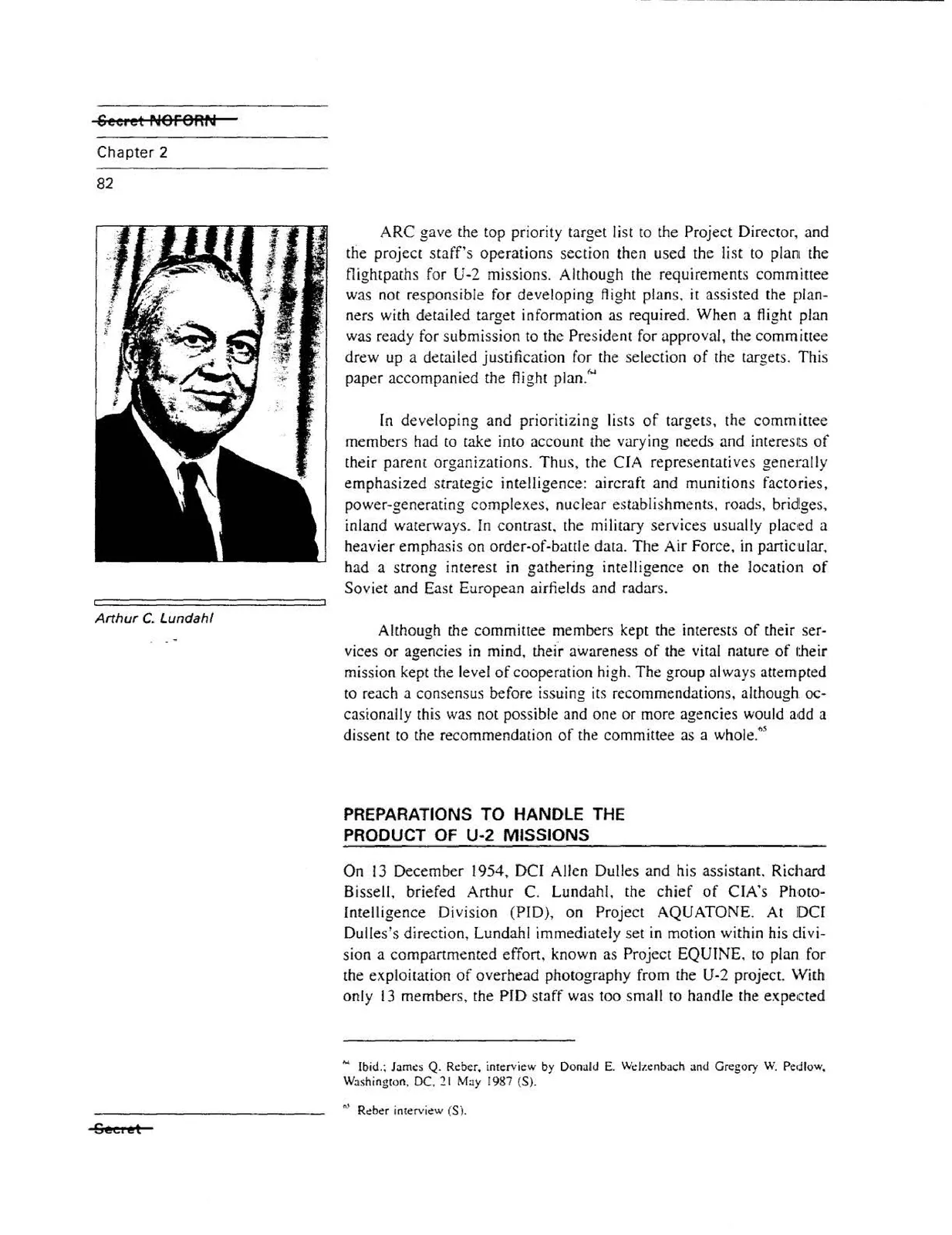
82 Gee, et NOFOAN Chapter 2 Arthur C. Lundahl ARC gave the top priority target list to the Project Director, and tlie project staff's operations section then used the list to plarn the tlightpachs for U-2 missions. Although the requirements committee was not responsible for developing flight plans. it assisted the plan ners with detailed target information as required. When a flight plan was ready for submission to the President for approval, the committee drew up a decailed justification for the selection of the targets. This paper accompanied the flight plan.(J [n developing and pnontIz1ng lists of targets, the committee members had to take into account the varying needs and interesIts of their parent organizations. Thus, the CIA representatives generally emphasized strategic intelligence: aircraft and munitions factories, power-generating complexes. nuclear establishments. roads. bridlges. inland waterways. In contrast, the military services usually plac,ed a heavier emphasis on order-of-baule data. The Air Force. in panicular. had a strong interest in gathering intelligence on the location of Soviet and East European airfields and radars. Although the committee members kept the interests of their ser vices or agencies in mind. their awareness of the vital nature of their mission kept the level of cooperation high. The group always attempted to reach a consensus before issuing its recommendations, although oc casionally this was not possible and one or more agencies would add a dissent to the recommendation of the committee as a whole." 5 PREPARATIONS TO HANDLE THE PRODUCT OF U-2 MISSIONS On 13 December 1954, DCI Allen Dulles and his assistant. Richard Bissell, briefed Arthur C. Lundahl. the chief of CIA's Photo Intelligence Division (PID), on Project AQUATONE. At !DC[ Dulles's direction, Lundahl immediately set in motion within his divi sion a compartmented effort, known as Project EQUINE, to plan for the exploication of overhead photography from the U-2 project. With only 13 members, the PID staff was too small co handle the expe,cted ~ lbi<l.: Jam.:s Q. Reber. interview by Donald E. Wd·lenbach and Gregory W. Pedlow. Wash ington, DC. 21 May 1987 (S). "' Reber interview (Sl. Gec,et