Los Alamos Conference on Aerial Phenomena, 1949
DOE-UAP-D004 · page 13 of 25
Text
This text came with the file. It may have mistakes. When the text and the image disagree, the image is right.
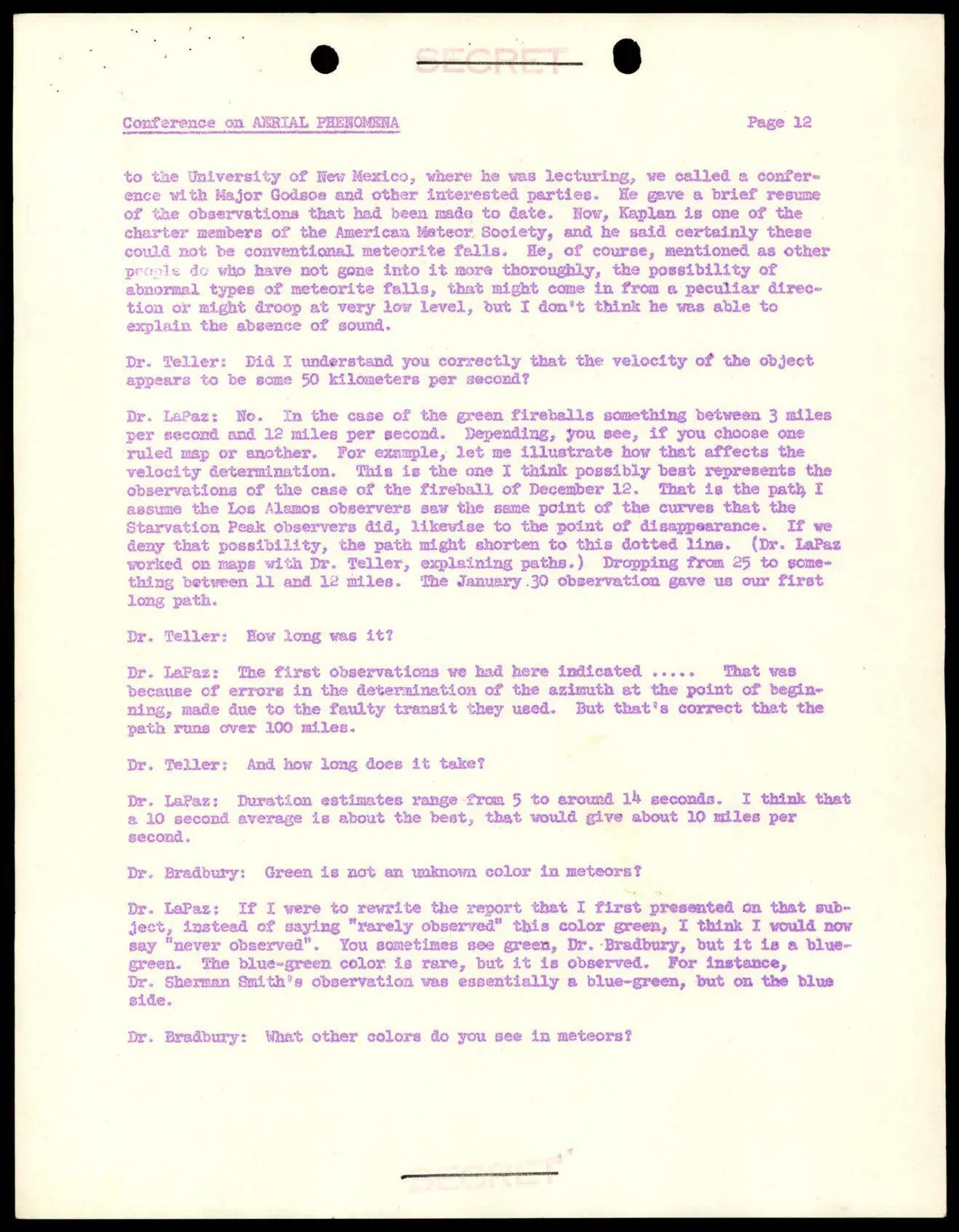
• Conference on AERIAL PRENOMENA Page 12 to t:1.e univers1ty of Neu Mexico, whert? h\9 was lecturiDS, we call.ed a confer ence Yith Major Godsoe and oth<?r interested. parties. Re ~ve a brief resume of t.~ observations that ha.d b:,en mado to date. Now, Kaplan is one or the charter members of the Americn:n. Iirtteor Sooiety, and he said certainly theee could not be conventional meteorite fe.11s. Re, of course, mentioned as other p<"' :,,h. do ub,o have not gone into it more thoroughly, the poeeibility of abnormal types o:f meteorite falls, tb.Bt misht come in trom a peculiar direc• tiOil or m1.ght droop at very l01r1 level, but I don't think he was able to ex:i>lain the absence ot sound. Dr. Teller: Did I und rstand you cor,:ectly that the velocity ot the object appears to be some 50 kilometers per second? Dr. Lo.Paz: No. In the case of the green i>ireballe sanething between 3 miles per second ond 12 miles per eecond. l)epeM.ing, you see, it you choose one ruled map or another. For exnnrple, let me illustrate how that aff"ects the velocity cleterm:l.nat1on. This is the one I th1nk poesibl7 best repre11ents the observations of the case ot the fireball of December 12. That is the pat~ I assu:ne the Los Alamos observers sav the same point of the curves that the Starvation Peak observers d1d, likevioe to the point ot disappearance. It we deny that possibility, the pathmipt shorten to this dotted Une. (Dr. LaPaz worked on maps ...ri~i.h Dr. Teller, explaining paths.) Drappillg from 25 to eome• thing betveen ll and 12 miles. The January . 30 observation gave us our first long path. Dr. Teller: J!ow long was it? Dr. La.Paz: The firet observatio~ we bad here indicated . . . . • That vss 'because of errors in the deter.llina.t1on ot the azimuth at t.b.e point of begin• ning, made due to the faulty transit they used. But that's correct that the path runs aver 100 miles. Dr. Teller: And how long does it take? Dr. La.Paz: Duration estimatec range t'rom 5 to around 14 secon.do. I think that a 10 second av-era&re is about the beat, that vould give about 10 miles per second. Dr. Bradbury: Green ie not an unknOffl'l. color in meteors! Dr. LaPa.z: If I were to rewrite the report that I first presented on that 8\lb ject, instead of oa.ying "re.rely observed 0 tbis color green, I think I woul4 DOY ea.y "never observed". You sometimes see green, Dr. ·Bradbury, but it 1a a blue green. The blue♦-g?"een color. ie rare., but it ie observed. Por instance, Dr. Shem.an Smith9s observation wae essentially a blue-green, but on the bluo side. Dr. Bradbury: What other colon do you see 1n meteors?