Los Alamos Conference on Aerial Phenomena, 1949
DOE-UAP-D004 · page 14 of 25
Text
This text came with the file. It may have mistakes. When the text and the image disagree, the image is right.
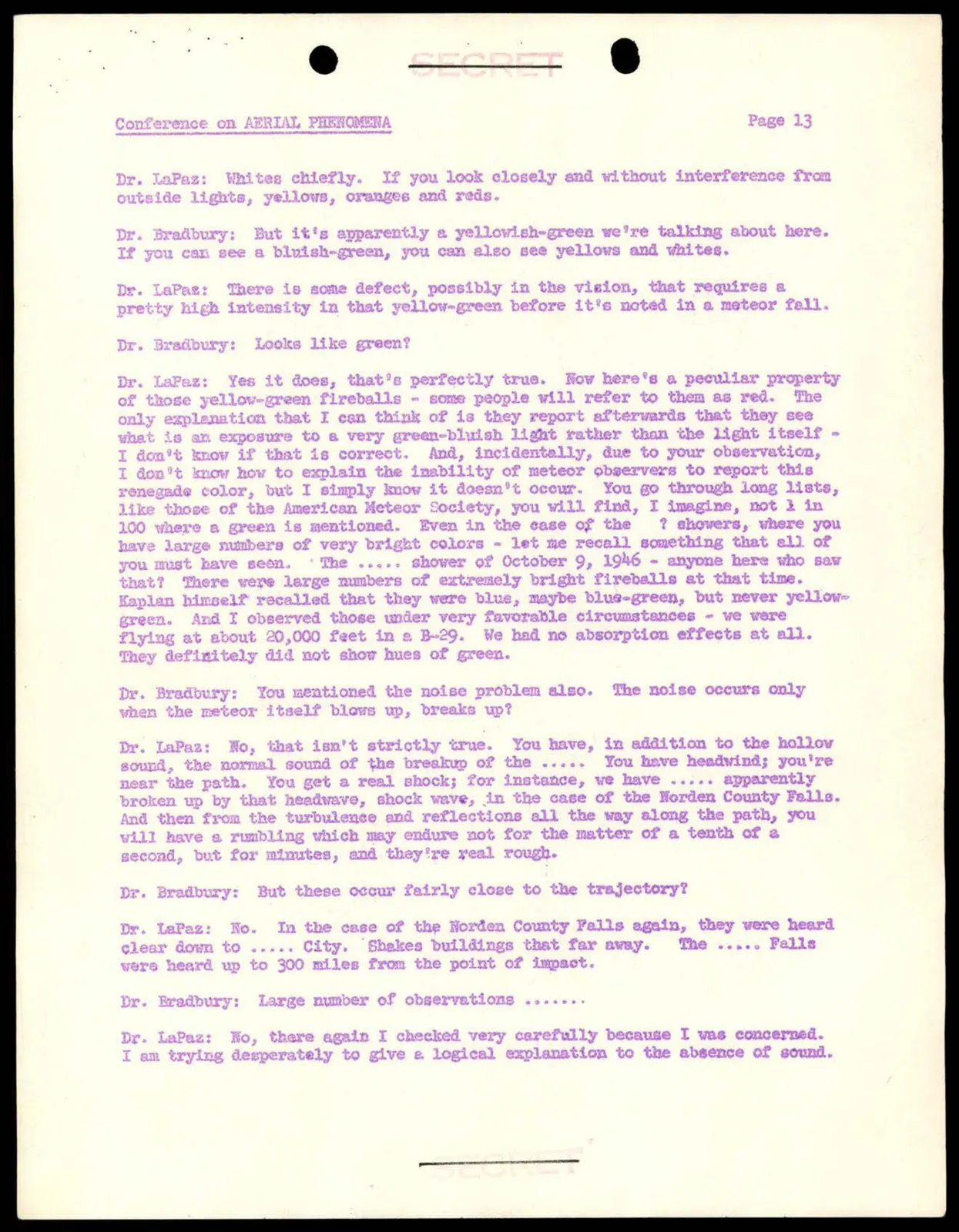
• Confe1·ence on AERIJ\.L PBENOMENA Page 13 Dr. :ta.Paz: mutee chiefly. If' you look closely snd Yithout interference 'from outside liglrts, yellmrs, oranges and reds. Dr. :era.clbury: But it's apparently a yellowish-green we 9re t.a.1k1ng G.bout here. If you can eee a bluish-green, you can aleo a,ee yellows and whites. Dr. laPaz: '!here is some defect, possibly in the vision, that %'8qu1ree a pretty high intensity in that yellow-green before it9s uoUd 1n a meteor fall. Dr. Bradbury: Looks like greenCZ Dr. LaI'az: Yes it does, that0s perfectly true. Now here's a peculiar property of thoae yellov.-gr"en fireballs - same people vill ref'er to them as red. The only exple..ne.tion that I can tbillk of is they report afterwards that they m:e what ~a@ exposure to a very green-blUioh light i"ather thnn -the Ugb.t itself• I donit lm.ov if that 1s correct. And, incidentally, due to your observation, I donqt kno\-r how to explain the ina.bility of meteor 9baervers to report this :;.-enega.d color, but, I eim;ply know it doesn't occur. You So through long lists, like those of the American Meteor Society, you will tilld, I i.JDaSi.ne, not l 1n 100 where a geen is mentioned. Even in the case of the ? ehowere, were you have largo nUinbera of very brigt.t colors• let me recall eooiething that allot you must have seen. The • • • • • shower of Oetober 9, 1946 - ~ here who so.v that? '!'here veN large numbers ot e:.ctremelJ bright fireball.a at that ti?r.e. 0 Kaplan himaelf' recalled that they were blue, maybe blus•sreen, but never yellow green. And I observ~d those und.er very to.vorable circumstances - ve were ny1ns a.t about 20.,000 f et in e. B-29. We had no absorption ettecta at ell. They def'ir:ite1Y' did not shov hues or green. Dr. Bradbury: You mentioned the noiae problem also. The noise occurs only when ·the meteot' i tselt blows up, breaks up? D:t•. La.Paz: No, tb&t isn't strictly ·i;rue. You have, in addition to the hollow sound, the normal sound of ~ breaku!) of the • • • • • You have headwind; you're near the path. You get a real ahock; 'to-r 1J1Stance, we have ••••• apparently broken up by that hea.dwave, shock wave, _in the caee ot the !ford.en County-P'alla. And then from the turbulence and retlections eJ.l the way along the path,~ liill have a. rumbling 'Qbich nyxy endure oot for the matter~ a tenth of a second, bQt for m1nutee, and they~re rw rough. Dr. Bradb"UrY: But these occur fairly close to the tra,Jeetory? Dr. Le.Paz: Ro. In the case ot ~ Norden County Fells aaa,n, they were heard clear doim to . . . . . City. •Shakes buildings that rar away. The •••• o Pe.Us were> heard up to 300 miles from the point ot 1-()act. Dr. ~48.dbury: Large number of observations ••.••.. Dr. LaPa.z: Bo, the.re again I checked very care:tw.ly because I we concerned. I am trying desp<erately to give e. logical explanation to the abaence ot 8011Dd.