UAP Reported at Sandia Base, 1948-1950
DOW-UAP-D017 · page 10 of 116
Text
A machine read this text from the scan. When the text and the image disagree, the image is right.
SECRET

August 17, 1949

TO: Colonel Doyle Rees

FROM: Lincoln LePaz

SUBJECT: Anomalous Luminous Phenomena. Sixth Report (attempts to collect volatili-zation products from green fireballs)

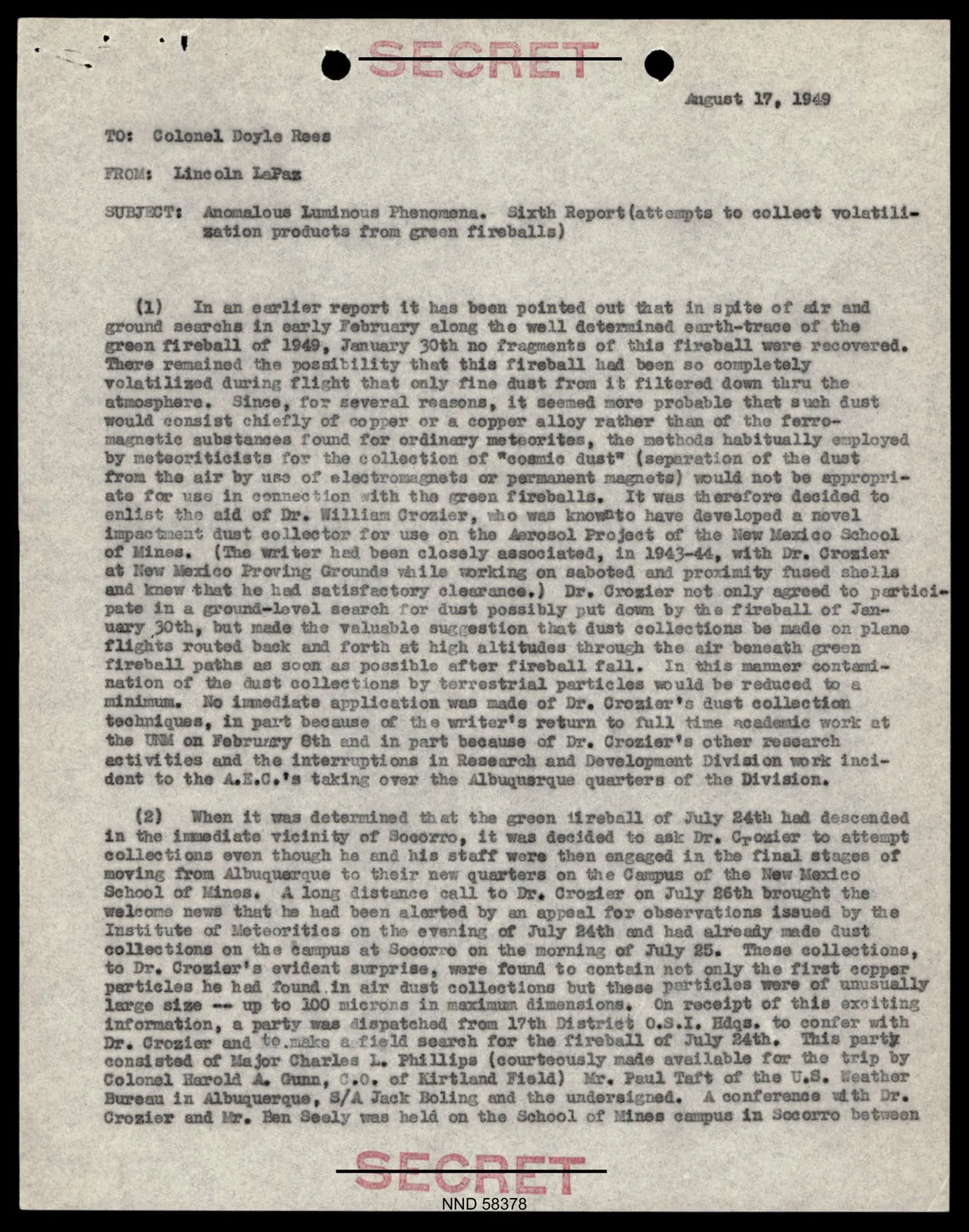
(1) In an earlier report it has been pointed out that in spite of air and ground searches in early February along the well determined earth-trace of the green fireball of 1949, January 30th no fragments of this fireball were recovered. There remained the possibility that this fireball had been so completely volatilized during flight that only fine dust from it filtered down thru the atmosphere. Since, for several reasons, it seemed more probable that such dust would consist chiefly of copper or a copper alloy rather than of the ferro-magnetic substances found for ordinary meteorites, the methods habitually employed by meteoriticists for the collection of "cosmic dust" (separation of the dust from the air by use of electromagnets or permanent magnets) would not be appropriate for use in connection with the green fireballs. It was therefore decided to enlist the aid of Dr. William Crozier, who was known to have developed a novel impactment dust collector for use on the Aerosol Project of the New Mexico School of Mines. (The writer had been closely associated, in 1943-44, with Dr. Crozier at New Mexico Proving Grounds while working on saboted and proximity fused shells and knew that he had satisfactory clearance.) Dr. Crozier not only agreed to participate in a ground-level search for dust possibly put down by the fireball of January 30th, but made the valuable suggestion that dust collections be made on plane flights routed back and forth at high altitudes through the air beneath green fireball paths as soon as possible after fireball fall. In this manner contamination of the dust collections by terrestrial particles would be reduced to a minimum. No immediate application was made of Dr. Crozier's dust collection techniques, in part because of the writer's return to full time academic work at the UNM on February 8th and in part because of Dr. Crozier's other research activities and the interruptions in Research and Development Division work incident to the A.E.C.'s taking over the Albuquerque quarters of the Division.

(2) When it was determined that the green fireball of July 24th had descended in the immediate vicinity of Socorro, it was decided to ask Dr. Crozier to attempt collections even though he and his staff were then engaged in the final stages of moving from Albuquerque to their new quarters on the Campus of the New Mexico School of Mines. A long distance call to Dr. Crozier on July 26th brought the welcome news that he had been alerted by an appeal for observations issued by the Institute of Meteoritics on the evening of July 24th and had already made dust collections on the campus at Socorro on the morning of July 25. These collections, to Dr. Crozier's evident surprise, were found to contain not only the first copper particles he had found in air dust collections but these particles were of unusually large size -- up to 100 microns in maximum dimensions. On receipt of this exciting information, a party was dispatched from 17th District O.S.I. Hdqs. to confer with Dr. Crozier and to make a field search for the fireball of July 24th. This party consisted of Major Charles L. Phillips (courteously made available for the trip by Colonel Harold A. Gunn, C.O. of Kirtland Field) Mr. Paul Taft of the U.S. Weather Bureau in Albuquerque, S/A Jack Boling and the undersigned. A conference with Dr. Crozier and Mr. Ben Seely was held on the School of Mines campus in Socorro between

SECRET

NND 58378