Department of the Air Force Report, 1996
DOW-UAP-D048 · page 42 of 181
Text
This text came with the file. It may have mistakes. When the text and the image disagree, the image is right.
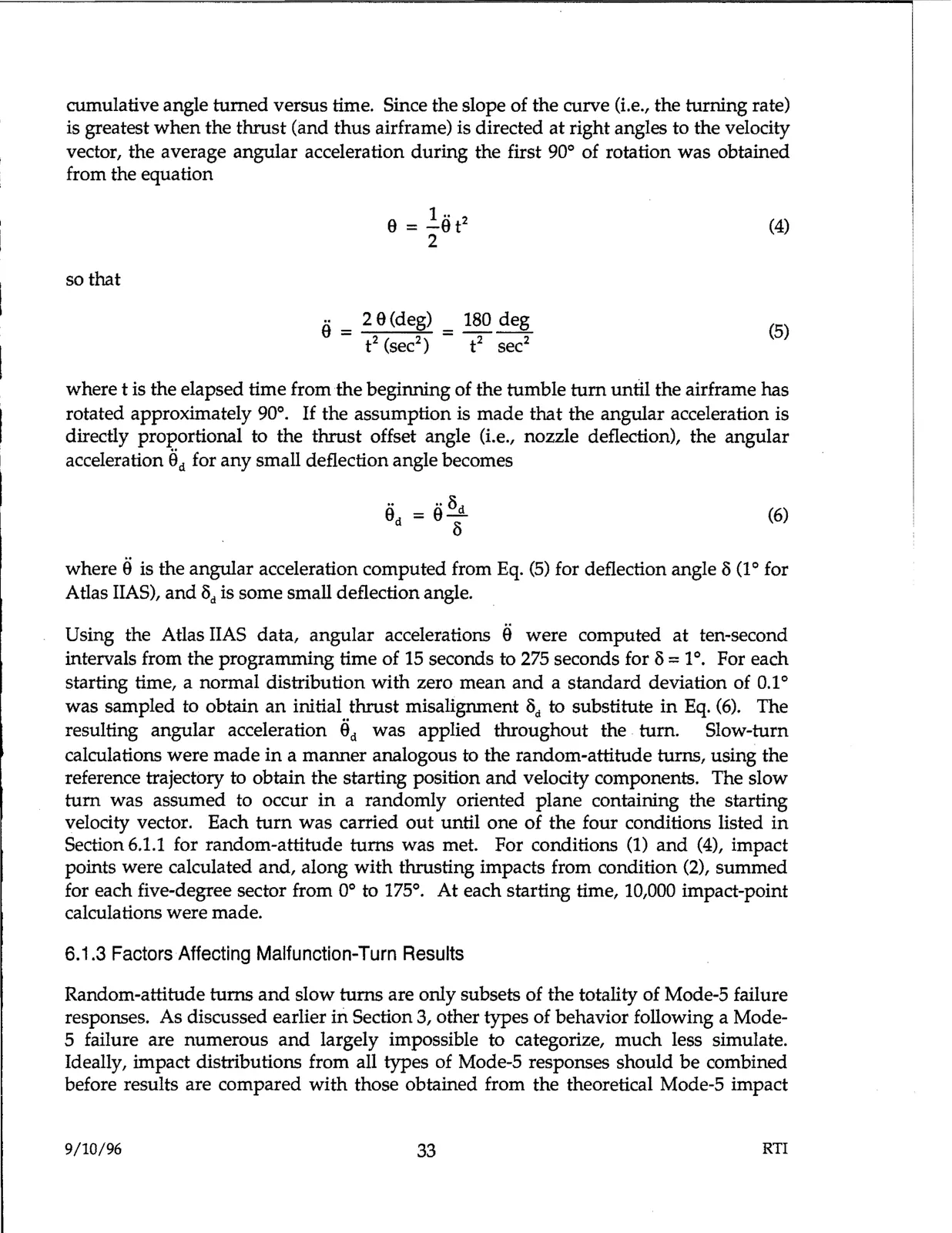
cumulative angle turned versus time. Since the slope of the curve (i.e., the turning rate)
is greatest when the thrust (and thus airframe) is directed at right angles to the velocity
vector, the average angular acceleration during the first 90° of rotation was obtained
from the equation
(4)
so that
8 = 2 8(deg) = 180 deg
(5)
t2 (sec2 )
t2 sec2
where t is the elapsed time from the beginning of the tumble tum until the airframe has
rotated approximately 90°. If the assumption is made that the angular acceleration is
directly proportional to the thrust offset angle (i.e., nozzle deflection), the angular
acceleration 0d for any small deflection angle becomes
(6)
where 0 is the angular acceleration computed from Eq. (5) for deflection angle 6 (1° for
Atlas IIAS), and 6d is some small deflection angle.
Using the Atlas IIAS data, angular accelerations 8 were computed at ten-second
intervals from the programming time of 15 seconds to 275 seconds for 6 = 1°. For each
starting time, a normal distribution with zero mean and a standard deviation of 0.1°
was sampled to obtain an initial thrust misalignment 6d to substitute in Eq. (6). The
resulting angular acceleration 8d was applied throughout the. tum.
Slow-tum
calculations were made in a manner analogous to the random-attitude turns, using the
reference trajectory to obtain the starting position and velocity components. The slow
turn was assumed to occur in a randomly oriented plane containing the starting
velocity vector. Each turn was carried out until one of the four conditions listed in
Section 6.1.1 for random-attitude turns was met. For conditions (1) and (4), impact
points were calculated and, along with thrusting impacts from condition (2), summed
for each five-degree sector from 0° to 175°. At each starting time, 10,000 impact-point
calculations were made.
6.1.3 Factors Affecting Malfunction-Turn Results
Random-attitude turns and slow turns are only subsets of the totality of Mode-5 failure
responses. As discussed earlier in Section 3, other types of behavior following a Mode-
s failure are numerous and largely impossible to categorize, much less simulate.
Ideally, impact distributions from all types of Mode-5 responses should be combined
before results are compared with those obtained from the theoretical Mode-5 impact
9/10/96
33
RTI