Project Sign Progress Report, 1948
DOW-UAP-D097 · page 37 of 45
Text
This text came with the file. It may have mistakes. When the text and the image disagree, the image is right.
\
I
THE AEROPLANE
186
FEBRUARY 13, 1948
C..HlUr of the "well-tried " convention,
.. normal " wings.
For the c reasons. a study of. the hi\lory of the u'IC of low
asp,.-ct. rat,o) m wing de:.11n will be of interest.
Sp1ruually, the fathers of uch acronauucal exhibits were
Ens!"hmen. 1 hey were people of good reputation ttnd by
no _me.ins suspect o( aerodynamic perversion.
F. W. Lanchcstcr was undoubtedlf the first acrodynamici,t
to g,~e thought to aeroplane winis ot circular or squ.irc ,hapc.
lo ht) bool.. publl\hcd m 1907, he referred c'<prcssivcly 10 ~uch
"aptcrold" wmii hnpc~ {F1a. 2) i,nd advanced the view that
Nc11.ton's law wa, valid for these. 1he correctncs; of thi~
Fig. 3.-A simple experiment In annular .ierofolls.
vie\\ wa~ c~pcrimentally proved 30 ~cars later.
In a prev1ou\ article on " Stalling Characteristics of Taille-.s
Aeropl.rne~ •• ( lttE AFROl'LANI:. for August IS. 1947), tl,e early
mtcrc-.t tal..cn by F. <i:iow Sir Frederick) Handley Pa~e m the
stalling quahucs of wmgs of low aspect rauo was mentioned.
He showed, 10 a pap~r read an April. 1911. that marginal vortices
and pressurc-equalmng flow around the tips were respon~iblc
for the delay of flow separation which h.id been obmved at
high incidence).
He stated. in this connection:-•· . .. With planes of high
aspect ratio _(I.e.. with slender wings of normal span chord
rnllo), \here " not the same facility for the " feedmg m " of
f_rcsh air at the plane sides (i.e .. nt the wing tips) 10 act as a
l~nk between the plane and the live stream. and therefore the
live stream leaves the plane's b11ck at .in earlier st11i;e than in
the ca,e of the plane of lower aspect ratio...."
He then
sho11.,ed_ some experimental evidence for the delay of flow
separauon with decrease of the aspect ratio and for the greater
Fig. 4.-Prlnclple or th• Huth annular-biplane system.
maximum lift of such wing~.
. When Lanches.tcr published his bool.., man was ju~t begin
main wing. the tailless aeroplane is created.
For all these
nma to_spre~d his wmgs. and in order 10 fly with a minimum
arrangements. the condition is that, in the case of a wina com
ellpend1ture m power, wini:s of fair aspect ratio were a neccs
s11y.
Neverthele\s, there were a few early aeroplanes. notably
pmed of normal (unstable) aerofoil ~lions. the stabilizin&
aerofoil exens a certain leverage in relation to the centre of
the little :· Demo1~lle •• monoplane of Santos Dumont (1909
gravity of the aircraft.
19 !0l, which had an aspect ratio of only 2 and proved to be
quIle \Ucces,ful.
Another possibility is to combine two lifting winas so that
they will stabilize and balance each other. For this purpose, all
One o( the earlie~t attempts at a genuine •· apteroid" 11cro
plane was an experiment by a German architect, Flick-Remig
that is required is that the front wing shall possess, at all inci
dence, of.flight, a greater effective incidence than the rear wiog.
( 1910). It had a span of 7j ft .. and performed in hops only.
In other words. the centre of gravity must be nearer to the
le.iding wing than to the traili9g wing, and the whole arrange
Annular Aerodynamks
ment must be balanced accordmgly. In this way, we arrive at
A ,1mple experiment with ~ome paper and a pair of sci,sor;
the conception of a stable tandem aeroplane.
shows that the ~inl..ing speed of a circular disc loaded with a
If we now take such a tandem arrangement and sweep the
paper clip is decreased when a hole of suff1e1ent diameter is cut
leading wing back and the trailing wina correspondingly forward
out in the centre (Fig. 3). This justifies the development from
so that the tips of both wings merge into each other, we obtain
the circular d1-.c wmt; to the annular aerofoil. The theory of
an annular or ring-shaped wing system. Aerodynamically, it is
the phenomenon i~ still somewhat obscure.
of minor importance if the shape is actually circular or oval,
(Having tried thl\ experime01. we can confirm that the char
or 1f triangular or quadrangular shapes con,titute the wing. For
acteristics of an annular aerofoil are certainly very different
,implicity's ..ake, in all such cases considered here, the term
from those of the plain d1-.c aerofoil. Our own experiment,
.. annular" 1, applied.
11.cre admittedly somewhat lim1ted in scope and we were unable
As mentioned, the aerodynamics of such shapes cannot yet
!O form more than an imprc~10n of the relauve sinking ,peed,:
be considered as fully established. But it i, proved that longi
II did, howev~r. arpcar to be le,~ with the annular aerofoil. Our
tudinally stable wing systems can be obtnined with such shapes.
mam conclu\lon, w•!re that cutting a 2.25-in. diameter hole in
Some type~ relying on such wings have shown quite remarkable
a .5 37S-in. diameter disc. resulted in a much flatt.er glide; the
llying qualiue~. It is also pos,ible that, with annular wings. the
,tall 11.,1, not ,o abrupt. and the stability in the glide wa,
induced drai; i, less than with conventional wings of equiva
1mpm,cd. We were so fascinated with the e>tperiment th.it we
lent aspect ratio.
hope to repeat u ,U a later date on a more ..c:1entific levcl.- Eo.)
In common with circular wing,. annular wings have the
fhe conven11onal aeroplJne " constituted of two ba\ic aero
remarl..able property that the lift force ,teadily increases with
frnh: a "ing (,, h1ch ,uppl1e~ the lift) and ri tail (,, hich balances
incidence up to fairly high values without a stall.
For all
and ~tabilize~ the wing). We I.now that \Uch an arrangement
I.no" n arrangements the maximum lift seem, 10 occur at
o.f the 111.0 aerofoil compnnenh i, by no mean, the only pos
incidences exceeding 30 degree,.
A, ,uch high angle~ of
\tblc one.
The balancing .ind st11b1lmng aerofoil (tailplane)
incidence are not likely 10 be reached an flight unintentionally.
need not to be aft of the lifting wing a, a tail.
It can be
It 1s obv1ou, "hy annular wings have become renowned for
arranged anywhere 1n relation to the wing. e.g .. above It, belo11.
their good-natured flying charac1eri,1il:,.
it. or in front of it.
Another property of annular wings (first establi,hed by
If the balancing aerofoil i, in front of the main win~. the aero
Tilghman Richard,) i, that the centre of pre,sure of ,uch wing
plane i~ of the tail-first type. and if it i, attached to the
,y,tcm, i, nearly stationary in flight, or that a travel of the
centre of pre,wre can be obtained which i, po,itively stable
unul incidences of the order of 18 degree are reached.
In
fact. no case of longitudmal in,tabihty ha, ever been reponcd
w11h an annular wing. although the centre of gravity has often
been located d:ingerou,ly far back.
The fi~t annular-wing aeroplane dates bacl.. 10 1908.
It
h,1d little succe\\.
Two type, 11.ere con~tructed m ,ucces\ion
tu the de,1gns of a capable German aeronautical engineer, Fritz
Huth. who "as by profe\\1on a teacher at a technical ,;chool
( f-tg,. 4 and 61.
The ,econd type. which had a less elaborate
a1r,crcw drive. flew in May. 1910: it wa,. however. ,o devoid
of performance. in spite of a SO b.h.p. engine. that it was soon
,1f1erv.ards d1..carded as a hopeless proposition.
Britain'~ Fir..1 Doughnut
The Bri11,h concepuon of the idea has been for more
,ucccs,ful.
A, it i, cun,1i1u1ed, until now. the best tried
reprc,cntativc. it~ hi,1ory may be given somewhat more
c,1cn,1vcly.
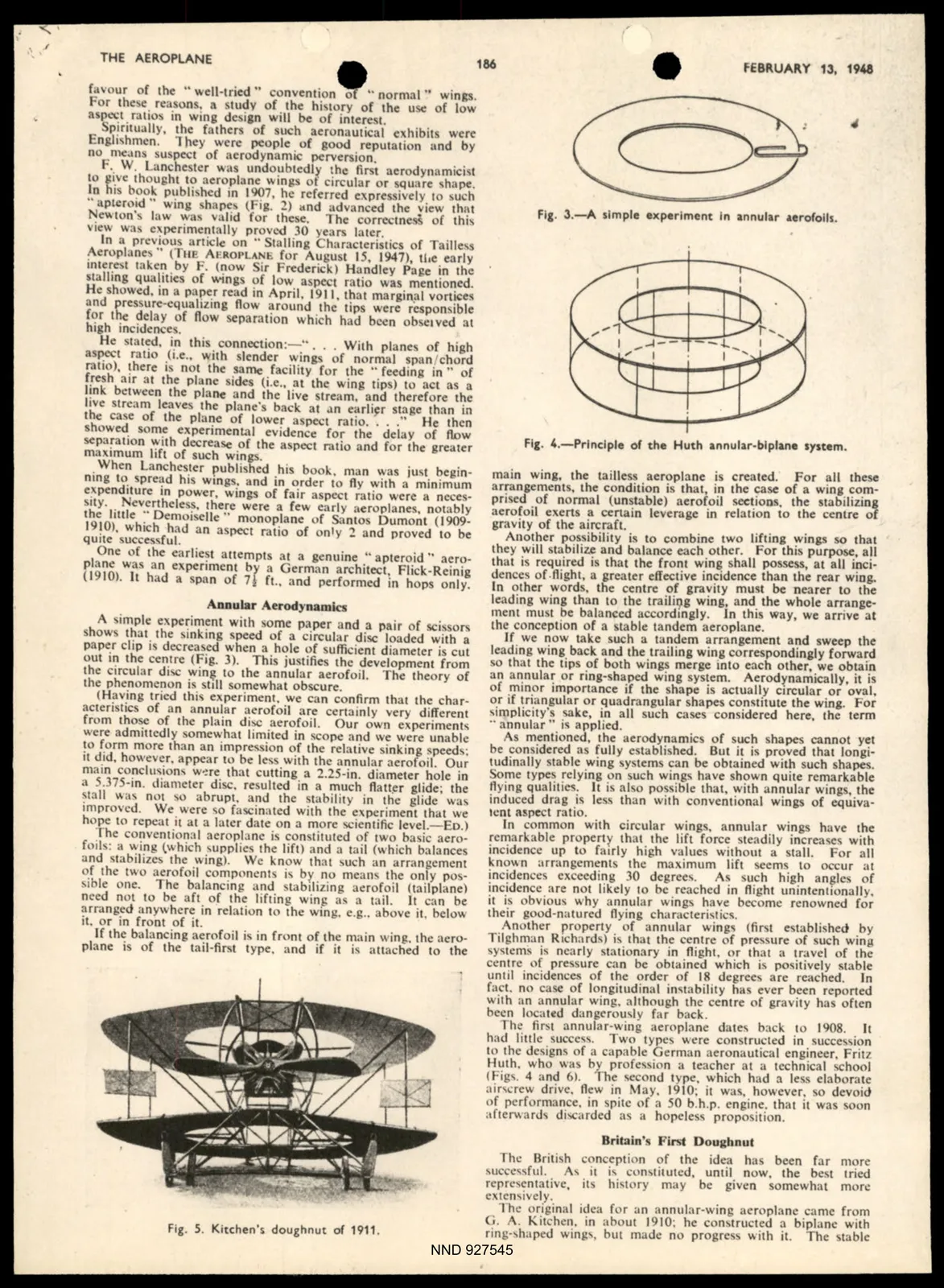
Ihe ori~mal idea for an annular-wing aeroplane came from
(,. A Kitchen. m about 1910; he con,tructed a b1pl.1ne with
Fig. S. Kitchen's doughnut of 1911 .
rini:-,haped wmg,, but made no progrcs, "ith it. The stable
NND 927545