Project Sign Progress Report, 1948
DOW-UAP-D097 · page 38 of 45
Text
This text came with the file. It may have mistakes. When the text and the image disagree, the image is right.
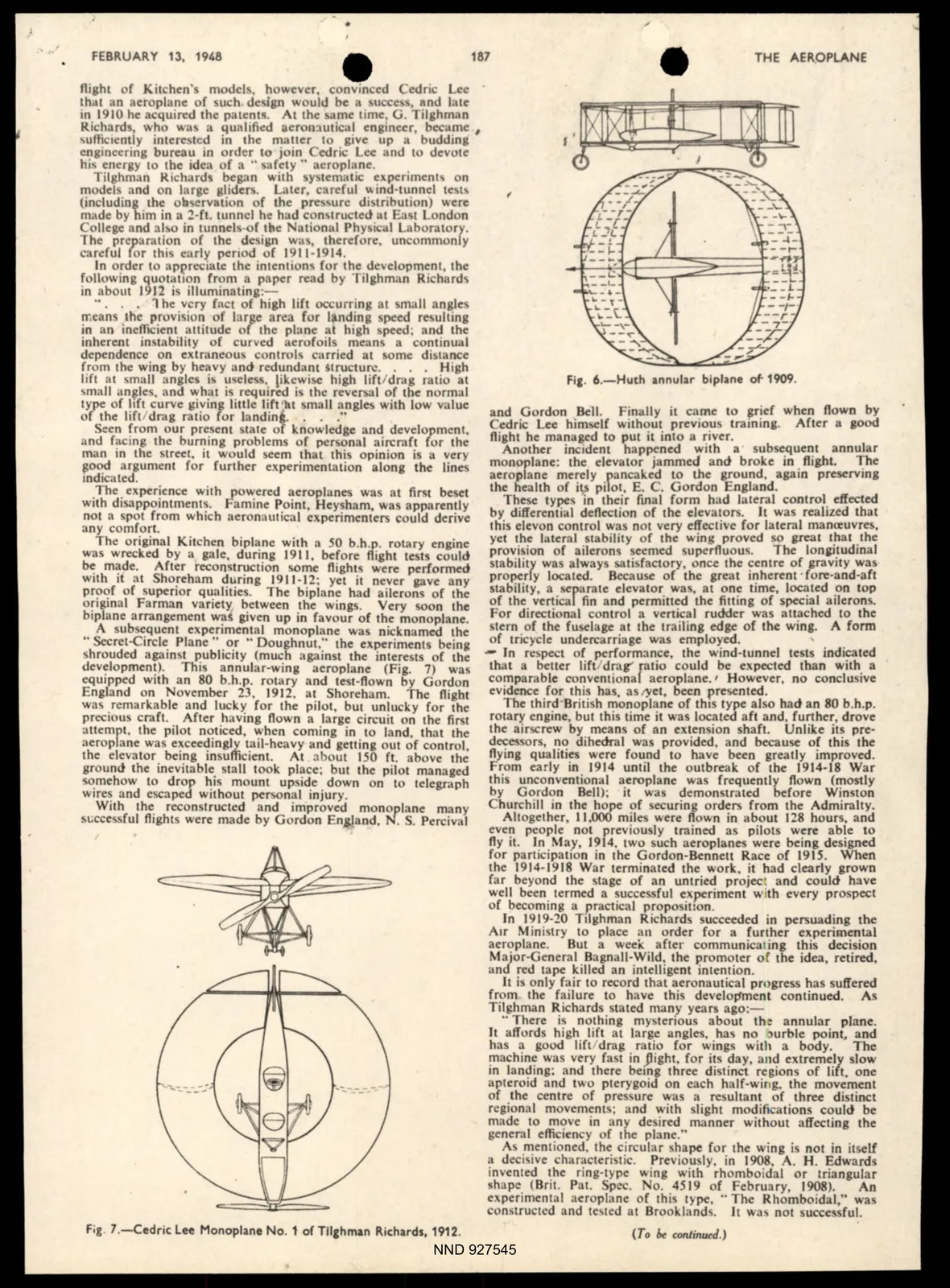
FEBRUARY 13, 1948 187 THE AEROPLANE flight of Kitchen's models. however. convinced Cedric Lee that an aeroplane of such de~ign would be- a succes,. 11nd late in 1910 he acquired the patents. At the same time, G. Tilghman Richards, who was a qualifii:d aeron:iutical engineer, became , ~uffic1ently interested in the mailer to give up a budding engineering bureau in order to join Cedric Lee and 10 devote ·JUI· tl?,!i m hib energy 10 tbe idea of a ·• safety " aeroplane. Tilghman Richards began with systematic experiment, on __.._ models and on large gJiders. Later, careful wind-tunnel test~ (including the observation of the pressure distribution) were made by him in a :!-ft. tunnel he had constructed at East London College and al~o in tunnels-of tile National Physical Laboratory. The preparation of the design was, therefore, uncommonly ~-ardul for this early period of 1911 -1914. In order to ap(>reciate the intention~ for the development, the following quota11on from a paper read by Tilghman Richards in about 1912 is illuminating: ... . . 1 he very fnct of high lift occurring at small angles rreans the provision of large area for l•nding speed resulting in an inefficient altitude of the plane at high speed: and the inherent instability of curved aerofoils means a continual dependence on extraneou, controls carried at some distance f_rom the wing by heavy and redundant Structure. . . . High lift at small angles il> u~eles~. likewise high lift/ drag ratio at ,mall an,les, and what is required is the reversal of the normal type of hft curve i:iving little lift •lit small angles with low value of the lift/ drag ratio for landini. . . ." Seen from our pre.sent state of knowledge and development, and facing the burning problems of personal aircraft for the man in the street. it would seem that this opinion is a very i;o~ argument for further experimentation along the lines indicated. _The. experience with _powered aeroplanes was at first beset with disappointment~. Famine P_oint, Heysham, was apparently not a spot from which aeronauucal experimenters could derive any comfort. The original Kitchen biplane with a 50 b.h.p. rotary engine was wrecked by a gale, during I 9 I I. before flight tests could b~ m~de. After recort~truction some flight~ were performed wtth 11 at Sho!eham <!~ring 1911-12: yet it never gave any pr~~f of superior q~ah11es. The biplane had ailerons of the or1gmal Farman variety between the wings. Very soon the biplane arrangement w!1s given up in favour of the monoplane. A subs~quent experimental monoplane was nicknamed the " Sccret-C1rct1: Plane ".~r "Doughnut,'' the experiments being shrouded agamst pubhclly (much against the interests of the dev~lopmen!), This annular-wing aeroplane (Fig. 7) was equipped with an 80 b.h.p. rotary and test-flown by Gordon England on November 23, 1912. at Shoreham. The flight was _remarkable and luck>; for the pilot, but. unlucky for the precious craft. After havmg flown a large circuit on the first attempt. the pilot noticed, when coming in to land that the aeroplane was exceedingly tail-heavy and getting out ~f control the elevator. bei!Jg insufficient. At about 150 ft. above th~ ground the inevttable stall took place: but the pilot managed ~~mehow to drop his mount upside down on to telegraph wire~ and escaped without personal injury. Wtth the reconstructed and improved monoplane many s\iccessful flights were made by Gordon England, N. S. Percival -:'x: - -' Fig. 6.-Huth annular biplane of 1909. and Gordon Bell. Finally it came to i;ricf when flown by Cedric Lee himself without previous training. After a good fliaht he managed to put it into a river. Another incident happened with a subsequent annular monoplane: the elevator jammed anct broke in flight. The aeroplane merely pancaked to the ground, again preserving the health of i~ pilot, E. C. Gordon England. These types in their final form had lateral control effected by differential deflection of the elevators. It was realized that this elevon control was not very effective for lateral manceuvres. yet the lateral stability of the wing proved so great that the provision of ailerons seemed superfluous. The loneitudinal stability was always satisfactory, once the centre of gravity was properly located. Because of the great inherent ·fore-and-aft stability, a separate elevator was, at one time, located on top of the vertical fin and permitted the fitting of special ailerons. For directional control a vertical rudder was attached to the stern of the fuselage at the trailing edge of the wing. A form of tricycle undercarriage was employed. - In respect of performance, the wind-tunnel tests indicated that a better lift/ drag' ratio could be expected than with a comparable conventionaf aeroplane., However, no conclusive evidence for this has, as,yet, been presented. The third British monoplane of this type also had an 80 b.h.p. rotary engine. but this time it was located aft and. further, drove the airscrew by means of an extension shaft. Unlike its pre d~cssors, ~~ dihedral was provided. and because of this the flying qualities were found to have been greatly improved. From early in 1914 until the outbreak of the 1914-18 War this unconventional aeroplane was frequently flown (mostly by Gordon Bell): it was demonstrated before Winston Churchill in the hope of securing orders from the Admiralty. Altogether, 11,000 miles were flown in about 128 hours, and eve~ people not previously trained as pilots were able to fly 11. In May, 1914. two such aeroplanes were being designed for parlicipation in the Gordon-Bennett Race of 1915. When the 1914-1918 War terminated the work. it had clearly grown far beyond the stage of an untried project and could have well been termed a successful experiment with every prospect of becoming a practical proposition. In l?l~-10 Tilghman Richards succeeded in persuading the Air Mm1stry 10 place an order for a further experiRlental aeroplane. But a week after communica1ing this decision Major-General Bagnall-Wild, the promoter of the idea, retired, and red tape killed an intelligent intention. It is only fair to record that aeronautical progress has suffered fr~m the failure to have this develop'ment continued. As Tilghman Richards stated many years ago: .. There i~ no!hing myMerious about th~ annular plane. It affords high ltft at large angles, ha~ no >urble point and has ~ good lift/ drag . rati_o for wings with a body. ' The !Tiachm~ was very fast in p,ght. for its day, and extremely slow m lan~mg: and there bei!)g three dislinct regions of lift, one aptero1d and two pterygo1d on each half-wing. the movement of the centre of pressure was a resultant of three distinct regional movements; ,tnd with slight modifications could be made 10 move in any desired manner without affecting the general efficiency of 1he plane." As _mentioned. th«: c!rcular shape for the wing is not in itself ~ dec1s1ve cha".\c1enst1c. ?reviously. in 1908, A. H. Edwards invented the ring-type wing with rhomboidal or triangular shape_ (Brit. Pat. Spec. No. 4519 of February, 1908). An experimental aeroplane of this type, "The Rhomboidal,'' was constructed and tested at Brooklands. It wa~ not successful. (To ~ conlit1u~d.) Fig 7.-Cedric Lee Monoplane No. 1 of TIighman Richards, 1912. NND 927545