Project Sign Progress Report, 1948
DOW-UAP-D097 · page 45 of 45
Text
This text came with the file. It may have mistakes. When the text and the image disagree, the image is right.
~ ARCH 19, 1948
339
THE AEROPLANE
.,...
M. B. Morgan has recently communicated the following
0·3 r----------------------i~
values for the limit of stability at the stall from this araph:
<=o,
0
Upper llmic of th• Ansl• of Swetp,back (r•lerred
to th• l chord) beyond which Hll••tall can be
A,poc, Ratio 11.•qulr•d
expected
Ocareu
6S
1
S4
2
46
3
38
'
2S
6
14
••
8
s
It is thus advisable to combine sweep-back with low-aspect
ratio w!1en s~fc stallin_g is required.
. Consaderataon, of high speed lead to a ,imilar combination.
since both feature~ tend to delay the shock stall.
We have.
04
as ~ res!lll, the rare ca~ i;,f two quite different aspects of an
o-a
1·0
enginee~ing_ problem pointing to an identical solution.
1 he incv11able result has been the development of arrow
sh<;1ped:. more ?r less triangular, . disc wings, termed " Oelta
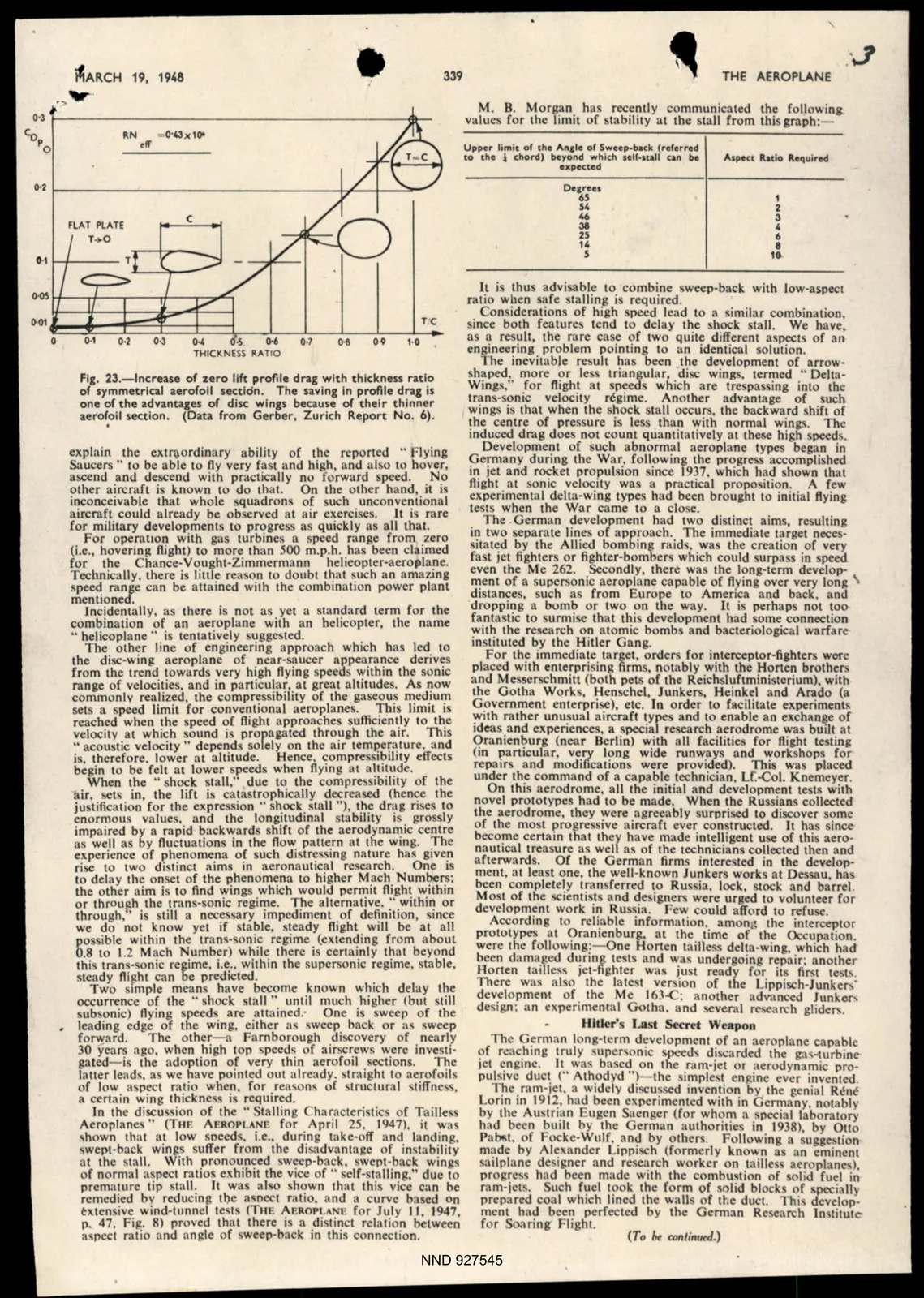
Fig. 23.-lncrease of xero lift profile drag with thickness ratio
Wangs, _for lhgh~ at sp~eds which are trespassing into the
of symmetrical aerofoil sectldn. The saving In profile drag Is
tr~ns•s?nlC
velocity rtg1me. Another advantage of such
one of the advantages of disc wings because of their thinner
wings as that when the shock stall occurs. the backward shift of
aero~oll section. (Data from Gerber, Zurich Report No. 6).
!he centre of pressure is less than with normal wings. The
induced drag doe, not count quantitatively at tbeg high speeds
explain the extr~ordinary ability of the reported •• Flying
Development of such abnormal aeroplane types began i~
9e:many during the War_. following the progress accomplished
Saucers·• to be able to fly very fast and high, and also to hover,
•~ 1et and r~ket propulsion since 1937, which had shown that
ascend _and de_sceod with practically no forward speed.
No
flight . at sonic vcla<:IIY wa, a r,ractical proposition.
A few
~ther a!rcraft 1s known to do that.
On the other hand, it is
ll!(ODCeavable that whole squadrons of such unconventional
experimental delta-wing types had been brought to initial flying
te~t, when the War came to a close.
atreraft could already be observed at air exercises.
It is rare
. The German ~evclopmcnt had two distinct aims, resulting
for military developments to progress as quickly as all that.
11_1 two separate hn_es of approach. The immediate target neces
. For operatao~ with gas turbines a speed range from zero
satat~d by the Allied bombing raids. was the creation of very
(1.c., hovcrin~ flight) to more than .500 m.p.h. has been claimed
fast Jct fighters or fighter-bombers which could surpass in speed
for
t~e Chance:V~ught-Zimmcrmann
helicopter-aeroplane.
even the Mc 262. _Secondly, there was the long-term develop
Technically. there 1s httlc reason to doubt that such an amazing
spec<! range can be attained with the combination power plant
~ent of a supersonic aeroplane capable of flying over very lon11 \
d1sta~es. such n, from Europe 10 America and back. and
menuoned.
Jncidcntally, as there is not as yet a standard term for the
dropp11_1g a born~ or two ~n the way. Jt i, perhaps not too
fa_ntastac to surm1,e that t~•s development had some connection
combination of an aeroplane with an helicopter, the name
with the research on atomic bombs and bacteriological warfare
•• helicoplane •• is tentatively suggested.
The. oth~r line of engineering approach which has led to
instituted by the Hitler Gang.
For th~ immcdia!e. target, orders for interceptor-fiahters were
the da..c-winl! aeroplane of near-saucer appearance derives
from the trend towards very high flying speeds within the sonic
placed wath cnterpming firms, notably with the Honen brothers
and Messerschm111 (both pets of the Rcichsluftministerium) with
range of velocities. and in panicular1
at great altitudes. As now
the Gotha Works, ttenschcl, Junkers, Heinke! and Arado (a
commonly realized, the compres,ibi ity of the gaseous medium
sets a speed limit for conventional aeroplanes.
This limit is
G?vernment cntcrpra~). etc. In order to facilitate experiment~
reached when the speed of flight approaches sufficiently to the
~•th rather unu~ual aarcraJt ~ypcs and to enable an exchange of
veloc11v at which sound is propa&3ted through the air.
This
ideas.and expenences, a special research aerodrome was built at
"acoustic velocity" depends solely on the air temperature. and
(?ranien~urg (near Berlin) with all facilities for flight testing
is, therefore. lower at altitude.
Hence. compressibility effects
(in ~anacular, ve_ry l~ng wide runway, and workshop, for
begin to be felt at lower speeds when flying at altitude.
repairs and mod1fica11on, were provided).
This was placed
When the "shock stall," due to the compre~sibility of the
under th~ command of a capa~I~ _technician, Lf.-Col. Kncmeyer.
On this aerodrome, all the in111al and development tests with
air, ,;cts in, the lift is catastrophically decreased (hence the
novel prototypes had to be made. When the Russians collected
justification for the expression "shock stall "), the dmg ri,cs to
enormous values, and the longitudinal ~tability i, grossly
the aerodrome, they were agreeably surpri,;ed to discover some
impaired by a rapid backwards shift of the aerodynamic centre
of the most progressive aircraft ever constructed. It has since
beco!11e cenain that thcr have made intelligent use of this aero
a~ well as by fluctuations in the flow pattern at the wing. The
nau11cal treasure as wcl a, of the technicians collected then and
experience of phenomena of such distressing nature has given
rise to two distinct aims in aeronautical rc,carch.
One is
afterwards.
Of the German firms interested in the develop·
ment, at least one. the well-known Junkers works at Ocssau has
to delay the ono;et of the phenomena to higher Mach Numbers;
the other aim i, to find wings which would permit flight within
been complete!y t!"llnsferred ~o Russia, lock, stock and barrel.
Most of the sc1cnt"_ts and ~e 1snen were urged to volunteer for
or throuF,h the tran,-sonic regime. The alternative. " within or
through,' is still a necessary impediment of definition, since
developm~nt work 11_1 Rus~m. Fe~ could afford to refuse.
we do not know yet if Mable, steady flight will be at all
According to reh_able mrorma11on, amont: the interceptor
prototypes at 9ran1cnburg, at the time of the Occupation.
possible within the tran,-sonic regime (extending from about
0.8 to 1.2 Mach Number) while there is certainly that beyond
were the following:-One Honen taille,, delta-wing, which had
been dama_ged d(!rmg tests and ~as undergoing repair: another
this tran~-sonic regime. i.1:., within the supersonic regime, ~table.
steady flifht can be predicted.
Honen ta1lle,, Jct-fighter was J.ust ready for it~ first test,.
There was also the latest version of the lippi-;ch-Junker,,·
Two \ample mean, have become known which delay the
dev~lopmem of. the Mc 16.\-C: another advanced Junker,
occurrence of lhe "shock stall" until much higher (but still
sub,onic) flying speed, are attained.·
One is sweep of the
design: an experimental Gotha. and several re;,earch gliders.
,
leading edge of the wing, either a, sweep hack or a, ,weep
Hitler's Last Secret Weapon
forward.
The othe~-a Farnborough _discovery of nearly
The G~rman long-term development of an aeroplane capable
30 years ago, when high top ,peed, of a1r<.erew, were investi
~f reac_hing truly supersonic ,peed, discarded the gaHurbine
gated-i, the adoption of very thin aerofoil sections.
The
1et engine.
It wa, based on the ram-jct or aerodynamic pro
latter lend,. as we ~ave pointed out already. straight to aerofoils
puhivc due~ (" Ath_odyd ")-the simplc~t en11ine ever' invented
of low a,pect ratio when, for rea,on, of structural ,tiffness
1 ~e. ram-Jet, a widely d1,cu,,ed invention by the genial Rtnci
a certain wing thickne,, is required.
'
Lorin in 1~1~. had been c~pcrimented with in Germany, notably
ln the discu,sion of the "Stalling Characteristics of Toille,s
hy the Austrian Cugcn Saenger (for whom a special laboratory
Aeroplanes'' (THP AER0PLANr for April 2.5. 1947). it was
had been built hy the German authornie~ in 1938), by Otto
,hown that a_t low soecd,. i.e., duri_ng take-off and landing,
Pabo\t, of Focke-Wulf, _an~ by others.
Following a suuestion
swept-back win1t,s ,uffer from the d1s.1dvanta11e of in,tability
m~de by Al~xander L1pp1sch (formerly known as an eminent
at the ,tall.
W11h pronou_n~ed sw«:ep-back, &wept-back wing,
sa1lplnne des1(tner and resc~rch worker on _tnillcs, aeroplanes).
of normal a~pcct rataos exh1b11 the vice of" ,clf-,talling," due to
prog~e~, had been made wath the combustion of solid fuel in
premature tap stall. It was al'° shown that this vice can be
ram-1ets. Such fuel took the form of ~olid blocks of ~pccinlly
remedied bv reducing the a,r>ect ratio. and a curve based on
r,rcpared coal which lined the walls of the doct. This develop
exten,av~ wind-tunnel te,ts CT11c ~ER0P~~c for July t I. 1947,
ment ha~ bee~ perfected by the German Research In1titutc
p. 47, F111_. 8) proved that there 1, a dastmct relation between
for Soarmg Fhaht.
a,r,ect ratio and an11le of sweep-back in this connection.
(To ~ continued.)
NND 927545