AAWSAP DIRD, Metallic Glasses for Aerospace Applications, December 2009
DOW-UAP-D117 · page 13 of 30
Text
This text came with the file. It may have mistakes. When the text and the image disagree, the image is right.
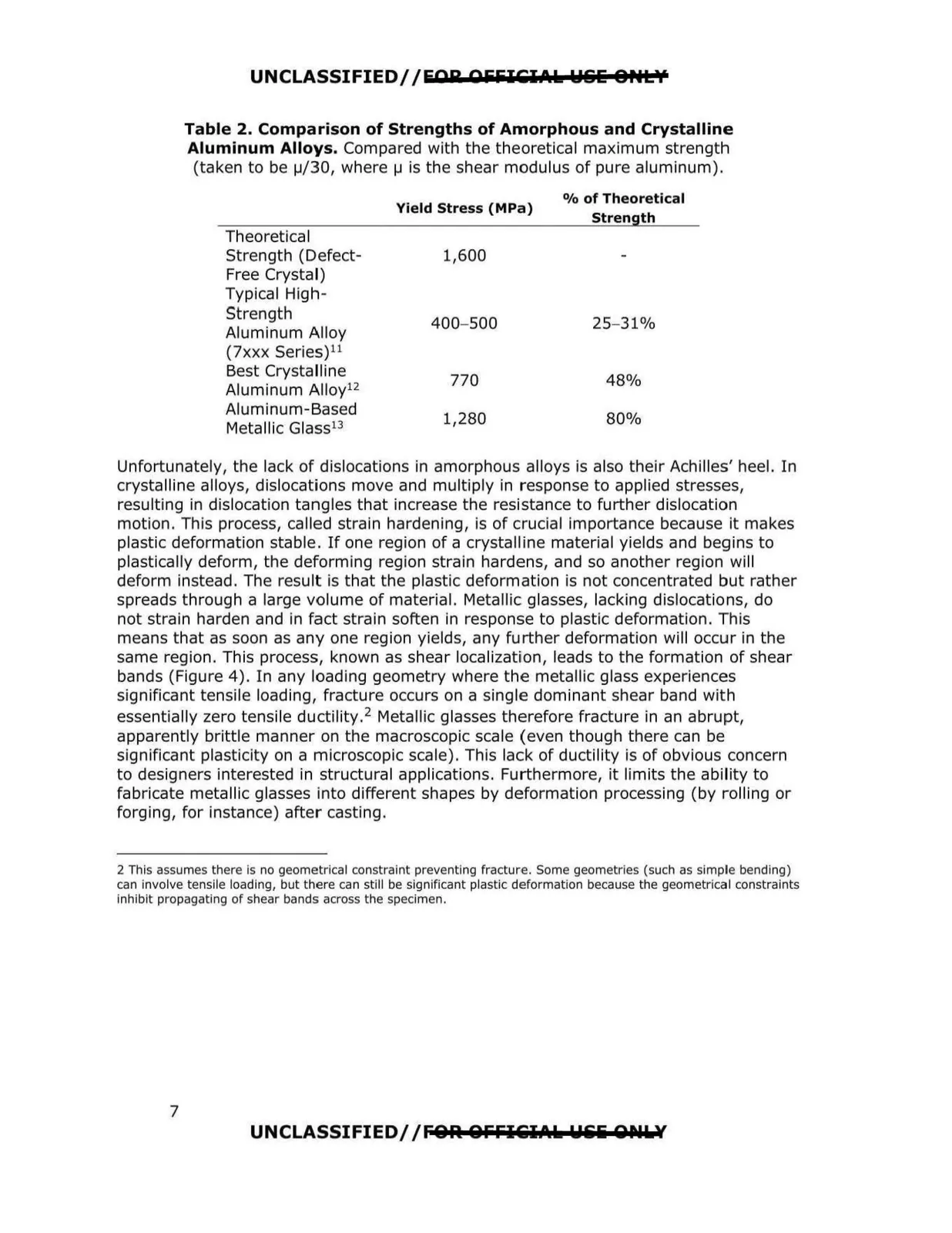
UNCLASSIFIED//FOR O&&iliCilial.ls: W&E 8,.L'l Table 2. Comparison of Strengths of Amorphous and Crystalline Aluminum Alloys. Compared with the theoretical maximum strength (taken to be µ/30, where µ is the shear modulus of pure aluminum). % of Theoretical Yield Stress (MPa) Stren th Theoretical Strength (Defect 1,600 Free Crystal) Typical High Strength Aluminum Alloy 400- 500 25- 31% (7xxx Series) 11 Best Crystalline Aluminum Alloy12 770 48% Aluminum-Based Metallic Glass13 1,280 80% Unfortunately, the lack of dislocations in amorphous alloys is also their Achilles' heel. In crystalline alloys, dislocations move and multiply in response to applied stresses, resulting in dislocation tangles that increase the resistance to further dislocation motion. This process, called strain hardening, is of crucial importance because It makes plastic deformation stable. If one region of a crystalline material yields and begins to plastically deform, the deforming region strain hardens, and so another region will deform instead. The result is that the plastic deformation is not concentrated but rather spreads through a large volume of material. Metallic glasses, lacking dislocations, do not strain harden and in fact strain sohen in response to plastic deformation. This means that as soon as any one region yields, any further deformation will occur in the same region. This process, known as shear localizati1on, leads to the formation of shear bands (Figure 4 ). In any loading geometry where the metallic glass experiences significant tensile loading, fracture occurs on a single dominant shear band with essentially zero tensile ductility.2 Metallic glasses therefore fracture in an abrupt, apparently brittle manner on the macroscopic scale (even though there can be significant plasticity on a microscopic scale). This lack of ductility is of obvious concern to designers interested in structural applications. Furthermore, it limits the ability to fabricate metallic glasses into different shapes by deformation processing (by rolling or forging, for instance) aher casting. 2 This assumes there is no geometrical constraint preventing fractur,e. Some geometries (such as simple bending) can involve tensile loading, but there can still be significant plastic deformation because the geometrical constraints Inhibit propagating of shear bands across the specimen. 7 UNCLASSIFIED//FOR OFFIGlal.ls: Wii QfilLV