AAWSAP DIRD, Metallic Glasses for Aerospace Applications, December 2009
DOW-UAP-D117 · page 14 of 30
Text
This text came with the file. It may have mistakes. When the text and the image disagree, the image is right.
UNCLASSIFIED!/FOR err1e11ct l1!1! 614[1
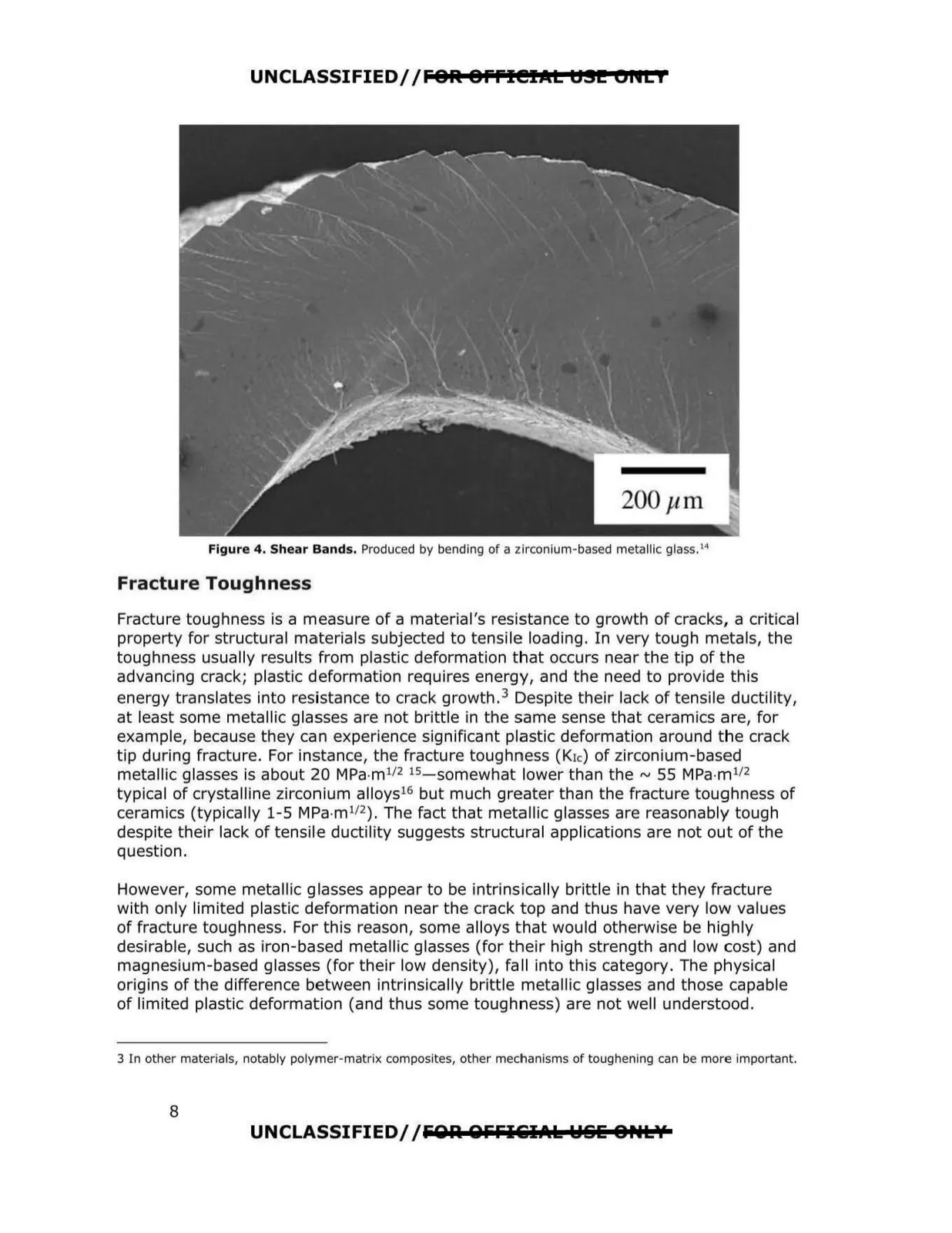
200µm
Figure 4. Shear Bands. Produced by bending of a zirconium-based metallic glass. v,
Fracture Toughness
Fracture toughness is a measure of a material's resistance to growth of cracks, a critical
property for structural materials subjected to tensile loading. In very tough metals, the
toughness usually results from plastic deformation that occurs near the tip of the
advancing crack; plastic deformation requires energy, and the need to provide this
energy translates into resistance to crack growth. 3 Despite their lack of tensile ductility,
at least some metallic glasses are not brittle in the same sense that ceramics are, for
example, because they can experience significant plastic deformation around the crack
tip during fracture. For instance, the fracture toughness (Krc) of zirconium-based
metallic glasses is about 20 MPa-m112 15-somewhat lower than the "' 55 MPa -m112
typical of crystalline zirconium alloys16 but much greater than the fracture toughness of
ceramics (typically 1-5 MPa-m112). The fact that metallic glasses are reasonably tough
despite their lack of tensile ductility suggests structural applications are not out of the
question.
However, some metallic glasses appear to be intrinsically brittle in that they fracture
with only limited plastic deformation near the crack top and thus have very low values
of fracture toughness. For this reason, some alloys t hat would otherwise be highly
desirable, such as iron-based metallic glasses (for their high strength and low cost) and
magnesium-based glasses (for their low density), fa II into this category. The physical
origins of the difference between intrinsically brittle metallic glasses and those capable
of limited plastic deformation (and thus some toughness) are not well understood.
3 In other materials, notably polymer-matrix composites, other mechanisms of toughening can be more important.
8
UNCLASSIFIED//FOA OFFIGI.t.k lel&E 0,.LY