AAWSAP DIRD, Metallic Glasses for Aerospace Applications, December 2009
DOW-UAP-D117 · page 16 of 30
Text
This text came with the file. It may have mistakes. When the text and the image disagree, the image is right.
..c
UNCLASSIFIED//fOR Offl@IAL Wfi& 0PU1¥
bJ)
C
-
~
en
a)
4
.....
en
C
a)
.....
2
a)
.....
c,;j
E
..... -5
+-'
a)
"O
:::J
4
.....
;.:::
0..
8
2
c,;j
en
en
a) 0.01
tl
Dendritic composite
......
-- - - --
High-strength steel
ingle-pha e
metallic gla
a .....
Cl')
Number of cy le to failure
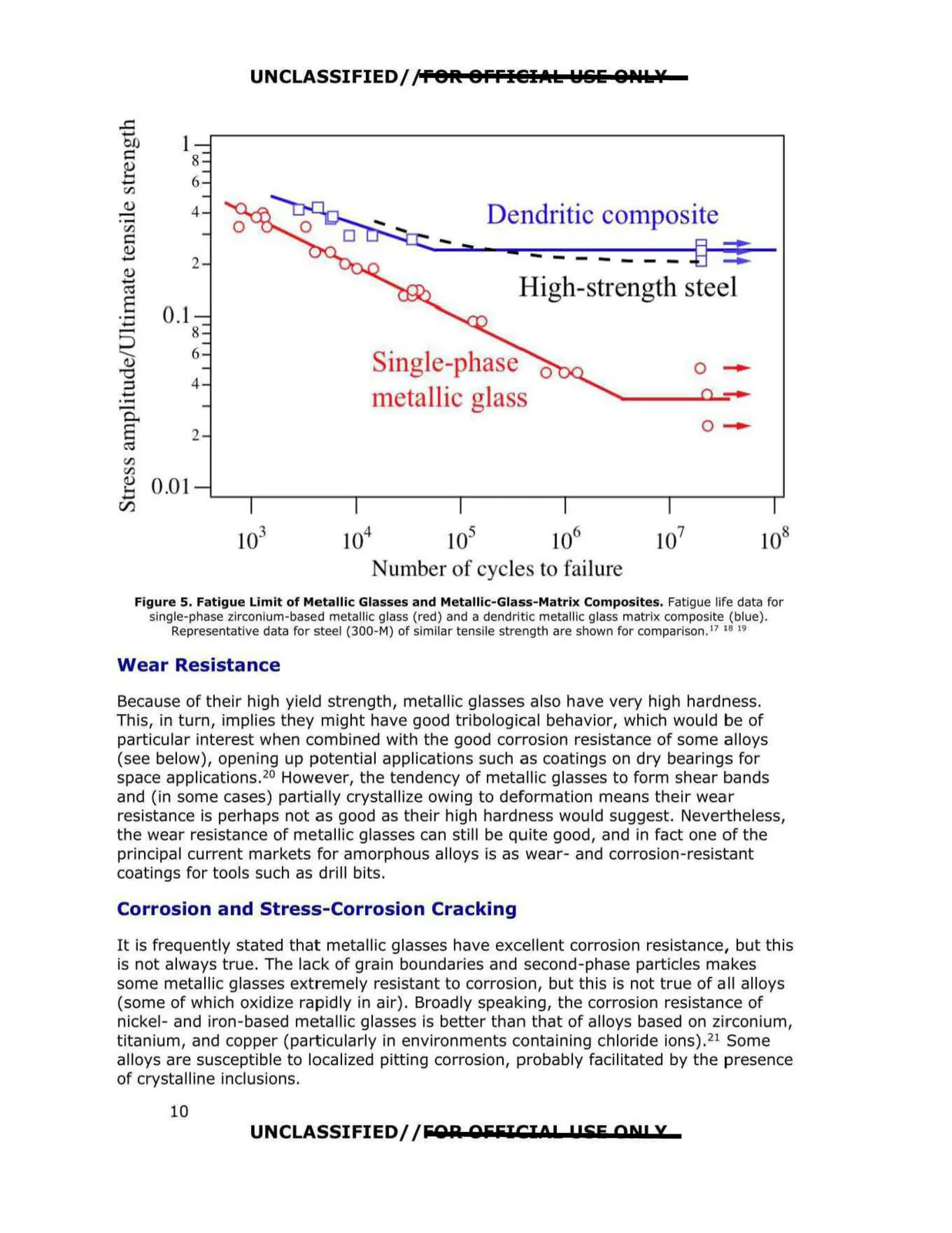
Figure 5. Fatigue Limit of Metallic Glasses and Metallic-Glass-Matrix Composites. Fatigue life data for
single-phase zirconium-based metallic glass (red) and a dendrltlc metallic glass matrix composite (blue).
Representative data for steel (300-M) of similar tensile strength are shown for comparison .17 16 19
Wear Resistance
Because of their high yield strength, metallic glasses also have very high hardness.
This, in turn, implies they might have good tribological behavior, which would be of
particular interest when combined with the good corrosion resistance of some alloys
(see below), opening up potential applications such as coatings on dry bearings for
space applications.20 However, the tendency of metallic glasses to form shear bands
and (in some cases) partially crystallize owing to deformation means their wear
resistance is perhaps not as good as their high hardness would suggest. Nevertheless,
the wear resistance of metallic glasses can still be quite good, and in fact one of the
principal current markets for amorphous al loys is as wear- and corrosion-resistant
coatings for tools such as drill bits.
Corrosion and Stress-Corrosion Cracking
It is frequently stated that metallic glasses have excellent corrosion resistance, but this
is not always true. The lack of grain boundaries and second-phase particles makes
some metallic glasses extremely resistant to corrosion, but th is is not true of all alloys
(some of which oxidize rapidly in air). Broadly speaking, the corrosion resistance of
nickel- and iron-based metallic glasses is better than that of alloys based on zirconium,
titanium, and copper (particularly in environments containing chloride ions) .21 Some
alloys are susceptible to localized pitting corrosion, probably facilitated by the presence
of crystalline inclusions.
10
UNCLASSIFIED//5i0A: 05i5ilCIOP !!SF ON! X