AAWSAP DIRD, Metallic Glasses for Aerospace Applications, December 2009
DOW-UAP-D117 · page 17 of 30
Text
This text came with the file. It may have mistakes. When the text and the image disagree, the image is right.
UNCLASSIFIED//50A OFFIEJIAL ~!! e..c,
The subject of stress-corrosion cracking of metallic glasses, despite its obvious
importance for structural applications, has received scant attention in the literature.
What little work that has been done has focused on zirconium-based glasses, with the
observation that these alloys are very susceptible to stress-corrosion cracking in
aqueous environments containing chloride ions, likely owing to the fact that they do not
form protective oxide surface layers. 22
Mechanical Behavior at Elevated Temperature
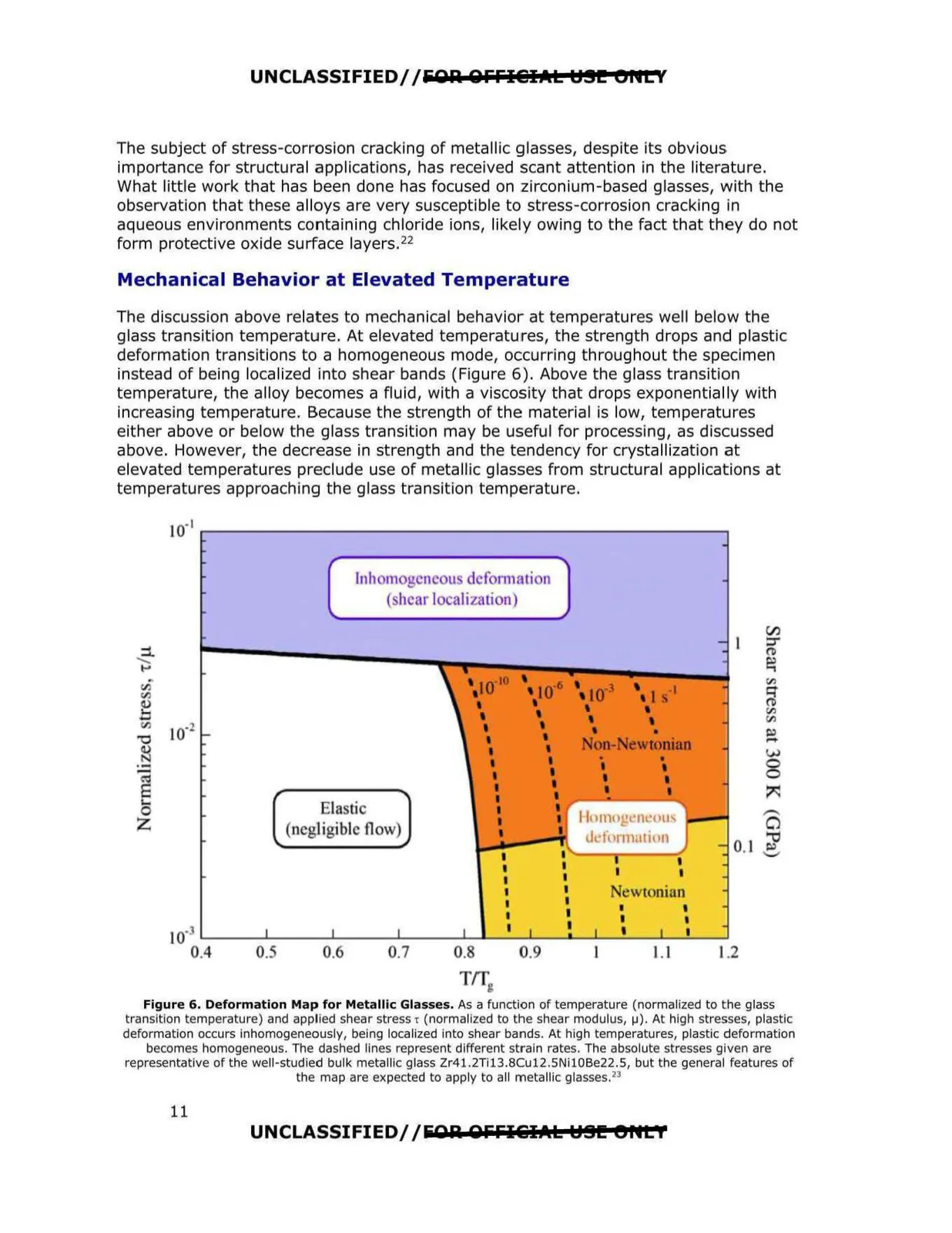
The discussion above relates to mechanical behavior at temperatures well below the
glass transition temperature. At elevated temperatures, the strength drops and plastic
deformation transitions to a homogeneous mode, occurring throug hout the specimen
instead of being localized into shear bands (Figure 6). Above the glass transition
temperature, the alloy becomes a fluid, with a viscosity that drops exponentially with
increasing temperature. Because the strength of the material is low, temperatures
either above or below the glass transition may be useful for processing, as discussed
above. However, the decrease in strength and the tendency for crystallization at
elevated temperatures preclude use of metallic glasses from structural applications at
temperatures approaching the glass transition temperature.
::i
1:-' -
<I)
Q)
b
-c,
Q) -·-e
~
z
io•I .------------------------------,
lnh
C/)
::r
ell
I
I
I
11 1m11 'l'I\ ·ou
J •fi111na1i11n
'
I
t!wtonian
I
I
I
I
I
I
1. 1
~
cn
~
cn
en
l0-2
l),'l....
:,i::
la ti
C>
negl igible fl ow
"O
l),'l
0.1
lO" 0.4
0.
0.
0.7
1.2
Trrl/.
Figure 6. Deformation Map for Metallic Glasses. As a function of temperature (normalized to the glass
transition temperature) and applied shear stress 1 (normalized to the shear modulus, µ). At high stresses, plastic
deformation occurs inhomogeneously, being localized into shear bands. At high temperatures, plastic deformation
becomes homogeneous. The dashed lines represent different strain rates. The absolute stresses given are
representative of the well-studied bulk metallic glass Zr41.2Ti13.8Cu12 .5Ni10Be22.5, but the general features of
the map are expected to apply to all metallic glasses.23
11
UNCLASSIFIED/ /iiOA OFFI&iIAt 1!18! 8flt I