AAWSAP DIRD, Aerospace Applications of Programmable Matter, December 2009
DOW-UAP-D118 · page 10 of 20
Text
This text came with the file. It may have mistakes. When the text and the image disagree, the image is right.
UNCLASSIFIED//f8Ft 8ffHHIIII:. .-se 8Hl:.V
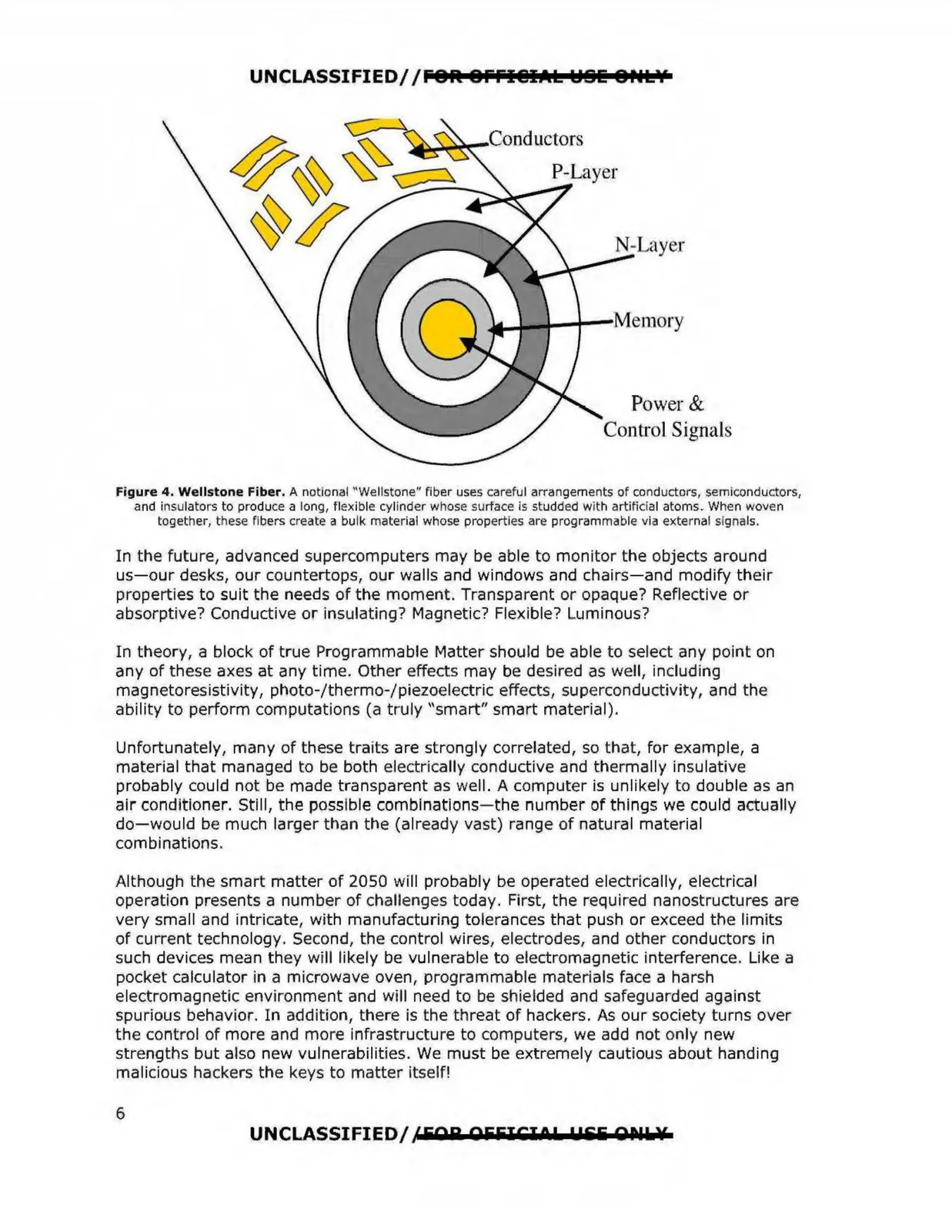
Power &
Control Signals
Figure 4. Wellstone Fiber. A notional "Wellstone" fiber uses careful arrangements of conductors, semiconductors,
and insulators to produce a long, flexible cylinder whose surface is studded with artiticial atoms. When woven
together, these fibers create a bulk material whose properties are programmable via external signals.
In the future, advanced supercomputers may be able to monitor the objects around
us-our desks, our countertops, our walls and windows and chairs-and modify their
properties to suit the needs of the moment. Transparent or opaque? Reflective or
absorptive? Conductive or insulating? Magnetic? Flexible? Luminous?
In theory, a block of true Programmable Matter should be able to select any point on
any of these axes at any time. Other effects may be desired as well, including
magnetoresistivity, photo-/thermo-/piezoelectric effects, superconductivity, and the
ability to perform computations (a truly "smart" smart material).
Unfortunately, many of these traits are strongly correlated, so that, for example, a
material that managed to be both electrically conductive and thermally insulative
probably could not be made transparent as well. A computer is unlikely to double as an
air conditioner. Still, the possible combinations-the number of things we could actually
do-would be much larger than the (already vast) range of natural material
com bi nations.
Although the smart matter of 2050 will probably be operated electrically, electrical
operation presents a number of challenges today. First, the required nanostructures are
very small and intricate, with manufacturing tolerances that push or exceed the limits
of current technology. Second, the control wires, electrodes, and other conductors in
such devices mean they will likely be vulnerable to electromagnetic interference. Like a
pocket calculator in a microwave oven, programmable materials face a harsh
electromagnetic environment and will need to be shielded and safeguarded against
spurious behavior. In addition, there is the threat of hackers. As our society turns over
the control of more and more infrastructure to computers, we add not only new
strengths but also new vulnerabilities. We must be extremely cautious about handing
malicious hackers the keys to matter itself!
UNCLASSIFIED/,'FOR OEEIG'I0l 11&:E $Ull¥
6