AAWSAP DIRD, Aerospace Applications of Programmable Matter, December 2009
DOW-UAP-D118 · War Dept. · Dec 14, 2009 · document · 20 pages · Release 6
What the war.gov catalog says
This document is a Defense Intelligence Reference Document (DIRD), a technical reference format used by the Defense Intelligence Agency (DIA) to capture baseline knowledge on a specific topic for later analytic use. DIRDs are best understood as reference and synthesis products rather than as original research. It is one of 38 DIRDs produced under the Advanced Aerospace Weapon System Applications Program (AAWSAP) between 2009 and 2011. Because AAWSAP’s scope permitted a broad range of supporting topics, not every DIRD in the series directly concerns aerospace systems or future threat assessment. The following summary reflects the DIRD’s scope and framing at the time of writing and should not be read as implying current validation of the concepts discussed. This DIRD describes “programmable matter” as smart materials whose properties can be changed on command, potentially allowing spacecraft components to change function through software updates rather than physical repair or replacement. The report suggests that such materials could someday enable adjustable sensors, smart windows, heat control, energy collection, active camouflage, and systems that switch between different functions, making spacecraft more flexible and adaptable. At the same time, it presents the idea as highly speculative and emphasizes major technical obstacles, including manufacturing at extremely small scales, shielding against radiation and electromagnetic interference, managing temperature effects, reducing component failures, and preventing hacking or malicious control. Overall, the document presents programmable matter as a promising long-term concept over the next 50 years, while judging that simpler near-term uses such as smart windows and energy-saving surface materials are far more realistic than the more ambitious aerospace applications.
From the file
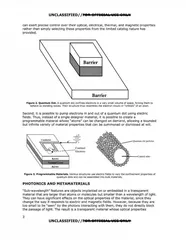
However, because they are too small to be "seen" by the photons interacting with them, they do not directly block the passage of light. p. 7
While the astronauts eat their breakfast in a bright little galley, more portholes appear, looking down at Earth and at points of interest in the black sky above it. p. 17
This text came with the file. It may have mistakes. When the text and the image disagree, the image is right.