AAWSAP DIRD, Aerospace Applications of Programmable Matter, December 2009
DOW-UAP-D118 · page 12 of 20
Text
This text came with the file. It may have mistakes. When the text and the image disagree, the image is right.
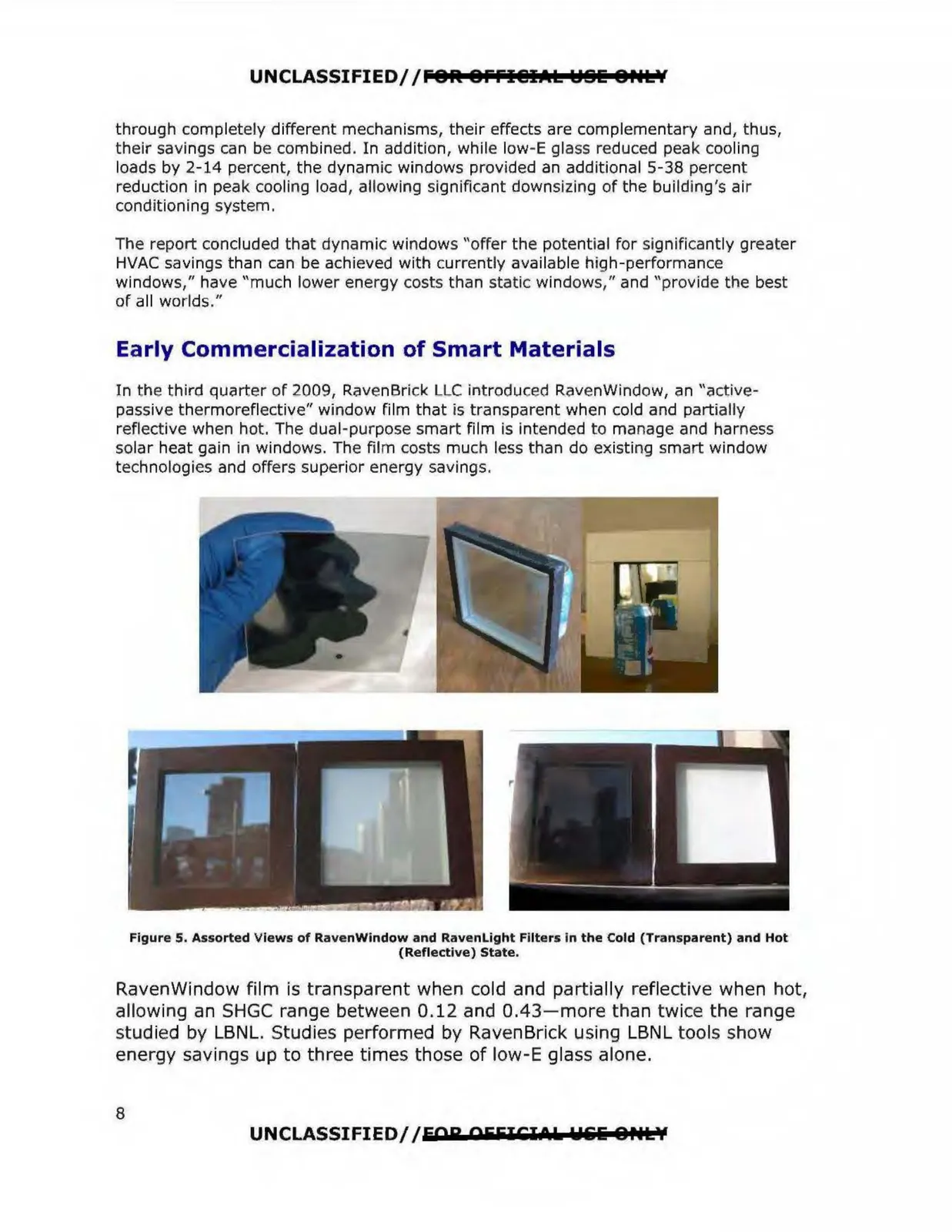
UNCLASSIFIED//f8R 8ffl811111: .-sE 8Hl:l/ through completely different mechanisms, their effects are complementary and, thus, their savings can be combined. In addition, while low-E glass reduced peak cooling loads by 2-14 percent, the dynamic windows provided an additional 5-38 percent reduction in peak cooling load, allowing significant downsizing of the building's air conditioning system. The report concluded that dynamic windows "offer the potential for significantly greater HVAC savings than can be achieved with currently available high-performance windows," have "much lower energy costs than static windows," and "provide the best of all worlds." Early Commercialization of Smart Materials In the third quarter of 2009, RavenBrick LLC introduced RavenWindow, an "active passive thermoreflective" window film that is transparent when cold and partially reflective when hot. The dual-purpose smart film is intended to manage and harness solar heat gain in windows. The film costs much less than do existing smart window technologies and offers superior energy savings. Figure 5. Assorted Views of RavenWindow and Ravenlight Filters in the Cold (Transparent) and Hot (Reflective) State. RavenWindow film is transparent when cold and partially reflective when hot, allowing an SHGC range between 0.12 and 0.43-more than twice the range studied by LBNL. Studies performed by RavenBrick using LBNL tools show energy savings up to three times those of low-E glass alone. UNCLASSIFIED//FOR AEFICl I k W&li &HI:¥ 8