AAWSAP DIRD, Aerospace Applications of Programmable Matter, December 2009
DOW-UAP-D118 · page 15 of 20
Text
This text came with the file. It may have mistakes. When the text and the image disagree, the image is right.
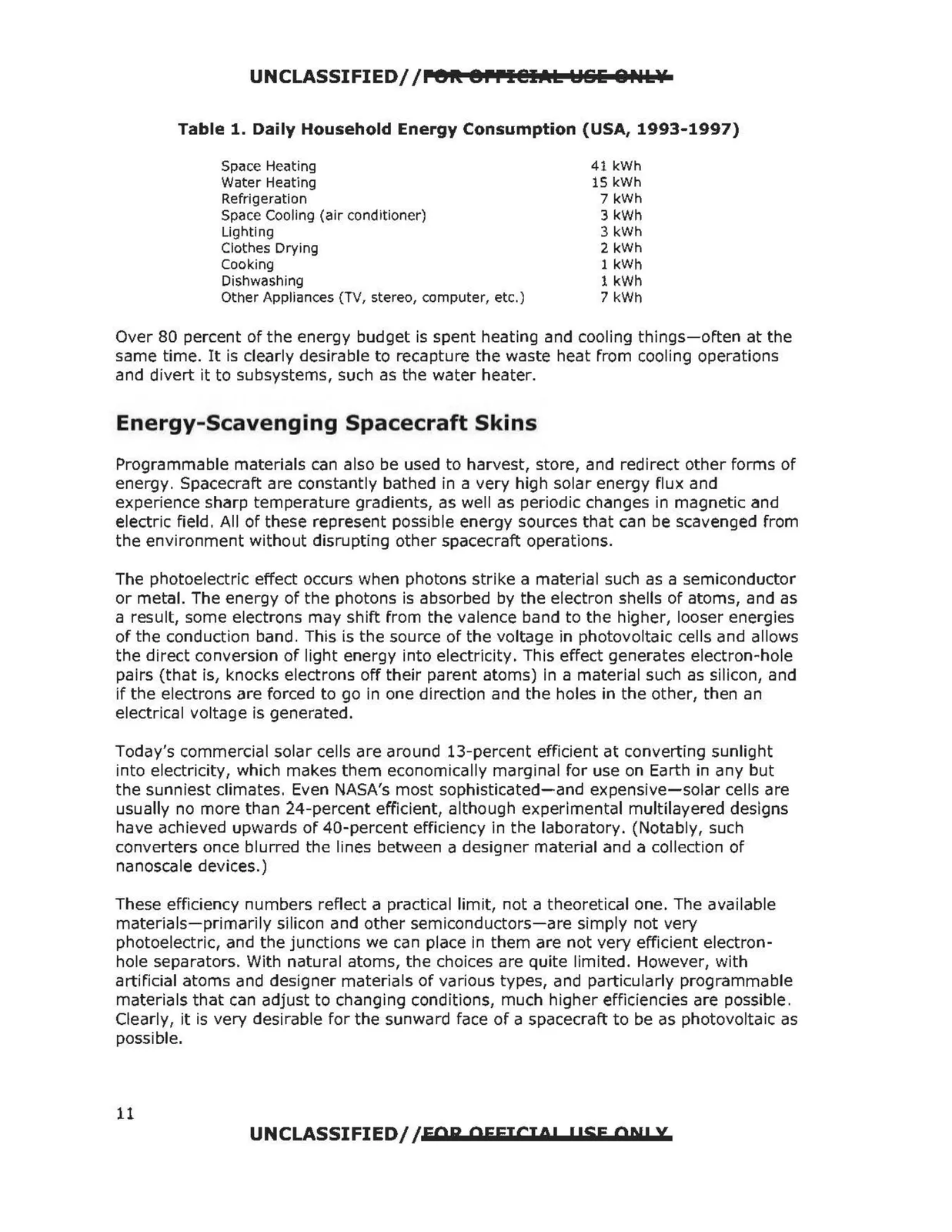
UNCLASSIFIED//1'91t err1e11111:: W&I &Hkl/ Table 1. Daily Household Energy Consumption (USA, 1993-1997) Space Heating 41 kWh Water Heating 15 kWh Refrigeration 7 kWh Space Cooling (air conditioner) 3kWh Lighting 3kWh Clothes Drying 2kWh Cooking lkWh Dishwashing lkWh Other Appliances (TV, stereo, computer, etc.) ?kWh Over 80 percent of the energy budget is spent heating and cooling things-often at the same time. It is clearly desirable to recapture the waste heat from cooling operations and divert it to subsystems, such as the water heater. Energy-Scavenging Spacecraft Skins Programmable materials can also be used to harvest, store, and redirect other forms of energy. Spacecraft are constantly bathed in a very high solar energy flux and experience sharp temperature gradients, as well as periodic changes in magnetic and electric field, All of these represent possible energy sources that can be scavenged from the environment without disrupting other spacecraft operations. The photoelectric effect occurs when photons strike a material such as a semiconductor or metal. The energy of the photons is absorbed by the electron shells of atoms, and as a result, some electrons may shift from the valence band to the higher, looser energies of the conduction band. This is the source of the voltage in photovoltaic cells and allows the direct conversion of light energy into electricity. This effect generates electron-hole pairs (that is, knocks electrons off their parent atoms) in a material such as silicon, and if the electrons are forced to go in one direction and the holes in the other, then an electrical voltage is generated. Today's commercial solar cells are around 13-percent efficient at converting sunlight into electricity, which makes them economically marginal for use on Earth in any but the sunniest climates, Even NASA's most sophisticated-and expensive-solar cells are usually no more than :2.4-percent efficient, although experimental multilayered designs have achieved upwards of 40-percent efficiency in the laboratory. (Notably, such converters once blurred the lines between a designer material and a collection of nanoscale devices.) These efficiency numbers reflect a practical limit, not a theoretical one. The available materials-primarily silicon and other semiconductors-are simply not very photoelectric, and the junctions we can place in them are not very efficient electron hole separators. With natural atoms, the choices are quite limited. However, with artificial atoms and designer materials of various types, and particularly programmable materials that can adjust to changing conditions, much higher efficiencies are possible. Clearly, it is very desirable for the sunward face of a spacecraft to be as photovoltaic as possible. UNCLASSIFIED//FOR AEEJCJA! !!SE ON! X 11