AAWSAP DIRD, Biomaterials, January 2010
DOW-UAP-D119 · page 13 of 32
Text
This text came with the file. It may have mistakes. When the text and the image disagree, the image is right.
UNCLASSIFIED//FOR OFFI@IAL YSE OHL¥
TEFLON
Biomedical materials must be inert to the complex chemistry of biological fluids so they
neither suffer nor instigate change in tissue. Teflon™ admirably fulfills these
requirements. Teflon is a trade name for polytetrafluoroethylene (PTFE), a
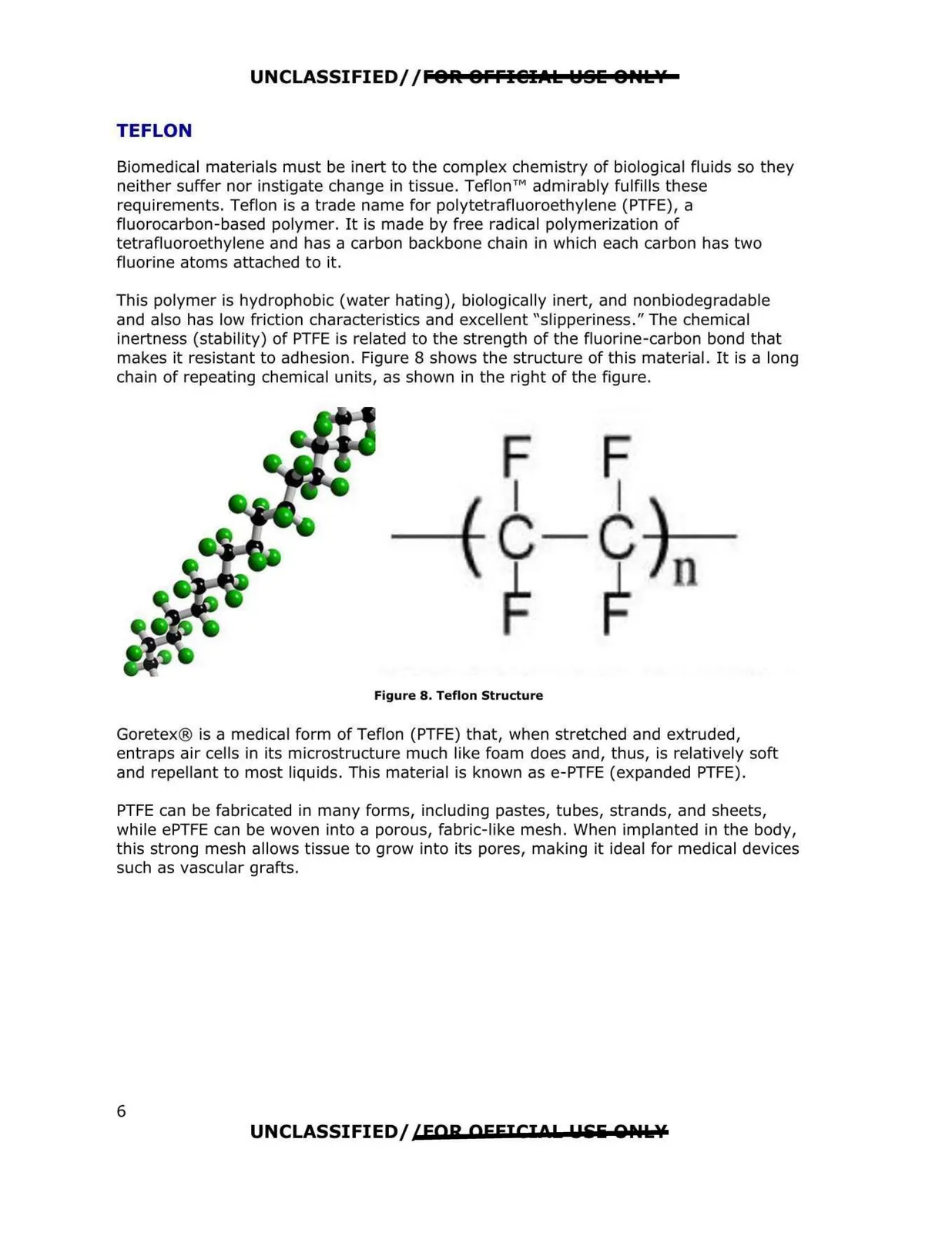
fluorocarbon-based polymer. It is made by free radical polymerization of
tetrafluoroethylene and has a carbon backbone chain in which each carbon has two
fluorine atoms attached to it.
This polymer is hydrophobic (water hating), biologically inert, and nonbiodegradable
and also has low friction characteristics and excellent "slipperiness." The chemical
inertness (stability) of PTFE is related to the strength of the fluorine-carbon bond that
makes it resistant to adhesion. Figure 8 shows the structure of this material. It is a long
chain of repeating chemical units, as shown in the right of the figure.
Figure 8. Teflon Structure
Goretex® is a medical form of Teflon (PTFE) that, when stretched and extruded,
entraps air cells in its microstructure much like foam does and, thus, is relatively soft
and repellant to most liquids. This material is known as e-PTFE (expanded PTFE).
PTFE can be fabricated in many forms, including pastes, tubes, strands, and sheets,
while ePTFE can be woven into a porous, fabric-like mesh. When implanted in the body,
this strong mesh allows tissue to grow into its pores, making it ideal for medical devices
such as vascular grafts.
UNCLASSIFIED/ {EAR OFFICIO 1 1Pili QPlk¥
6