AAWSAP DIRD, Biomaterials, January 2010
DOW-UAP-D119 · page 14 of 32
Text
This text came with the file. It may have mistakes. When the text and the image disagree, the image is right.
UNCLASSIFIED/ /FOR. errl@IAL YSI: e ..tv
Preformed ePTFE subcutaneous
implant materials have been used to
improve facial reconstruction and
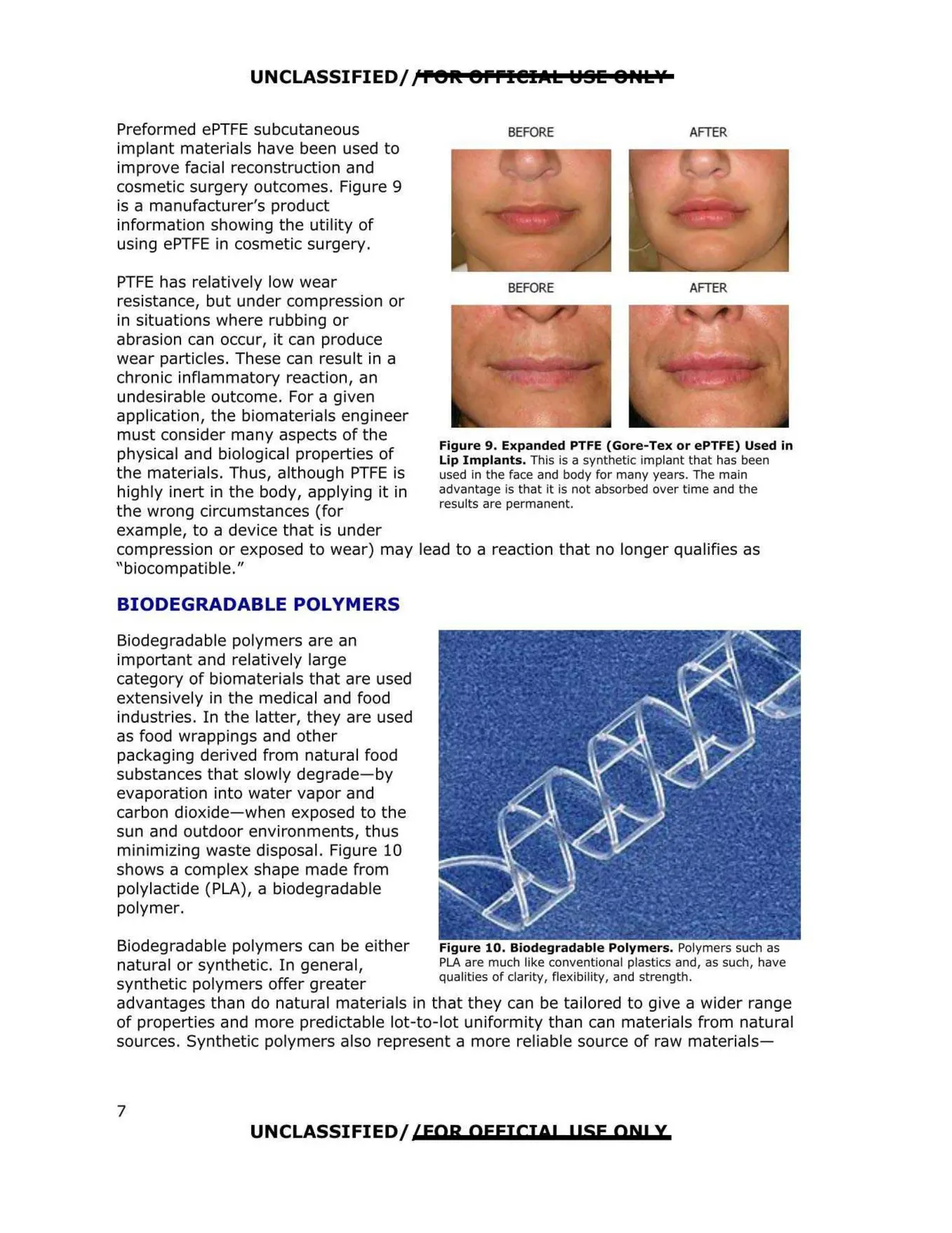
cosmetic surgery outcomes. Figure 9
is a manufacturer's product
information showing the utility of
using ePTFE in cosmetic surgery.
PTFE has relatively low wear
resistance, but under compression or
in situations where rubbing or
abrasion can occur, it can produce
wear particles. These can result in a
chronic inflammatory reaction, an
undesirable outcome. For a given
application, the biomaterials engineer
must consider many aspects of the
physical and biological properties of
the materials. Thus, although PTFE is
highly inert in the body, applying it in
the wrong circumstances (for
example, to a device that is under
BEFORE
AFrER
BEFORE
AFrER
Figure 9. Expanded PTFE (Gore-Tex or ePTFE) Used in
Lip Implants. This is a synthetic implant that has been
used in the face and body for many years. The main
advantage is that it is not absorbed over time and the
results are permanent.
compression or exposed to wear) may lead to a reaction that no longer qualifies as
"biocompatible."
BIODEGRADABLE POLYMERS
Biodegradable polymers are an
important and relatively large
category of biomaterials that are used
extensively in the medical and food
industries. In the latter, they are used
as food wrappings and other
packaging derived from natural food
substances that slowly degrade-by
evaporation into water vapor and
carbon dioxide- when exposed to the
sun and outdoor environments, thus
minimizing waste disposal. Figure 10
shows a complex shape made from
polylactide (PLA), a biodegradable
polymer.
Biodegradable polymers can be either
natural or synthetic. In general,
synthetic polymers offer greater
advantages than do natural materials in that they can be tailored to give a wider range
of properties and more predictable lot-to-lot uniformity than can materials from natural
sources. Synthetic polymers also represent a more reliable source of raw materials-
UNCLASSIFIED/ {FOR OEE!CJA1 11SE QNI X
Figure 10. Biodegradable Polymers. Polymers such as
PLA are much like conventional plastics and, as such, have
qualities of clarity, flexibility, and strength.
7