AAWSAP DIRD, Biomaterials, January 2010
DOW-UAP-D119 · page 16 of 32
Text
This text came with the file. It may have mistakes. When the text and the image disagree, the image is right.
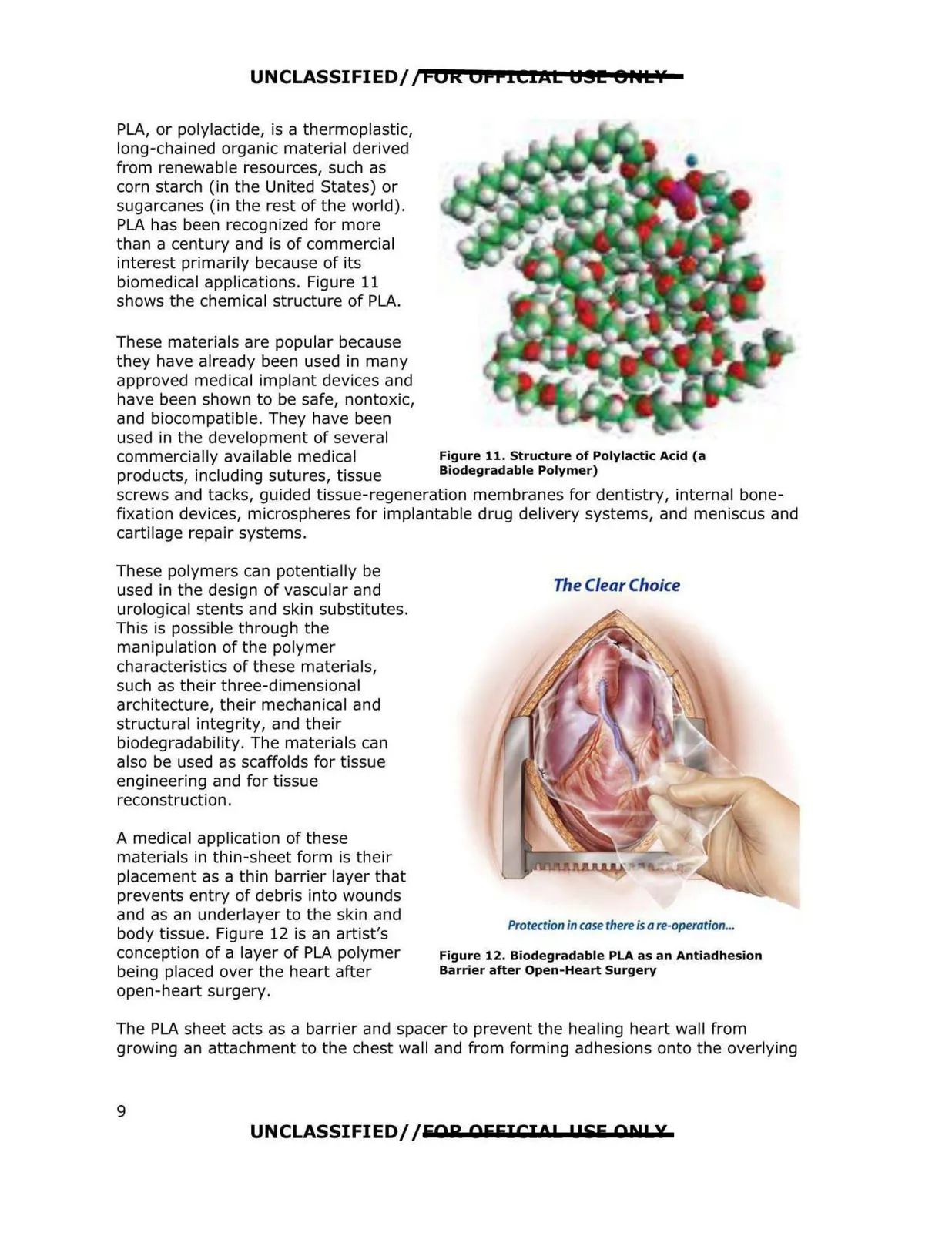
UNCLASSIFIED// FOR OFFICIAL t:191!! 9HL\I PLA, or polylactide, is a thermoplastic, long-chained organic material derived from renewable resources, such as corn starch (in the United States) or sugarcanes (in the rest of the world). PLA has been recognized for more than a century and is of commercial interest primarily because of its biomedical applications. Figure 11 shows the chemical structure of PLA. These materials are popular because they have already been used in many approved medical implant devices and have been shown to be safe, nontoxic, and biocompatible. They have been used in the development of several commercially available medical products, including sutures, tissue screws and tacks, guided tissue-regeneration membranes for dentistry, internal bone fixation devices, microspheres for implantable drug delivery systems, and meniscus and Figure 11. Structure of Polylactic Acid (a Biodegradable Polymer) cartilage repair systems. These polymers can potentially be used in the design of vascular and urological stents and skin substitutes. This is possible through the manipulation of the polymer characteristics of these materials, such as their three-dimensional architecture, their mechanical and structural integrity, and their biodegradability. The materials can also be used as scaffolds for tissue engineering and for tissue reconstruction. A medical application of these materials in thin-sheet form is their placement as a thin barrier layer that prevents entry of debris into wounds and as an underlayer to the skin and body tissue. Figure 12 is an artist's conception of a layer of PLA polymer being placed over the heart after open-heart surgery. The Clear Choice Protection in case there is a re-operation... Figure 12. Biodegradable PLA as an Antiadhesion Barrier after Open-Heart Surgery The PLA sheet acts as a barrier and spacer to prevent the healing heart wall from growing an attachment to the chest wall and from forming adhesions onto the overlying UNCLASSIFIED//EAR AEFICIOP I155 CNP X 9