AAWSAP DIRD, Biomaterials, January 2010
DOW-UAP-D119 · page 21 of 32
Text
This text came with the file. It may have mistakes. When the text and the image disagree, the image is right.
UNCLASSIFIED//FOR OFFICIAL 031! BHLY
medical therapeutics and differs from standard drug therapy or permanent implants in
that the culture becomes integrated within the patient, affording a potentially
permanent and specific cure of the disease state.
There are many approaches to tissue engineering, but all involve one or more of the
following key ingredients: harvested cells, introduction of specialized signaling
molecules, and three-dimensional matrices.
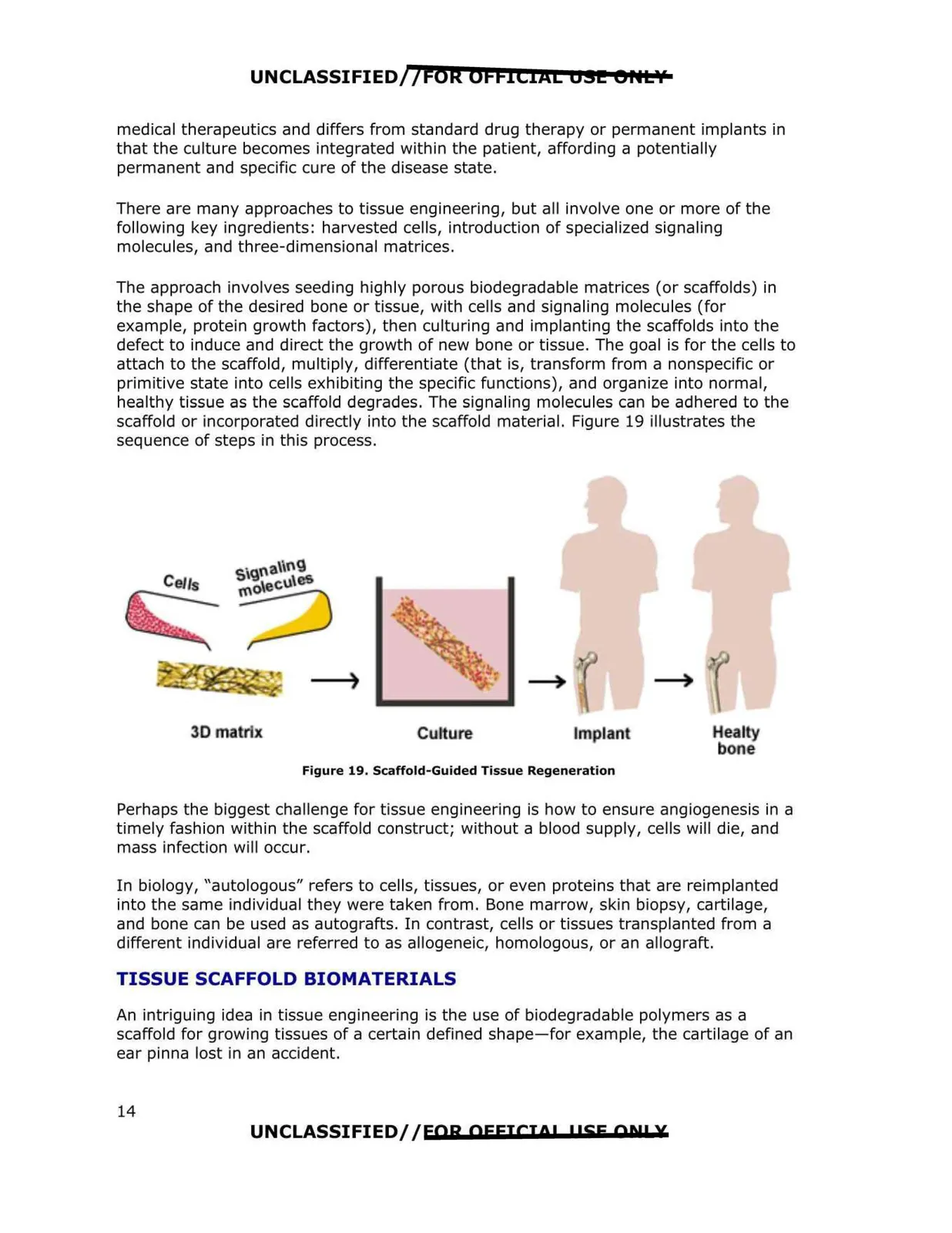
The approach involves seeding highly porous biodegradable matrices (or scaffolds) in
the shape of the desired bone or tissue, with cells and signaling molecules (for
example, protein growth factors), then culturing and implanting the scaffolds into the
defect to induce and direct the growth of new bone or tissue. The goal is for the cells to
attach to the scaffold, multiply, differentiate (that is, transform from a nonspecific or
primitive state into cells exhibiting the specific functions), and organize into normal,
healthy tissue as the scaffold degrades. The signaling molecules can be adhered to the
scaffold or incorporated directly into the scaffold material. Figure 19 illustrates the
sequence of steps in this process.
----+
30 matrix
Cutture
Implant
Healty
bone
Figure 19. Scaffold-Guided Tissue Regeneration
Perhaps the biggest challenge for tissue engineering is how to ensure angiogenesis in a
timely fashion within the scaffold construct; without a blood supply, cells will die, and
mass infection will occur.
In biology, "autologous" refers to cells, tissues, or even proteins that are reimplanted
into the same individual they were taken from. Bone marrow, skin biopsy, cartilage,
and bone can be used as autografts. In contrast, cells or tissues transplanted from a
different individual are referred to as allogeneic, homologous, or an allograft.
TISSUE SCAFFOLD BIOMATERIALS
An intriguing idea in tissue engineering is the use of biodegradable polymers as a
scaffold for growing tissues of a certain defined shape- for example, the cartilage of an
ear pinna lost in an accident.
UNCLASSIFIED//FOR OFFICIA! I !SE ON! X
14